Maritime & Shipping, Crude Oil, Refined Products, Wet Freight
July 15, 2026
Long-haul clean tanker demand rises on Russian diesel exports woes
By Thomas Washington and Alara Tizer
Editor:
HIGHLIGHTS
Russian diesel exports plunge after ban enacted
Atlantic Basin MR tanker rates face mixed signals
Shadow fleet tankers may face extended idling
Russia's fuel export bans and ongoing attacks on its oil infrastructure by Ukraine are forcing a structural shift in clean tanker markets, broadly favoring long-haul routes while pressuring short-haul regional trade.
In June 2026, Russia's exports of refined products experienced a significant downturn, falling by 14% month over month to 1.613 million b/d, down from 1.876 million b/d in May, according to data from S&P Global Commodities at Sea. This represents the lowest level of refined product exports from Russia since the fourth quarter of 2016, CAS data showed.
Russia has duly enforced a full diesel export ban, Deputy Prime Minister Alexander Novak said July 8. While initially covering July, it is expected to extend through the third quarter as damaged refineries remain offline and seasonal grain harvest demand rises, BRS said.
The supply disruption has already pressured clean tanker rates, particularly for vessels lifting from Russia, shipbroker BRS said July 13.
"Considering expectations that Atlantic Basin clean product exports will not rise significantly across the summer, this implies that rates and earnings may struggle to gain traction across the coming months," BRS said.
Viewed from another perspective, Europe has increasingly had to rely on diesel imports from the Middle East Gulf, India, and the US Gulf Coast, in the absence of Russian barrels. These longer voyages dramatically increase ton-mile demand for mainstream tankers. Thus, the USGC to UK/Continent route remains a "critical alternative supply route," that keeps transatlantic rates resilient, Fotios Katsoulas, a shipping analyst at S&P Global Energy CERA, said July 15.
The losers in this equation are the short, high-frequency shuttle routes that previously moved Russian diesel from Baltic ports such as Primorsk to Northwest Europe, which have evaporated, Katsoulas said.
"Short-haul European regional trade has suffered a permanent contraction in volume," he said.
Platts, part of S&P Global Energy, assessed the rate to carry a 38,000 metric ton cargo of refined products from the USGC to UKC at an average of $77.07/mt from January to April. Since the start of May, it has averaged $47.99/mt, although this is still higher than the five-year average of $36.74/mt.
Shadow fleet
Shadow fleet tankers face particular challenges, likely forced to wait for Russian loadings to rebound rather than seeking alternative employment. Such vessels are unlikely to be scrapped given expectations that damaged refineries will eventually return, BRS said.
While the reduction of Russian diesel exports significantly reduces the overall ton-mile demand for the specialized shadow fleet, it serves as a structural boost for mainstream operators by forcing traditional import hubs to source replacement barrels from much longer-haul destinations, Katsoulas said.
The wider implications for mainstream tanker markets are that the transition of diesel supply sourcing from Baltic-to-Europe -- short-haul voyages on Medium Range tankers -- to Persian Gulf or India-to-Europe -- long-haul voyages on Long Range tankers -- has locked up massive amounts of LR capacity, Katsoulas said.
"LR2s, in particular, are yielding high premiums due to their superior economics on long-distance voyages," he said.
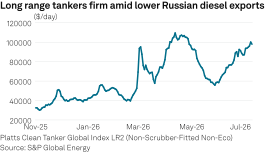
The Platts LR2 index, for non-scrubber-fitted, non-eco vessels, has climbed from $57,204/day at the start of June to $97,872/day July 14.
China in focus
"In the east, as usual, much depends on China," BRS said. It is unlikely that China will significantly increase its diesel exports, although Beijing has recently removed some product export restrictions that could help exports inch higher, the shipbroker said.
The outlook is for any incremental Chinese exports to remain in Asia or Australasia; this should, in turn, provide some limited upside to regional MR, rather than LR demand. Any long-haul LR demand to move diesel from east to west is likely to have been cannibalized by the newly delivered Suezmaxes, BRS said.
Routes that transport East Asian -- namely, Chinese and South Korean -- surplus diesel to either South America or West of Suez destinations are benefiting from structurally higher freight premiums, Katsoulas said.
National oil companies and refiners in the Middle East and India have solidified their roles as crucial swing suppliers, Katsoulas said. Clean tankers moving cargoes from the Persian Gulf or West Coast India to Singapore, Australia, and European destinations are seeing sustained high utilization, he added.
