Crude Oil, Maritime & Shipping, Refined Products, Wet Freight
June 16, 2026
G7 tankers support high Russian crude exports amid US sanctions exemption

By Max Lin
Editor:
HIGHLIGHTS
G7 share at 10-month high in May
Greek operators outperform peers
Outlook uncertain as US could refocus on Russia
G7-linked crude tankers have maintained a high market share in Russia in recent weeks, emboldened by Washington's continued sanctions exemption to avert a supply crisis during the war in the Middle East.
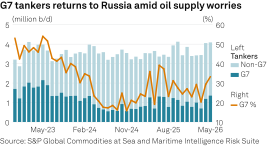
Tankers flagged, owned or operated by companies based in G7 countries and their allies, or insured by Western protection and indemnity clubs, lifted 33.2% of Russia's crude exports of 4.1 million barrels/day in May, according to S&P Global Commodities at Sea and Maritime Intelligence Risk Suite data.
The share was the highest since July 2025 and up from 29.4% in April. In the first two weeks of June, G7 tankers accounted for 29.7% of Russia's exports of 4.5 million b/d, a historically high level, the data shows.
The US Treasury Department issued another 30-day sanctions waiver for Russian oil that is already at sea on May 18, seeking to ease supply worries amid much-reduced oil flows through the Strait of Hormuz, which handles 20% of global seaborne trade in normal times.
The general license was the third sanctions waiver from Washington. The first was issued March 15, and the second April 17.
Tanker operators could only transport Russian crude if the barrels were sold at no more than $60/barrel under the US sanctions regime, but the waivers have removed this requirement temporarily while allowing sanctioned tankers to deliver Russian cargoes.
While the EU, UK, and Canada have set their price cap at $44.10/b, and Japan at $47.60/b, US sanctions tend to be most effective among G7 members due to the US dollar's dominant currency status.
Japan received its first cargo of Russian crude May 4, after the government in March indicated it would uphold energy security through diverse crude sources, including Russia. Local media reported that Taiyo Oil imported crude oil from Russia's Sakhalin-2 oil and gas project, which is exempt from Western sanctions.
The monthly average price for Urals, Russia's flagship crude, was $90.4/b in April and $86.554/b in May on a free-on-board Primorsk basis, according to assessments from Platts, part of S&P Global Energy. This was much higher than $39.169/b in February before the war between Iran and the US started.
Greeks take pole position
Tanker operators in Greece, the EU's top shipowning nation, loaded 804,000 b/d of Russian crude last month, a 10-month high, according to CAS and MIRS data. This was higher than their peers in all other countries and higher than 687,000 b/d in April.
In a press conference earlier this month, officials from the industry association Union of Greek Shipowners said Greek companies are not transporting sanctioned oil in the shadow fleet operations while expressing concerns that sanctions laws would create unfair competition.
"EU sanctions are unilateral and not global. They distort market competition while we should protect fair competition," said UGS President Melina Travlos.
Russian crude is often sold at a price inclusive of freight and insurance, allowing tanker companies to report high rates and low FOB prices while staying compliant with the price cap.
Platts assessed the monthly average rate for a Suezmax tanker transporting 140,000 metric tons of Russian crude from Novorossiisk to West Coast India at $73.421/metric ton in May, compared with $64.357/mt in February. The assessment stood at $66.07/mt June 16.
G7-linked tankers trading in Russia could be under more scrutiny, however, as the US is set to formally sign a 60-day peace deal with Iran June 19, which could return Hormuz oil flows to normal levels and reduce the need for further sanction waivers.
When asked whether US sanctions on Russia would be reimposed during the G7 summit, US President Donald Trump told reporters: "Because the oil is now flowing ... We're in a position to do that soon."
The comment came after the UK and the EU announced new sanctions to clamp down on ships and maritime service providers operating outside of the price cap, while Canada is planning to follow suit soon.
