Refined Products, Gasoline
July 03, 2026
Nigeria's Dangote refinery cuts prices after pressure from antitrust body

Editor:
HIGHLIGHTS
Dangote cuts gasoline prices for fourth time in month
Coastal price increased to shift logistics inland
Landed crude price in June was $95/b, refinery says
Nigeria's Dangote refinery cut prices for gasoline loaded at its truck depot on July 2 after the country's competition authority raised concerns over stubbornly high costs in the retail fuel sector.
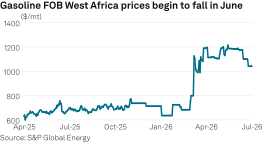
In a statement, the refinery—Nigeria's only commercial-scale fuel producer—said it has cut its gasoline truck-out price by 50 Naira per liter (about $0.04/l) to Naira 1,075/liter, the fourth discount in a month. Prices reached Naira 1275/l in May amid market disruption due to the Middle East conflict, which Dangote said pushed up its feedstock prices and forced it to absorb some costs.
On the other hand, the refiner hiked the price for barges to load gasoline via its coastal route. On June 2, the company lifted its coastal price by Naira 10/l, putting it at parity with truck loading rates. A notice to customers seen by Platts, part of S&P Global Energy, said loadings would additionally be expanded from a consortium of companies previously given priority access to the route.
Devakumar Edwin, Dangote's vice president for oil and gas, said the company was pushing to move all its logistics to its truck gantry, blaming high port charges and fees from the maritime authority for making barge loadings uneconomic. "Coastal movement is not profitable," he said.
The announcement follows a notice from Nigeria's Federal Competition and Consumer Protection Commission on June 28, which suggested that local fuel prices had failed to fall quickly enough after a US-Iran peace deal caused global oil benchmarks to collapse. It warned surveillance of retail prices suggested "undue exploitation" of consumers, and blamed refiners and marketers for "token reductions" in rates.
Brent crude futures are currently trading around 30% below their mid-May peak of $101/b, while markets have become preoccupied with expectations of an imminent supply glut amid an influx of trapped supply from the Persian Gulf.
Dangote challenges that it has offered price stability through the crisis, and shielded Nigeria from the price shock seen in neighboring countries, according to its statement. The company did not respond to a request for comment on the FCCPC statement.
Dangote pricing outlook
"Pricing decisions are anchored on actual production economics and inventory costs rather than short term fluctuations in international oil markets," Dangote said.
The refinery is currently processing crude purchased at higher costs than prevailing market rates, the statement said. Its landed feedstock cost, based on crude priced on a Dated Brent basis, combined with freight and logistics, averaged $95/b in June, it said.
Nevertheless, it added that Nigerians should "expect further moderation" in fuel prices and said its truck-loading costs for diesel and jet fuel had dropped by Naira 300/l and Naira 500/l, respectively, since late May.
The price reductions could help temper FCCPC criticism over uncompetitive dynamics in the downstream Nigerian market, which relies mostly on Dangote products. On the other hand, some local traders complained they were wrongfooted by the announcement, having bought significant volumes of fuel from the refinery at higher costs.
"We are bleeding seriously," said one local trader who had purchased large quantities of gasoline from the site, adding that his company was making a renewed push to get an import license from the government. With the exception of six companies granted special import licenses, most traders and marketers depend on Dangote to source their fuel.
A second Nigerian trader said it was too soon to tell whether the price drop would encourage a new wave of purchasing, noting flash flooding in the region had affected some activity.
Logistics plan
Since starting operations in 2024, Dangote has overhauled Nigeria's downstream oil sector, and the company is still working on advancing its planned distribution model. In 2025, the company announced it would launch a free fuel distribution service with 4,000 trucks powered by compressed natural gas, but plans were delayed after mass protests from third-party drivers.
In an interview earlier this year, refinery CEO David Bird told Platts that many of the company's CNG trucks remained idle, but said plans for a full rollout were still moving ahead.
"There are still too many parked up there. That's had its own considerations about just how we manage the domestic market," he said.
Speaking on July 3, Edwin said the company was working to move all its logistics to truck loadings, and said all 4,000 CNG trucks would be put in service once coastal loadings are suspended.
