Refined Products, Jet Fuel
June 29, 2026 · Updated June 30, 2026
European jet fuel prices ease, but supply risks remain
Editor:
HIGHLIGHTS
Europe jet prices lowest since start of Middle East war
US exports to Europe drop sharply in June
Stock declines raise concerns for August supply
European jet fuel prices have tumbled since the US and Iran announced a preliminary peace deal, but with stocks low and potential strong summer demand ahead, market tightness may persist and potential shortages may still emerge.
Both European and American jet fuel prices are at their lowest since the start of the US and Israel's war against Iran, with the geopolitical risk premium eroding and expectations that Middle East production will recover.
Platts, part of S&P Global Energy, assessed CIF Northwest European jet cargoes at $912/mt on June 26, twice down from a peak of $1,842.5/mt on April 2 but still above the prewar $831.25/mt on Feb. 27.
Despite the price collapse, Europe may still face challenges in the coming months, analysts with S&P Global Energy CERA warn.
"The market seems to be holding up for the European summer. But we have heard from several airlines that they are still a bit concerned about August," James Simpson, CERA's head of aviation research, said.
Officially, some airlines have cut flights but remain generally positive about their outlook. Several airlines are holding sales to win back customers spooked by higher ticket prices and general instability.
A Lufthansa Group spokesperson told Platts on June 26 that the airline was "very confident that ... there is no kerosene shortage."
Another major European airline, which requested not to be identified to discuss commercial matters, said it was not seeing any disruption to fuel supply and was continuing to operate flights as normal, without making any schedule changes or cancellations.
European jet fuel demand was around 1.5 million barrels/day in 2025. Roughly 67% of pre-conflict consumption was met by domestic production and about 13% covered by Middle Eastern imports via the Strait of Hormuz, according to CERA analysis. The closure of the Strait of Hormuz has significantly changed the ratio.
All European refineries had been maxing out their jet production to serve the aviation market, the president of Shell's Netherlands arm, which operates a giant refinery in Rotterdam, formerly known as Pernis, said April 22.
The International Energy Agency had warned in April that Europe had "maybe six weeks of jet fuel left."
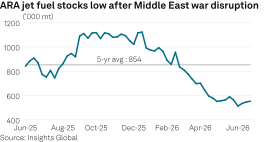
Jet fuel stocks in Europe and globally continue to decline. At the current rate of depletion, the market is facing a looming supply and price squeeze, though it remains unclear when this will occur, Simpson said.
Jet fuel and kerosene stocks in the Amsterdam-Rotterdam-Antwerp hub stood at 554,000 metric tons in the week to June 19, Insights Global data showed. This was up 1% week over week but still 34% below the week ending Feb. 26 and 35% below the five-year average, the data showed.
Jet vs gasoline
Increased imports from the US have been one of the most important ways for Europe to substitute lost Middle Eastern jet fuel volumes.
Europe received 1 million barrels of US jet fuel in March, up from zero a year earlier, S&P Global Commodities at Sea data showed. US exports received by Europe jumped to 6 million barrels in April, up from 700,000 barrels in the same month of 2025, and they were 4.5 million barrels in May, up from zero a year earlier.
However, exports from the US discharged in Europe in June were only about half of May deliveries, as of June 26. And receipts could drop further in July as only 300,000 barrels of jet fuel destined for Europe were loaded in the US, according to preliminary CAS data. Overall, US jet international loadings in June are on track to be among the lowest in years.
Optimization of jet fuel yields in favor of gasoline production and the rise of gasoline cracks, amid the summer driving season, could prompt US refiners to make more gasoline in the coming months, "thus reducing the amount of jet fuel available to be sent to Europe," according to Simpson.
However, the World Cup could continue to support jet fuel demand over gasoline over the coming weeks, while more relaxed policies on working from home during the summer holidays could maintain the incentive for refiners to keep jet production high, CERA's lead North American fuel analyst Brian Stetter said.
Strait in question
Platts assessed the Jet CIF NWE Cargo Financial for July at $920/mt on June 26, falling to $912/mt in August, suggesting bearish sentiment for the summer. Two European jet fuel traders told Platts that they generally support the sentiment but added that all depends on what happens next in the Strait of Hormuz and whether the vessels can all actually come through.
It is unclear when Middle Eastern refineries can return to prewar production levels, as some energy infrastructure was damaged by strikes and other facilities will require time to restart.
"If there is 'peace in the Middle East', increased demand, resulting from flights in and out of the region, will return faster than local refinery production. This could add to demand pressures this summer," Simpson said.
