Crude Oil
April 17, 2026
Middle East oil recovery to require months, once Strait of Hormuz remains open
By Lauren Holtmeier and Lulwa Albuainain
Editor:
HIGHLIGHTS
Field restarts may take up to 7 months from war’s end
14.2 million b/d of supply in fields disrupted by war
OPEC March output lowest since 1989: Platts survey
Between damage to fields and pipelines from air strikes, disruptions to shipping and evacuations of oil workers, Middle East crude producers will require months -- perhaps more than half a year -- to fully restore output once the war ends, promising extended tightness in markets, industry analysts say.
Some 14.2 million b/d of global oil supply sits in fields that have been disrupted by the war, according to research from CERA, part of S&P Global Energy. Actual volumes offline could grow as the war lengthens and storage fills.
Around 90% of those volumes are in fields that can't easily be restarted, the research shows. Some fields are mature, while some require gas or water injections, and some are offshore, making restarts more logistically complicated.
Depending on how long the field has been offline, CERA's restart scenarios estimate it could take between five weeks and seven months to return to full production, assuming that the Strait of Hormuz is fully reopened and port operations resume regular service, which analysts say could add nearly two months to restart timelines.
"The most important determinant of recovery timing is the operating state of fields at reopening, particularly whether production has remained curtailed at reduced rates or has moved into full shut-in, and for how long," said Chad Barnes, associate director of upstream solutions at CERA.
The production dip has caused tightness in crude markets, especially for heavy sour crudes, and disruptions in Asian countries where refiners favor heavy sour crudes as refinery feedstock.
The US and Iran on April 17 said the Strait of Hormuz would be open during a ceasefire between Israel and Lebanon, but the US blockade of Iranian ports remains in effect, with the two sides having yet to reach a deal to end the war.
Morgan Stanley analysts said in an April 13 note that even if a peace deal with a durable ceasefire were to be reached immediately, a complete restoration of crude export volumes would not be achieved until October.
"Even once the Strait re-opens, restarting supply chains is likely to take months rather than days or weeks," the note read.
The International Energy Agency on April 14 said that if oil shipments were to resume in May, production would continue to recover throughout the third quarter of 2026.
That could mean dire supply crunches in many parts of the world, with some governments already warning of fuel shortages and scrambling to secure alternative barrels, with the Strait of Hormuz effectively closed.
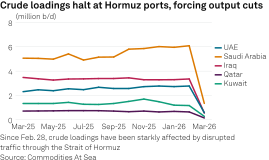
Crude exports transiting the strait averaged 2.3 million b/d in March, just 10% of pre-war levels, with Iran accounting for over 70% of flows, according to the IEA.
Reservoir damage
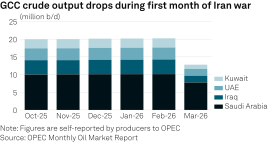
The blockage of the strait has forced production curtailments. During the first month of the war, OPEC's crude output tumbled in March to the lowest level since 1989, falling 8.51 million b/d -- nearly 30% -- from February to 20.55 million b/d, according to the latest Platts OPEC+ survey.
Rig operators have been asked to "hot stack" operations, meaning the rig is temporarily out of contract.
Under CERA's scenarios, some of the fields that shut down for one month may return to normal production within five weeks, but as closures extend to a second month, restart timelines reach 10 weeks to seven months.
Restarting offshore and onshore operations differs significantly, and easier-to-access onshore reservoirs typically take less time than their offshore counterparts.
"But the more important variable is what happens to the reservoir while it's shut-in," said Barnes, who authored the CERA report. "If there is reservoir damage, it will take time to repair that damage, whether it's onshore or offshore."
In the drilling sector, rigs, like ships, are largely trapped inside the Strait of Hormuz and require days to resume operations.
"Once you turn off the engine, it can take five to 10 days to start an offshore rig back up and move personnel back," said Pamela Cordova, an offshore drilling rigs principal analyst at S&P Global Energy.
Rigs in the UAE have not been affected, even if production has been throttled back, while 21 rigs in Saudi Arabia moved to anchorage, Cordova said.
There are 38 fewer active and operating rigs in the Gulf countries in March than in February, Baker Hughes rig count data show.
"The situation is fluid," Cordova said. "Rigs in Qatar and Saudi Arabia are already returning to work."
Returning ships
But before any production can reach the market, the Strait of Hormuz must remain open.
Industry sources estimate it could take nearly two months after a durable ceasefire for traffic to return to normal, delaying a full reset to the status quo.
Ramping up production requires rigs ready to drill, damage to energy infrastructure repaired, resources mobilized to rehabilitate wells, and, most importantly, ships at ports ready to load crude.
"More than 80 energy facilities have been damaged during the hostilities, and a recovery could take as long as two years," IEA Executive Director Fatih Birol said April 13.
There could be a 50-day lag -- nearly two months -- in getting ships, many of which had moved away from the Middle East, back into the region, one industry source told Platts. Similarly, the IEA predicts steady exports could resume after two months.
Fotios Katsoulas, a tanker shipping lead analyst at S&P Global Energy, said that a 50-day estimate could be conservative, but determining exactly how long it would take to move ships is difficult.
"It's all sentiment-driven," he said. Markets, shippers and insurers will have to trust that the ceasefire will hold.
