Agriculture, Energy Transition, Refined Products, Biofuels, Renewables, Jet Fuel
June 17, 2026
Europe's SAF strategy risks new energy dependency without diversification: SkyNRG

Editor:
HIGHLIGHTS
eSAF, advanced biofuels needed for long-term resilience
Over half of EU biofuel feedstock already comes from imports
SAF supply could narrow jet fuel supply gap
Europe's ability to secure sustainable aviation fuel supply beyond 2030 will hinge on diversifying production technologies away from waste-oil-based pathways, as the region faces growing dependence on imported feedstocks to meet its own climate mandates, according to producer SkyNRG's 2026 SAF Market Outlook.
There is a structural mismatch in Europe's SAF strategy, the SkyNRG report said June 16. While the region has established the world's most ambitious aviation decarbonization mandates through RefuelEU and the UK SAF mandate, its production capacity remains overwhelmingly concentrated in hydroprocessed esters and fatty acids (HEFA) technology, which processes waste oils and animal fats, and much of this comes from Asia.
As such, Europe's current pathway risks trading one energy dependence for another, SkyNRG said. In 2022, approximately 70% of used cooking oil consumed in EU biofuel production came from imported raw feedstocks, with 68% of net UCO imports across the EU and UK sourced from China, Malaysia and Indonesia, SkyNRG said. By 2025, the share from these three countries declined slightly to 57%, though overall import volumes remained stable, SkyNRG said.
"This increases exposure to trade restrictions, export controls, and rising domestic demand in exporting regions such as China, Indonesia, Malaysia, and the United States," the report said.
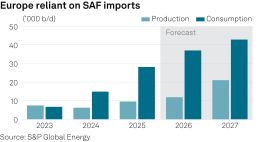
According to data from analysts at S&P Global Energy Horizons, Europe will produce 533,000 metric tons, or 12,000 barrels/day, of SAF in 2026, equivalent to 32% of its demand.
This imbalance exposes Europe to new forms of energy insecurity at a time when the region is already grappling with declining conventional refining capacity and heavy reliance on imported crude oil, SkyNRG said.
Around 30% of Europe's jet fuel demand is currently met through imports, while over 80% of crude oil supply comes from outside the region, according to SkyNRG data. This exposure is expected to increase further as European fossil refining capacity could decline by more than 5 million b/d by 2050, SkyNRG said.
SAF production could help maintain regional fuel production capability and reduce import exposure, SkyNRG said.
The price gap between SAF and jet fuel is considerable. Platts, part of S&P Global Energy, assessed SAF on a CIF basis in Northwest Europe, produced via the HEFA pathway, at $2,726.75/mt June 16, compared with $957/mt for jet fuel cargoes on an equivalent basis.
SkyNRG and airline KLM plan to launch production of 100,000 mt/year of SAF at the Netherlands' first dedicated SAF facility in 2028, according to its website.
Technology diversification
There is a feedstock challenge, which is intensifying as several Asian countries are taking steps to retain feedstocks for domestic refining and energy security objectives, SkyNRG said. China has removed export tax incentives and introduced controls on UCO, while Indonesia already restricts exports of palm oil mill effluent and used cooking oil. Malaysia is considering similar measures.
"If these trade flows become disrupted, European HEFA facilities could face tightening feedstock access and increasing competition with renewable diesel and other biofuel sectors," SkyNRG said.
A range of experts and policymakers identify e-SAF and advanced biofuels as critical pathways for improving Europe's long-term resilience. eSAF, which uses renewable electricity to produce synthetic jet fuel, accounts for 70% of announced feasibility-stage capacity in Europe and benefits from dedicated sub-mandates under RefuelEU and UK regulations, according to SkyNRG data.
Advanced biofuel pathways also offer diversification potential, leveraging Europe's existing refinery conversion projects and approximately 8.5 million mt of ethanol production capacity, though additional infrastructure investment would be required, SkyNRG said.
European policymakers are increasingly complementing binding mandates with investment support and de-risking mechanisms aimed at accelerating the commercialization of alternative pathways. These include the EU Sustainable Transport Investment Plan and the UK Revenue Certainty Mechanism, designed to reduce financial risk for first-of-a-kind advanced fuel projects.
Current SAF trajectory
If regional SAF production scales in line with European mandates, a further 8 million mt of capacity could be added, reducing the projected regional jet fuel supply gap to around 2 million mt, equivalent to roughly 5% of fuel consumption, SkyNRG said.
In 2026, global SAF demand is expected to increase to around 3 million mt, corresponding to approximately 0.9% of global jet fuel demand, roughly equivalent to the total jet fuel demand of Vietnam, SkyNRG said. Under its central Current Trends scenario, global SAF demand is projected to reach 12.8 million mt by 2030, equivalent to 3.6% of global jet fuel demand. By 2050, SAF demand reaches 194 million mt, equivalent to 42% of global jet fuel uplift, SkyNRG said.
According to Horizons data, global SAF demand in 2026 will be 2.89 million mt or 64,000 b/d.