Agriculture, Energy Transition, Refined Products, Biofuels, Renewables, Jet Fuel
April 16, 2026
EU eSAF projects stall as price forecasts fall and rules in question

Editor:
HIGHLIGHTS
Contracts should give early investors certainty: consultant
eSAF prices significantly above jet, HEF-based SAF
Mandates must stay in place: lobby group
High capex, a steeply falling cost curve and uncertainty over EU mandates and offtake terms are delaying investment decisions, leaving dozens of synthetic sustainable aviation fuel (eSAF) projects without final approval.
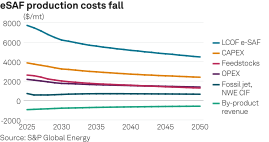
The eSAF or Power to Liquid cost curve sits very high today but has one of the steepest downward cost trajectories over time, Rahul Malik, a consultant at S&P Global Energy, said April 16.
The challenge this creates for investors is timing risk; early, first-of-a-kind projects enter the market at very high production costs, while later projects benefit from rapid cost reductions driven by technology learning, scale up, and declining renewable power and electrolyzer costs, Malik said.
"This means early movers are structurally exposed to higher costs and the risk that their production becomes uncompetitive relatively quickly," Malik said. That, in turn, makes long-term price formation difficult and creates uncertainty around future margins, he added.
The falling cost curve complicates long-term offtake contracting, because buyers are hesitant to lock into prices that may look expensive compared with future supply, Malik said.
Strategy firm Capstone noted April 6 that there are about 40 e-SAF projects in the EU, and so far no FID.
"The way you break that cycle is the same way it was broken in offshore wind and solar: you use contracts that give early investors certainty, even if it means early buyers pay a premium," Izabela Santos, managing director at SAF commercial advisory StratX, told Platts, part of S&P Global Energy, April 16. The UK's Revenue Certainty Mechanism and the EU's proposed double-sided auction are designed to do exactly that, she said.
"They are not perfect, and as we've seen with Germany's H2Global experience, the design has to be right, or producers simply won't bid," Santos said. "But the principle is sound: you need a mechanism that makes it rational to invest today, even in the knowledge that prices will be lower tomorrow."
The lion's share of SAF at present is made from hydroprocessed esters and fatty acids, but concerns about the availability of feedstocks, such as used cooking oil, mean regulators wish to encourage eSAF projects.
Analysts at S&P Global Energy forecast that the levelized production costs for eSAF in 2026 will be $7,471/mt, falling to $4,480/mt in 2050.
Platts assessed SAF produced via the HEFA pathway, sold on a CIF basis in Northwest Europe at $2,641/mt April 15, compared to $1,549.75/mt for jet fuel on an equivalent basis. The gap between them has narrowed as the war in the Middle East has buoyed jet fuel prices. The prices averaged $2,180/mt and $741.01/mt in 2025, respectively.
Commercial risk
Projects typically fail on commercial rather than technical grounds, with inadequate revenue structures and risk allocation preventing deals from reaching financial close, Santos said separately April 14 during the Sustainable Aviation Fuel Summit in Brussels. Many project developers lack the internal expertise to conduct successful offtake negotiations, she said.
"The issue is not the price most of the time, the issue is that many of the project developers work in a very lean structure and they don't really have internal expertise in order to be able to carry out successful offtake negotiations," she said.
Power-to-liquid eSAF offers long-term scalability as costs decline through improvements in wind and solar efficiency, hydrogen production scale and carbon capture technology, Denis Zaica, head of SAF trading at Envision Energy, said April 14, during the summit. However, potential buyers face uncertainty about whether to commit now or wait for further cost reductions.
Offtake agreements could include cost-efficiency sharing mechanisms to distribute future savings between producers and buyers, Zaica said.
Regulatory caution
Many carriers are delaying commitments until they gain clarity on whether the EU will maintain its mandates, even as the bloc's RefuelEU Aviation regulation requires 2% of jet fuel supplied at European airports to be sustainable by 2025, rising to 6% by 2030 and 70% by 2050, Santos said.
The EU's eSAF sub-mandates require the synthetic fuel to account for 1.2% of the aviation fuel mix by 2030 and 35% by 2050.
"The eSAF mandates are essential, so they need to stay. That would be a tremendous signal to the market if we are moving those targets away, that would kill a lot of projects that are built on this assumption," Lars Hummel, head of EU affairs at the eFuel Alliance, a lobby group, said April 14.
While government funding can support early-stage projects, the market will need to function independently over the long term, Hummel said.
Demand remains a key issue, Sylvain Verdier, senior business strategy manager for Strategy & Innovation at Topsoe, said. "It's not an egg and chicken thing," Verdier said. "It's quite easy. Demand; producers will produce fuels that they always provide what the market wants."
