Maritime & Shipping, Refined Products, Wet Freight
June 10, 2026
Dangote ramp-up slashes WAF product imports, reshapes clean tanker routes: analysts
By Thomas Washington and Kelly Norways
Editor:
HIGHLIGHTS
Dangote ramp-up cut West African clean product imports 23%: CAS
CPP ton-miles fell 47% YoY, with the steepest declines in LR1/LR2: BIMCO
Fewer inter-hub flows shift trade toward regional shuttles
The ramp-up of Nigeria's 650,000 b/d refinery has cut imports of clean products to West Africa and is redirecting tanker flows around the region, according to analysts.
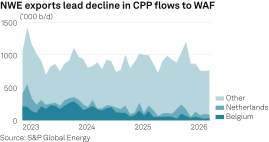
West African imports of clean refined products fell to 765,000 b/d in May from 997,000 b/d in April, a 23% decline, S&P Global Commodities at Sea data showed June 10.
Analysts at shipping association BIMCO reported a higher decrease of 44% over the same timeframe. The drop in import volumes cut ton-miles by 47% year-over-year, lowering the region's share of global CPP ton-miles from 5.3% to 3.6%, BIMCO said in a June 10 research note.
"LR1 and LR2 product tankers recorded the largest declines, down 88% and 78% respectively, and together accounted for 55% of the total ton-miles loss," BIMCO said.
MR product tanker ton-miles fell only 4% year over year during April to May, despite a sharp drop in imports from all major loading regions. A 34-fold increase in volumes from the Americas largely offset the decline, limiting the overall loss, BIMCO said.
Historically, the Rotterdam-to-Lagos route was a cornerstone of the MR tanker market; as the Dangote refinery met over 90% of Nigeria's domestic demand by early 2026, these imports plummeted, analysts at CAS said May 15. "Data indicated a 39% year-on-year drop in Nigerian CPP imports by mid-2025, essentially removing a massive source of employment for MR tankers in the Atlantic," the CAS analysts said.
Platts, part of S&P Global Energy, assessed the rate to carry a 37,000 metric ton cargo of clean products from the UK/Continent to West Africa at an average of $27.95/mt in June 2025, down 14% from June 2024. The rate averaged $36.19/mt June 1-9, 2026, amid wider freight rate support from disruption in the Middle East.
Dangote was commissioned in 2024 and hit its 650,000 b/d capacity for the first time in February 2026.
According to government figures, the refinery supplied roughly 80% of Nigeria's gasoline – its main fuel market – in April. After increasing its capacity to 700,000 b/d, Dangote says it can serve 150% of recent consumption levels, albeit supported by higher imports of gasoline blendstock from mostly European countries.
New role
The slide in Western Africa's imports appears to reflect a reduced role for Lome, Togo, as a key offshore storage and redistribution hub. Imports into Lome offshore storage, and re-exports from there to Western Africa, saw a larger volume decline than the region overall, Niels Rasmussen, chief shipping analyst at BIMCO, said in the research note.
"As Lome may never regain Nigeria's volumes, its position as a major offshore import and storage hub could be lost along with the related tanker demand. It could, however, remain an important offshore distribution hub for smaller markets and ports," Rasmussen said.
Clean products are now being shipped from Lagos to West African neighbors, such as Ghana, Togo, Ivory Coast, and further afield to South Korea, the US, and Europe. This shift is replacing long-haul imports with shorter, regional "shuttle" voyages, which increase the frequency of tanker calls but reduce overall tonne-miles compared to global imports, CAS analysts said.
The refinery's export strategy has increased demand for LR1 and LR2 tankers capable of moving large product volumes to international hubs like Singapore or Rotterdam, CAS analysts said. "This transition from being a destination for MRs to a source for LRs is reshaping the global fleet distribution," they said.
The loss of the lucrative Europe-to-Nigeria gasoline run has created a surplus of MR tankers in the Atlantic Basin, CAS analysts said. While this would typically depress freight rates, its effect has been mitigated by the refinery's own export volumes and the need for tankers to service new regional hubs, CAS analysts said.
Dangote has emerged as a growing export hub in the wake of the Middle East conflict, shipping a record 372,000 b/d of clean petroleum products in April, according to CAS data.
New capacities
With its planned expansion to double capacity by 2028, Dangote aims to offset even greater volumes of imports that once flowed into the West African market and to cement its role as a global export hub.
After hitting constraints with its single-point mooring system, the company is also building a new marine jetty to support smaller shipments of LR2 size and under into regional markets like Namibia, where it is constructing a 240-million barrel tank farm.
The fully automated systems at Lekki Deep Sea Port—including automated berthing and digital clearance through its computerized terminal operating system—are designed to reduce cargo wait times from over 50 days to just two days. "For larger LR2 tankers, this precision significantly slashes vessel turnaround times, minimizing port dwell time and the accrued expenses of demurrage, which is critical for maintaining the high-velocity export schedule required by the refinery," CAS analysts said.
