Crude Oil, Refined Products, Gasoline
June 02, 2026
Nigeria’s Dangote mulls new oil pipeline links to South Africa, DRC: CEO

Editor:
HIGHLIGHTS
Dangote eyes new oil links in both countries
Targets 30% energy cost advantage vs global average
West Africa fuel sales reach 56% in 2025
Nigeria's Dangote refinery is considering new oil pipeline projects in countries including South Africa and the Democratic Republic of Congo to boost its market penetration in the region, its CEO said June 2 at the S&P Global Middle East Petroleum & Gas Conference in London.
The Dangote Group commissioned its Nigerian refinery in 2024 and is advancing several large-scale infrastructure projects to support its operations across the continent.
It is finalizing approvals for a 240-million-barrel tank farm in Namibia's Walvis Bay and has discussed developing storage at its disused Sonara refinery in Cameroon, CEO David Bird said in an interview. In November, the company signed a memorandum of understanding in Harare, agreeing to build an oil products pipeline from its new depot in Walvis Bay to Botswana, Zimbabwe, and Zambia.
"Probably the most developed is our Southwestern opportunity from the Namibia tank farm and then a pipeline through Botswana into Zimbabwe into Zambia—potentially down into South Africa and maybe as far up as into DRC," Bird said at the event, hinting at more ambitious pipeline developments beyond the already announced 2,500-kilometer Walvis Bay link.
To support shipments of smaller cargoes to countries such as Namibia, Dangote is developing a new four-berth marine jetty at its Nigerian refinery, capable of loading LR2s and other smaller ships. It has limited storage capacity on the refinery premises, which can pose challenges for more complex gasoline blending and trading optimization plans.
Bird confirmed plans for Dangote to develop a second refinery in East Africa, mirroring the Nigerian blueprint, in a development he said would eventually grow the company's total capacity from the 1.4 million barrel/day Nigerian target to 2.1 million b/d.
Limited infrastructure and storage in African markets leave many countries reliant on trucks to access fuel, increasing landed costs and sometimes resulting in transit times of 4-5 days.
By investing in pipelines, Dangote hopes to cut delivery costs and stimulate regional demand, which is already on an upward trajectory due to population growth and industrialization. In Zambia, for example, a lack of access to diesel-generated power has been a key barrier to mining natural resources like copper, Bird said.
"We'll be able to bring reliable, dependable, affordable clean fuels to support that power development in these parts of the world," he said. Other areas of interest include south of Senegal down to South Africa, while the company has previously hinted at potential plans for a Djibouti oil link.
In Nigeria, security concerns and sabotage risks make pipelines a less-attractive investment, founder Aliko Dangote told Platts, part of S&P Global Energy, in a previous interview. Instead, the company has purchased 4,000 compressed natural gas (CNG) trucks to deliver fuel to rural areas. However, most of the fleet has yet to be put into service after trucker protests last year that involved a physical blockade of the refinery.
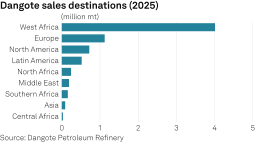
According to Dangote figures, some 4 million metric tons of its fuel, or 56% of total sales, came from West Africa in 2025. In contrast, 1.1 million mt went to Europe,158,000 mt was sold to Southern Africa, and just 30,000 mt landed in Central African markets.
However, the conflict in the Middle East has seen the company forge trade links in new markets. The refinery sent a record 30,000 b/d of fuel to South Africa in March, according to S&P Global Commodities at Sea data, and made its first export to China at about mid-May.
The company has so far relied on international traders to manage its exports, but is eager to develop more offtake relationships with governments and businesses, Bird said. The company hopes to make its Nigerian refinery the most energy efficient in the world, and is targeting a 30% cost-per-barrel basis compared with the global average, Bird said
Analysts at S&P Global Energy CERA see Nigerian oil demand growing from 450,000 b/d to 740,000 b/d by 2035, overtaking South Africa as the largest consumer on the continent. Total African liquids demand is expected to average 4.8 million b/d in 2026.
