Refined Products, Jet Fuel
May 18, 2026
Europe faces jet fuel supply risk despite temporary demand reprieve
By Thomas Washington and Aruni Sunil
Editor:
HIGHLIGHTS
US replacing much of lost Hormuz volumes to Europe
US gasoline stocks at five-year low; driving season nears
Lack of definitive EU inventory data masks supply vulnerability
Europe's jet fuel supply crisis may have been postponed rather than averted, with underlying structural tightness likely to persist even if Middle East tensions ease, according to analysts at S&P Global Energy CERA.
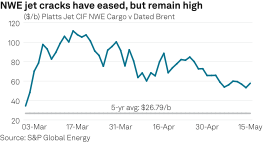
Jet fuel cracks have eased in recent weeks and some aviation industry participants have become more relaxed about the threat to supply, but the respite stems largely from demand destruction through flight cancellations rather than any fundamental improvement in supply, James Simpson, global aviation lead at CERA, said May 15, following the International Air Transport Association's Aviation Energy Forum in Paris.
The US Gulf Coast has replaced about half of the volumes previously flowing from the Strait of Hormuz to Europe, but the sustainability of those flows faces growing doubt as the US driving season approaches, Simpson said.
US jet fuel exports to Europe stood at 131,000 barrels/day in April, while there were no exports from the Persian Gulf, data from S&P Global Commodities at Sea showed May 18. In April 2025, exports from the Persian Gulf to Europe were 239,000 b/d, while the US sent nothing that month and 21,000 b/d through the year.
"Every US refinery has been in jet max mode because all the money is in making jet," Simpson said. As a result, gasoline stocks are now low, he said.
US gasoline stocks likely declined 4.78 million barrels to about 215 million barrels, analysts surveyed by Platts, part of S&P Global Energy, said May 11, putting stocks at a five-month low and more than 6% below average for this time of year.
Platts assessed jet fuel cargoes on a CIF basis in Northwest Europe versus Dated Brent at $57.76/b May 15, 68% higher than Feb. 27 before the Middle East war broke out and against a five-year average of $26.79/b.
The timing presents a critical challenge. US gasoline demand typically surges 10% during the summer driving season, which begins in the coming weeks. With refineries already running at maximum rates and optimized for jet fuel production, the market faces a stark choice between meeting aviation demand or satisfying motorists, Simpson said.
Competing pressures
The political implications of gasoline shortages in the US could shift refinery optimization away from jet fuel despite the aviation sector's needs, Eleanor Budds, director of fuels and refining research at CERA, said May 15.
"Jet fuel demand is more discretionary than gasoline and diesel," Budds said. "People have to drive to work, but you can put your holiday off."
Europe has become heavily dependent on the US and Middle East for diesel imports following the loss of Russian supplies. With Bahrain and Kuwait now cutoff and China, South Korea and India maintaining various export restrictions, the concentration of supply sources raises broader energy security concerns, she said.
The lack of reliable inventory data compounds the uncertainty. Even the International Energy Agency cannot provide accurate figures on European jet fuel stocks, making it impossible to determine when supplies might reach critical thresholds or which airports could face shortages first, Budds said.
Such data as is available suggests stocks are low. Regional inventories of aviation fuel were 558,000 metric tons on May 7, against a five-year average of 866,000 mt, according to data from Insights Global.
Policy response unclear
The Accelerate EU plan, which aims to address the bloc's rising energy costs amid volatile fossil fuel markets, is light on detail, Budds said. Support for refiners could potentially take the form of maintaining free emissions allowances under the EU Emissions Trading System rather than the scheduled annual reductions, although any such suggestions remain hypothetical, she said.
Any resolution to the Middle East conflict would likely reduce the psychological risk premium in jet fuel prices, but underlying supply tightness would persist, Simpson said. Refineries need time to restore capacity and the fundamental imbalance between available supply and demand would remain, he added.
"The refineries are still running full tilt as it is," Simpson said. "Prices will come down, but the cracks are going to remain high for a while."
