LNG, Maritime & Shipping
August 12, 2026
July Panama Canal LNG transits hit near-three-year high on Asian demand pull
By Corey Paul and Angeles Rodriguez
Editor:
HIGHLIGHTS
July laden LNG canal transits rise to 11 from six in June
Sustained netback premium draws traders back to waterway
Cape of Good Hope remains preferred route for most cargoes
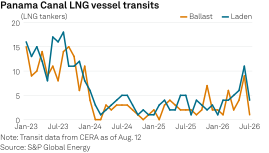
Laden LNG tanker transits through the Panama Canal climbed to the highest level in nearly three years in July, as elevated Northeast Asian LNG prices and a shift in US LNG exports toward Asia improved the economics of shipping cargoes through the waterway, an analysis of S&P Global Energy CERA data showed Aug. 12.
Some 11 laden LNG tankers passed through the canal in July, up from six in June to mark the highest monthly total since November 2023, before drought-related draft restrictions and transit caps caused LNG traffic to decline sharply.
Transits did not recover to pre-drought levels after water levels improved in 2024, with most LNG tankers bound for Asia opting for the longer route around Africa's Cape of Good Hope. From late 2023 through the outbreak of war in the Middle East in late February, laden canal transits averaged fewer than four cargoes per month, according to CERA data.
But over the past several weeks, sustained netback premiums for routing US Gulf Coast LNG cargoes to Northeast Asia via the canal rather than around the Cape of Good Hope helped draw charterers back to the waterway.
"This is the first time since the pre-drought period that we've seen a sustained and quite robust premium through the Panama Canal over the Cape of Good Hope," CERA LNG analyst Andres Rojas said. "That is what drove some traders back to the Panama Canal."
Platts, part of S&P Global Energy, assessed the arbitrage for US cargoes delivered to North Asia via the Panama Canal against Atlantic deliveries at minus 20.70 cents/million British thermal units on Aug. 12, while the arbitrage via the Cape of Good Hope was assessed at minus $1.219/MMBtu.
A spokesperson for the Panama Canal Authority, or ACP, said the increased traffic "was driven primarily by market conditions, particularly the rise in LNG flows from the United States to Asia."
The ACP also attributed the increase in LNG traffic to reservation programs and auction mechanisms that offer more predictable transit access while allowing market participants to respond to spot-market opportunities.
However, most US Gulf Coast LNG cargoes bound for Northeast Asia are still taking the longer route around Africa.
"As Asian prices move to a premium over Europe, US LNG flows shifted decisively east," Cheniere Chief Commercial Officer Anatol Feygin said during an Aug. 6 earnings call for the second quarter, noting US exports to the region had reached a quarterly record of about 11 million metric tons, while deliveries to Europe declined.
The spread between LNG spot prices in Northeast Asia and Europe remained firmly positive on Aug. 12, continuing to favor deliveries into Northeast Asia. Platts assessed the September JKM, the benchmark price reflecting LNG delivered to Northeast Asia, at $21.253/MMBtu, at a $1.112/MMBtu premium to the DES Northwest Europe marker, which stood at $20.141/MMBtu.
Much of the canal's LNG traffic in recent years has been tied to Japanese and South Korean utilities with long-term supply contracts and established shipping programs. Those buyers account for what CERA's Rojas described as a "baseload" level of LNG traffic moving through the canal, even after drought-related restrictions were lifted.
Charterers using the canal in July and August include suppliers such as Cheniere, France's EDF and QatarEnergy, CERA data shows.
Nine of the 11 laden transits in July were destined for North Asian destinations, namely Japan and South Korea. The remaining two carriers that transited during the month delivered their cargoes to Chile.
The increase in laden transits was mainly due to the Asian spread being "in the money," an Atlantic-based trader said.
"Shipping rates did not play a major part this time," the trader said.
Rojas said many market participants control ships under long-term charter arrangements and effectively treat shipping costs as sunk costs. As a result, charterers often focus on avoiding canal transit fees, helping keep the Cape of Good Hope as the preferred route for most cargoes.
The Cape route also offers traders greater commercial flexibility. Cargoes sailing around Africa can still be redirected to alternative markets in Europe, South America or South Asia if market conditions shift during the voyage. By contrast, ships booking Panama Canal slots are largely committed to Pacific Basin destinations.
"There is this optionality ingrained in the Cape of Good Hope route," Rojas said.
At the same time, higher LNG prices increase the value of shortening voyages and reducing cargo losses from boil-off.
"In this higher-priced spot LNG market, the Panama Canal route looks a lot more attractive," Rojas said.
