LNG, Natural Gas, Maritime & Shipping
March 11, 2026
Interbasin LNG competition results in seventh Atlantic cargo to Asia: CAS
HIGHLIGHTS
Five US, two Africa cargoes divert to Asia
US netbacks point to stronger Asia arbitrage
Asian LNG buyers have pulled at least seven Atlantic Basin cargoes away from Europe since the war in the Middle East began on Feb. 28, according to S&P Global Commodities at Sea data, driven by a widening Northeast Asia price premium and improved netbacks for eastbound flows.
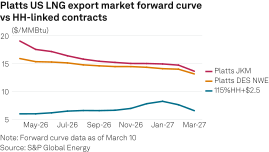
Cargoes in the Atlantic Basin sold on both spot and long-term contracts appeared to divert from Europe to Asia in response to the shifting market dynamics, with the Platts JKM, the benchmark price reflecting LNG delivered to Northeast Asia, reaching a three-year high of $25.393/million British thermal unit (MMBtu) on March 3.
Netbacks for US LNG spot volumes to end-user markets have increased significantly since the conflict began, underscoring how the supply disruption in the Middle East has increased the value of both US cargoes and tanker capacity. That is particularly true in Asia, which faces the most immediate impact from constrained flows through the Strait of Hormuz as the largest buyer of volumes transiting the waterway that accounts for about 20% of global supply.
"The widening spread is incentivizing cargoes to divert from Europe to Asia, but it's also accounting for the higher shipping rate," S&P Global Energy CERA LNG analyst Ross Wyeno said.
Platts, part of S&P Global Energy, assessed Atlantic tri-fuel diesel electric LNG carrier rates at $125,000/day and two-stroke carrier rates at $202,500/d on March 10, marking a more-than threefold increase compared to Feb. 27, the day before US-Israeli strikes began, but rates have come down from a peak of more than five times the pre-conflict values reached on March 5.
Changing course
The first vessel to divert on March 2 was the TotalEnergies-chartered BW Brussels, which loaded in The Bonny Inshore Terminal in Nigeria and changed course toward the Cape of Good Hope rather than Europe.
Days later, two more vessels -- the Cheniere-chartered Clean Mistral, which loaded from its Corpus Christi facility, and the QatarEnergy LNG chartered Simsimah, which loaded at Venture Global's Plaquemines LNG plant in Louisiana -- both appeared to divert from Europe to Asia.
On March 6, the Shell-chartered Pan Americas, which, after having loaded in the Bonny Inshore Terminal in Nigeria, was seen diverting from Europe to Asia.
On March 7, a third QatarEnergy LNG ship named Umm Ghuwailina, which loaded from Freeport LNG in Texas, was seen diverting a cargo loaded at Venture Global's Plaquemines LNG plant in Louisiana from Belgium to China, which would be the first US cargo imported by China in over a year, if ultimately delivered there.
Also on March 7, the Elisa Ardea chartered by France's EDF appeared to divert from the Netherlands to Japan after loading from the Freeport LNG terminal in Texas.
"Japan and China are relatively healthy, China is still offloading volumes it can be a swing supplier if prices are right and that can help ease some pressure," an LNG trader said.
Platts assessed April JKM at $17.983/MMBtu on March 11, down $1.087/MMBtu, or 5.7%, from the previous day, reflecting weaker near-term demand.
"Some players can divert to Asia but freight is still super high, so unless you have the end-user demand there ready to bite the bait then cargoes could still float in the Atlantic," the trader said.
All of the observed Atlantic Basin cargoes appeared to change course for Asia, headed for the Cape of Good Hope.
While freight rates via the Panama Canal to Asia appeared more competitive, market sources told Platts that limited slot availability -- allocated through reservations, lotteries and bidding -- may at times make passage challenging for spot cargoes.
Cargo swaps
Several of the diversions in the Atlantic are likely cargo swaps by US long-term contract holders rather than spot cargo sales, an Atlantic‑based market analyst said.
Beyond basin-to-basin diversions, several other cargo swaps have also been observed, including the Petronas-chartered Puteri Sarawak, which diverted on March 4 from South Korea to Thailand after loading at the LNG Canada facility in Kitimat, British Columbia.
"Taiwan spot demand is good; did not hear much movement from China, Korea or Japan so far," an Asia-based source said.
Another cargo diversion involving Asia was seen with the Diamond Gas Sakura, which loaded at the Cameron LNG terminal in the US and was rerouted on March 8 from Japan to Taiwan.
The diversions come as market participants said delivered LNG prices into Northwest Europe need to compete with Asia to retain cargoes in the basin ahead of the April refilling season and amid low storage levels, or risk losing further volumes.
"Europe needs to stockpile, so at one point they will pay whatever price is shown," an Atlantic Basin trader previously told Platts.

Editor: