Natural Gas
June 24, 2026
Netherlands exploring further strategic gas reserves

By Matt Hoisch
Editor:
HIGHLIGHTS
Aims to build 5 TWh Alkmaar emergency stock for coming winter
Spokesperson says no decision yet on added reserves
Advisory body sees 5 TWh as insufficient for major shocks, 'concerned' on filling
The Netherlands is exploring developing further strategic gas reserves on top of a 5 TWh (473 million cubic meters) stock it already plans to build at its Alkmaar storage site, a spokesperson for the Dutch Minister of Climate and Green Growth told Platts, part of S&P Global Energy, June 23.
"We are looking into adding more strategic reserves, but haven't made any decision yet," the spokesperson said.
The Alkmaar stocks would represent about 3.5% of Dutch technical storage capacity, according to figures published by Gas Infrastructure Europe. They will be used in emergency situations starting in winter 2026-27, the spokesperson said.
The move comes months after state-owned gas infrastructure operator Gasunie, via its subsidiary, Gasunie Transport Services, or GTS, called for the Netherlands to develop a strategic reserve to bolster the country against an extended loss of supply.
However, the operator told Platts it sees the 5 TWh Alkmaar reserve alone as insufficient to weather severe shocks.
"GTS believes that a strategic reserve must be of a larger scale in order, for example, to be resilient to a prolonged and large-scale supply disruption," a Gasunie spokesperson said, adding that it wants broader gas reserve planning.
"GTS advocates that the size of an emergency reserve be determined at EU level and established within the EU, including the Netherlands," the spokesperson said.
Although Europe has avoided the severe rationing that has curtailed gas use across many Asian countries since the outbreak of the Iran war in late February, the fighting in the Persian Gulf has underscored its vulnerability to supply disruptions that upend the global LNG market. More and more players across the continental gas market are warming to developing emergency gas stockpiles, much like those that already buffer oil markets.
Germany plans to begin stocking some 24 TWh of gas for its own strategic reserve from the start of year.
Trade group Eurogas has also recently advocated for member state gas reserves as an alternative to the EU's current central approach to gas supply security through mandating storage fill targets.
Dutch storage strains
The Netherlands's push to build emergency gas reserves comes amid a relatively lackluster restocking season. Dutch gas storage sites were 23.7% full as of June 22, according to the latest GIE data. At the same time in 2025 and 2024, stocks were filled to 44.8% and 67.4%, respectively.
GTS, which advises the Dutch government on gas storage needs, is "concerned" about the levels, the Gasunie spokesperson said on June 19.
"If filling continues at this rate, there will be insufficient stocks before winter begins," the spokesperson added.
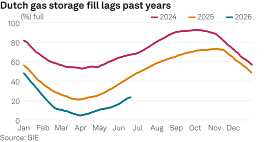
The Netherlands aims to stock 115 TWh of gas by Nov. 1, according to an April 30 government memo. This would represent 80% of the country's technical storage capacity.
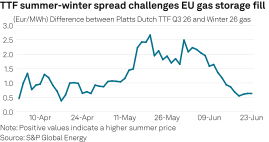
The government has approved state-owned energy company EBN to fill up to 80 TWh of gas to help meet the target and has provided it with a subsidy to do so. The rest is left to market participants, who have recently faced scant financial incentive to store gas across seasons amid persistent backwardation that has beset the European gas market throughout the filling period.
The Platts-assessed Q3 2026 Dutch TTF gas assessment has exceeded the Winter 2026 TTF assessment by an average of Eur1.30/megawatt-hour since April 1.