Natural Gas
June 16, 2026
Eurogas calls for EU to let gas storage law lapse after 2027

By Matt Hoisch
Editor:
HIGHLIGHTS
Critiques ‘one-size-fits-all approach,’ price impacts
Advocates more targeted measures such as strategic reserves
EC mulling storage under energy security framework update
Eurogas has called for the European Union to let its gas storage regulation lapse after expiring in December 2027, arguing the law's wide-reaching scope and impact on gas prices make it unsuitable as a longer-term energy security intervention, the European gas trade association said in a policy paper published on its website June 16.
"A one-size-fits-all approach through EU-wide storage obligations is ill-suited to Europe's diverse gas landscape, where member states differ in gas dependency, storage capacity, and access to alternative supply sources," the organization said in the paper. "While storage remains a key seasonal flexibility tool, European filling obligations distort price signals and risk increasing costs for both storage users and consumers."
Eurogas instead stressed that market signals should be the primary incentive for storage filling and withdrawals.
"From a market perspective, it is clear that the current Gas Storage Regulation and its mandatory filling obligations are not the appropriate instruments to ensure the required long-term resilience," Eurogas said. "They risk distorting market signals, undermining efficient storage use and leading to inappropriate price increases."
From 2028, instead of an EU-wide filling mandate, Eurogas advocated other, more targeted measures, such as member state strategic gas reserves, to ensure against emergencies.
A growing number of member states are exploring strategic gas reserves that would build stocks separate from normal market activities and only be accessed in exceptional circumstances. Germany plans to begin procuring gas for one early next year. Dutch state-owned gas infrastructure operator Gasunie has also called for the Netherlands to develop its own strategic reserve.
The Eurogas paper comes amid an update of the EU's energy security framework, which includes considerations about future approaches to EU gas storage regulation, Ruud Kempener, deputy head of unit for energy security and safety in the EC's Directorate-General for Energy, said at an industry event last month.
As part of that work, the EC is assessing questions such as whether there should be gas-filling targets for every member state and whether those targets could be defined differently -- for instance, based on gas consumption rather than as a percentage of storage capacity, according to Kempener.
The Brussels official said he expects the EC to release the updated framework for public review after the summer.
Storage struggles
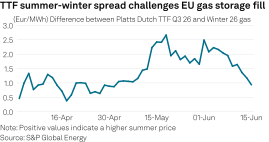
The EU has struggled to stock gas throughout the current filling season amid persistently unfavorable forward pricing dynamics. Summer gas prices in Europe have repeatedly outpaced those for winter, sapping the incentive for buyers to build stores in warmer months to sell for a profit in colder ones.
The Platts-assessed Q3 2026 Dutch TTF gas assessment has exceeded the Winter 2026 TTF assessment by an average of Eur1.38/megawatt-hour ($1.60/MWh) since April 1.
Market watchers have argued throughout several stocking seasons that the EU storage requirements have, ironically, muddied the price signals that would normally spur market-based filling.
An EU task force said in a gas market report released earlier this month that the design and implementation of some storage policies across the EU "may have influenced price signals and derivatives market dynamics."
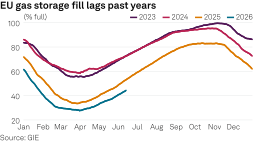
EU gas storage was filled to 44.7% as of June 14, according to the latest data from Gas Infrastructure Europe. At the same time in 2025 and 2024, stocks were filled to 53.4% and 73%, respectively.
EU regulation
The EU revised its gas storage regulation -- first imposed amid the gas supply crisis in the wake of Russia's 2022 full-scale invasion of Ukraine -- in 2025 to allow member states greater flexibility.
Under the latest iteration of the law, member states are allowed to achieve the Brussels-mandated 90% filling target at any point from Oct. 1 to Dec. 1, instead of the previous firm Nov. 1 target.
Member states are also able to deviate by up to 10 percentage points from the filling target in the event of "difficult" market conditions. The EC can further increase the deviation by another five percentage points under a delegated act for one filling season if these market conditions persist.
EU Energy Commissioner Dan Jorgensen has urged member states to take advantage of the regulatory allowances to fill storage to just 80% this year amid market disruptions from the Iran war.
The 2025 law runs through the end of 2027.
