Natural Gas
June 04, 2026
US gas storage stocks drop below 2025 levels after a bullish EIA report

Editor:
HIGHLIGHTS
Build is 4 Bcf below the Platts survey
Stocks fall below 2025 levels
The US Energy Information Administration reported June 4 a lower-than-expected weekly addition to natural gas storage inventories, reducing the surplus relative to the five-year average and sending stocks below 2025 levels.
US natural gas inventories climbed by 95 billion cubic feet in the week ended May 29, the EIA said. The reported injection was 4 Bcf below the consensus estimate of 99 Bcf in the May 26 gas storage survey by Platts, part of S&P Global Energy.
It was also bullish compared with the five-year average injection of 101 Bcf and the year-ago addition of 119 Bcf in the corresponding week, according to EIA data.
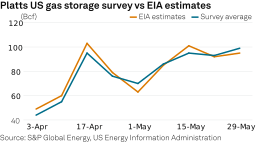
Gas inventories rose to 2.578 trillion cubic feet in the week ended May 29, the data showed.
The storage surplus to the five-year average fell to 138 Bcf, or 6%, while stocks flipped to a 3-Bcf deficit to 2025 levels. The delta to year-ago levels has shifted from a 142-Bcf surplus April 17, EIA data showed. Injections were exceptionally high in the 2025 shoulder season, with seven consecutive triple-digit additions from late April to early June.
| Working Gas in Underground Storage, US Lower 48 States (Bcf) | |||||||
| Region | 5/29/2026 | 5/22/2026 | Net Change | Year Ago (05/29/25) | % Change from Year Ago | 5‑Year Avg (2021‑25) | % Change from 5‑Yr Avg |
| East | 480 | 447 | 33 | 493 | -2.6% | 473 | 1.5% |
| Midwest | 573 | 539 | 34 | 574 | -0.2% | 560 | 2.3% |
| Mountain | 218 | 213 | 5 | 204 | 6.9% | 164 | 32.9% |
| Pacific | 298 | 292 | 6 | 260 | 14.6% | 232 | 28.4% |
| South Central | 1009 | 993 | 16 | 1,050 | -3.9% | 1012 | -0.3% |
| - Salt | 310 | 305 | 5 | 338 | -8.3% | 305 | 1.6% |
| - Nonsalt | 699 | 688 | 11 | 712 | -1.8% | 707 | -1.1% |
| Total Lower 48 | 2,578 | 2,483 | 95 | 2,581 | -0.1% | 2,440 | 5.7% |
| Source: US Energy Information Administration | |||||||
NYMEX Henry Hub prompt-month futures were up in morning trading before the storage print amid a warm weather outlook for mid-June.
Despite the bullish storage surprise, the July contract briefly lost momentum in the five minutes after the EIA's estimate, easing by about 3 cents to $3.31/million British thermal unit, according to data from exchange CME Group. The contract quickly recovered, and was trading at $3.34/MMBtu in the afternoon, up 13 cents from the prior settlement.
Fundamentals, outlook
The supply-demand balance loosened compared with the prior week, when EIA estimated a 92 Bcf injection. A 200 MMcf/d increase in dry gas production in the week ended May 29 was mostly cancelled out by a decline in net imports from Canada, according to CERA data.
Domestic consumption declined by 1.8 Bcf/d, with power-sector gas demand and residential-commercial demand both falling, the data showed. LNG feedgas demand climbed by 400 MMcf/d.
Inventories could fall further behind 2025 levels in the week to June 5. The CERA supply-demand and daily storage models called for injections of 102-106 Bcf for the week. That would be bearish compared with the five-year average injection of 95 Bcf, but below the year-ago injection of 110 Bcf, EIA data showed. Stronger supply could boost injections this week; net imports from Canada climbed by 800 MMcf/d according to CERA data. Total demand has fallen by 200 MMcf/d, with declines in res-comm demand and LNG feedgas demand offsetting stronger power sector gas burn, CERA data showed.
Further ahead, warming weather in mid-June could reduce storage injections. Population-weighted average temperatures are forecast to be almost 3 F above normal during June 5-18, and more than 5 F above the norm during June 11-14, CERA data showed.
