Natural Gas
June 02, 2026
US gas analysts expect 99 Bcf weekly storage injection, eroding surplus to 2025

Editor:
HIGHLIGHTS
Surplus to drop to 1 Bcf, from 142 Bcf in mid-April
Growth in LNG demand outpaces supply in summer 2026
US natural gas storage injections in the week ended May 29 were likely lower year over year, cutting the surplus to 2025 levels to almost zero.
Gas market analysts expect the US Energy information Administration to report a weekly net injection of 99 billion cubic feet, according to the last storage survey by Platts, part of S&P Global Energy. The EIA plans to release its next storage report June 4 at 10:30 am ET.
Responses to the survey were in a relatively narrow range, spanning 92 Bcf to 110 Bcf.
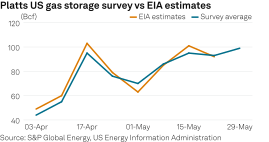
If accurate, a 99 Bcf addition would lift inventories to 2.582 trillion cubic feet. The storage surplus to the five-year average would narrow to 142 Bcf, or 6%, while the surplus to 2025 levels would almost disappear, falling to just 1 Bcf, EIA data showed
While the surplus to the five-year average has changed little since mid-April, the surplus to 2025 levels has collapsed from 142 Bcf on April 17, the data showed.Injections were exceptionally high in 2025 as weak power demand spurred seven consecutive triple-digit additions from late April to early June.
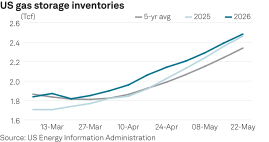
The dwindling surplus to 2025 could be putting a floor on gas prices.
The NYMEX July contract traded at $3.17/MMBtu on the afternoon of June 2, down 1 cent from its prior settlement on June 1, according to data from CME Group.
Prompt month Henry Hub futures had consistently settled below $3/MMBtu for a seven-week stretch from late March through the first half of May, according to data from CME Group and Platts.
"I think the market is looking with a little interest at the fact the year-over-year surplus has been whittled away," Stephen Schork, principal at the Schork Group, said by telephone June 2. "We're getting some hints the market is finding a structural bottom here."
So far this summer, supply has not kept pace with increasing demand from LNG export terminals.
Total supply has averaged 113.4 Bcf/d since April 1, around 2.2 Bcf/d higher year over year, CERA data showed. Production has been on average 2.8 Bcf/d stronger, but net flows from Canada have fallen.
Meanwhile, LNG feedgas demand has averaged 19.1 Bcf/d, or 3.2 Bcf/d higher year over year. While it dipped to 18.2 Bcf/d during May amid maintenance, it was still 2.7 Bcf/d higher year over year, outpacing a gain of 2.2 Bcf/d in total supply.
With the new Golden Pass LNG terminal ramping up, there is room for further growth in the second half of the year. On the supply side, new egress capacity is expected to boost Permian Basin production later this year.
Looking ahead, injections could be close to 2025 levels in the week to June 5. The CERA supply-demand and weekly storage models called for injections of 109-111 Bcf for the week. That would be bearish compared with the five-year average injection of 95 Bcf, but close to the year-ago injection of 110 Bcf, EIA data showed.
