Metals & Mining Theme, Non-Ferrous
December 18, 2025
COMMODITIES 2026: European aluminum billet faces weak demand, duty changes, CBAM
By Sophie Dyas and Tom Bennetts
HIGHLIGHTS
CBAM adds uncertainty, long-term contracts delayed
Secondary producers struggle with high costs, scrap scarcity
This is part of the COMMODITIES 2026 series where our reporters bring you key themes that will drive commodities markets in 2026.
The European aluminum billet market enters 2026 with a tentative outlook, as demand remains tepid amid cautious buying activity, while participants hope for improved clarity after a first quarter that will almost certainly be dominated by the EU's Carbon Border Adjustment Mechanism.
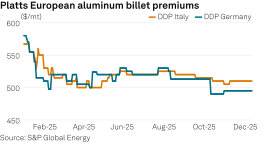
Platts, part of S&P Global Energy, assessed the European aluminum 6060/6063 billet premium at London Metal Exchange cash plus $500/mt DDP Germany on Dec. 17, on net 30-day payment terms, down 14% on the year.
The Italian premium was assessed at LME cash plus $510/mt DDP Italy on Dec. 17 for net 60-day payment terms, down 11% on the year.
Regulatory changes
The billet market faces a number of EU regulatory changes in 2026 that will reshape fundamentals in the region.
Firstly, billet import duty is set to rise from 4% to 6% as the current non-preferential tariff quota ends.
The quota allowed 573,000 mt of metal to enter Europe at the lower 4% duty rate, with anything above the quota incurring the higher cost.
However, due to ample supply from domestic and duty-free sources, alongside low demand this year, the quota to date is still not filled.
The latest available data shows that 418,090 mt of the total quota was filled by Dec. 15, representing 73% of total available units, according to EU customs data.
"The problem with billet and the tariff change from 4% to 6% is we don't know if the end-user will want to pay the difference, everything is a bit on hold," a European trader said.
Meanwhile, CBAM will enter its definitive phase in 2026, which adds further uncertainty to the market.
Many market participants are taking a 'wait-and-see' approach to CBAM regulation, as both consumers and producers have delayed signing long-term contracts while awaiting more clarity from the European Commission.
In welcome news for EU producers, the commission has announced that CBAM will be expanded to cover downstream steel and aluminum products from Jan.1, 2028.
This came amid mounting pressure from the industry that the omission of downstream products from CBAM would create a loophole for consumers to import finished goods from outside the EU and avoid the CBAM cost.
Sluggish demand
The demand landscape in the European aluminum billet market was lackluster across the second half of the year, with uncertainty persisting and buyers unwilling to commit to long-term proposals.
This sentiment is expected to carry on into the new year, capping premium levels, despite the bullish regulatory changes.
"Demand is still not good, I still get from customers that they are working at 60%-70% of capacity, working four days a week, especially in Italy," a European producer said.
The poor economic conditions in Europe were underlined by the announcement that Oslo-based aluminum producer Hydro will close five extrusion plants across the continent.
"What I'm getting from market participants is that billet premiums need to rise, will rise. Everyone is sure they will rise but demand is just not good; the bullish factors have not yet materialized," the same producer added.
Buying activity in the first quarter is set to remain cautious, too, as market visibility remains poor.
"[We will] fix the bare minimum for Q1 ... No one is committing long term," a second producer added.
Secondary billet struggles
Secondary billet producers have been burdened by rising primary aluminum prices and ongoing scrap scarcity.
"As a remelter, we need different numbers, we cannot stick around at $515/mt when primary [premiums] are at $330/mt," a third European producer said.
Platts assessed the European P1020 aluminum premium over LME cash at $320-$340/mt, duty paid in warehouse basis Rotterdam, on Dec. 17.
Market participants are eagerly awaiting a rise in premiums to help alleviate some of the pressure added by rising P1020 prices.
"For me, it [the billet premium] has to move up, there's no other choice," a European trader said. "The last thing I saw, prices were hovering around $520/mt in Spain and Italy, but that's unsustainable."
Related content: The potential proliferation of CBAM: a fragmented carbon tariff landscape

Editor: