Electric Power, Energy Transition, Emissions
December 16, 2025
Brussels to expand CBAM to downstream steel, aluminum; overhaul power import rules
By Eklavya Gupte and Irina Breilean
HIGHLIGHTS
Steel, aluminum downstream products to enter CBAM scope Jan 1, 2028
Electricity import rules simplified to include average grid emissions factors
Auto components, household appliances among targeted downstream goods
The European Commission is preparing to significantly expand its Carbon Border Adjustment Mechanism to cover downstream steel and aluminum products from Jan. 1, 2028, while simultaneously overhauling technical rules for electricity imports to better incentivize global decarbonization efforts.
The expansion will capture selected steel and aluminum-intensive downstream products, such as automobile components and household appliances, where embedded emissions and carbon leakage risks are highest, according to a draft proposal text seen by Platts, part of S&P Global Energy.
The EC's legislative proposal comes as Brussels has faced mounting pressure from European industries to address concerns about carbon leakage, with manufacturers of downstream steel and aluminum products confronting a "dual cost-push" from EU climate policies. The draft text also outlines rules to reform electricity import methodologies that stakeholders had criticized as overly rigid.
A spokesperson at the commission, which is expected to adopt the proposal by Dec. 17, was not immediately available for comment.
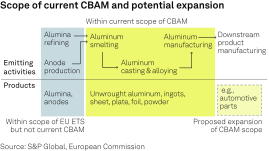
Carbon leakage
Products with higher shares of basic materials in their weight carry more embedded emissions relative to total weight and face greater leakage risks, making them priority candidates for inclusion.
"The impact of an extended number of CBAM goods [180 additional product codes] – extended with downstream products, will result in around 7500 new importers," according to the proposal.
The proposal also addresses scrap metal treatment, opting to include only pre-consumer scrap as a CBAM precursor while excluding post-consumer scrap, as it seeks to strengthen the effectiveness of this carbon policy.
"Since pre-consumer scrap is a co-product generated unintentionally in the production process of metal goods and immediately reusable in a production process, it is not considered at risk of carbon leakage in its own right. Therefore, the emissions of pre-consumer aluminum scrap and pre-consumer steel scrap should only be taken into account when used as a precursor for goods listed in Annex I of this Regulation," the proposal said.
The commission concluded that including post-consumer scrap "could disincentivize the circular economy and would not be consistent with several EU policies in this area."
The main purpose of the downstream extension is to prevent carbon leakage and deter EU companies from moving their manufacturing and processing operations to non-EU countries with less stringent climate policies.
This move reflects a changing political landscape in the EU where environmental ambition increasingly competes with economic pragmatism, testing whether CBAM can deliver climate benefits without undermining industrial competitiveness.
Related content: The potential proliferation of CBAM: a fragmented carbon tariff landscape
Electricity overhaul
Meanwhile, the commission is also proposing substantial changes to electricity import rules that stakeholders have found impractical since CBAM's transitional phase began in October 2023.
The current framework uses default emission values reflecting only fossil fuel electricity production, potentially overestimating the carbon content of electricity from countries exporting relatively clean power to the EU.
The preferred option shifts to average grid emission factors for exporting countries and removes congestion-related criteria for declaring actual emission values.
The average grid emission factor "will better reflect the decarbonization trend of the country of origin, since electricity produced from renewable sources will also be accounted for," according to the proposal.
"Together with the changes to the conditions related to PPAs and the nomination of capacity, the removal of the condition of absence of network congestion will further facilitate the reporting of actual values," the proposal said.
The changes address stakeholder feedback gathered through extensive consultations, including a public consultation from July to August this year. Most respondents indicated the current methodology for calculating default electricity values was inappropriate because it ignored non-fossil fuel sources, while conditions for applying actual embedded emissions needed simplification.
Future extensions to downstream products in other CBAM sectors -- cement, fertilizers and hydrogen -- are under consideration for future legislative revisions, according to the proposal.
CBAM is currently in a transitional phase, requiring importers to report emissions without financial penalties. The mechanism enters its definitive phase on Jan. 1, 2026, with companies liable for their emissions. This is expected to have significant implications for carbon-intensive industries.

Editor: