Metals & Mining, Coal, Non-Ferrous, Ferrous
November 04, 2026
Incoming Democratic majorities could seek to curb US tariffs, scrutinize mining deals

Editor:
HIGHLIGHTS
Congress to probe Trump's mining equity deals
Tariff rollback faces veto, supermajority hurdle
Critical minerals policy keeps bipartisan backing
Democrats' takeover of the US Congress in 2027 could bring heightened scrutiny of President Donald Trump's deals with mining companies and an effort to curtail executive tariff authority, but ultimately, policies advancing domestic metals and mining are likely to enjoy bipartisan support, observers and analysts told Platts.
Democrats won sweeping victories Nov. 3, securing substantial majorities in both the House of Representatives and the Senate. Newly Democratic-led committees could open investigations, hold hearings and issue subpoenas related to the administration's investments and critical minerals deals. And the party could also use its congressional majorities to advance legislation aimed at limiting presidential tariff authority, including tariffs on steel, aluminum and copper.
However, Democrats' ability to unwind Trump's policies could be constrained, experts said. The president could veto legislation seeking to curb the executive branch's trade authority, and Democrats may be reluctant to reverse initiatives intended to strengthen US critical minerals supply chains.
"I think the metals and mining space is susceptible to some of the same kinds of thematic drivers of oversight and investigations as many other industries, and really the common nexus is proximity to Trump administration policies, administration objectives and government contracts," Tom Moyer, a partner at Bracewell who leads the congressional investigations practice, told Platts, a part of S&P Global Energy.
Democrats to push oversight
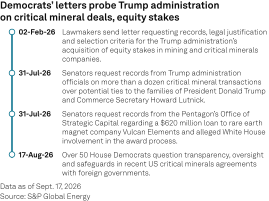
Mining companies could see aggressive congressional oversight as Democrats dig Trump's ming deals, including agreements to provide benefits in exchange for equity.
Democratic lawmakers are preparing to use oversight tools like hearings, document requests, subpoenas and other investigative powers to scrutinize the Trump administration's critical minerals agreements and equity stakes in mining companies. Companies that have received federal support could face scrutiny over their interactions with the administration, while lawmakers could also examine federal investments, permitting decisions and other administration initiatives, experts said.
Democrats have already signaled plans to use their new oversight powers. After the Nov. 3 election results came in, incoming Senate Finance Committee Chair Ron Wyden posted the single word "Subpoenas" on X, while incoming House Oversight and Government Reform Committee Chair Robert Garcia offered an even more concise warning after Democrats secured the House: "Lawyer up."
The ultimate impact on metals and mining companies could depend on whether congressional investigations remain primarily oversight exercises or translate into changes in executive policy or legislation.
"I do think there's going to be a large focus from our leadership in looking at who decided to make deals with this administration that then benefited their interests in a particular way and if the president benefited personally from that, we're going to want to explore that publicly," John Lee, chief of staff for Congresswoman Nikki Budzinski, a Democrat from Illinois who won her re-election bid, said during a Nov. 4 webinar.
However, timing could ultimately constrain lawmakers.
"It takes a long time to complete investigations and write legislation and then also pass that legislation," Joseph Brazauskas, yet another partner at Bracewell, said.
Metals tariffs face scrutiny, reversal difficult
Democrats will likely reopen debate over Trump's expansive use of presidential trade authorities, such as the Section 232 duties on steel, aluminum and copper. Congress could pass legislation to revoke or limit the authority underpinning those tariffs, but such measures would likely face a Trump veto, requiring a two-thirds majority in both the House and Senate to override it.
"If you're betting on long-term courage from Congress to take over control of trade policy, I don't think that's a strong fact," Josh Zive, a senior principal at Bracewell, said, adding, "Getting rid of the existing tariffs is going to be an uphill push."
Democrats could instead use their majorities to press the administration for tariff exclusions or exemptions while advancing legislation that would restrict future use of a president's tariff authorities.
"If the Democratically-controlled Congress wants to examine tariff policy broadly through legislative means as a way to alleviate what they view as some of the issues on costs of goods, then certainly putting together legislative proposals that limit the ability of the president to make such 232 determinations, I think that's certainly on the table," Brazauskas said.
Several Democrats who defeated Republican opponents criticized Trump's tariffs on the campaign trail, particularly the 50% duties imposed on Canadian imports in August. Democrat Abdul El-Sayed, who won Michigan's open Senate seat, campaigned against Trump's tariffs, arguing they were raising costs for Michigan households.
Mining policy retains bipartisan support
Despite the shift in congressional control, mining and metals industry groups emphasized the bipartisan support that has developed around strengthening domestic supply chains for critical minerals.
"While the balance of power may have changed in Washington, the fundamental issues that have transformed mining into a non-partisan issue remain the same," Rich Nolan, president and CEO of the National Mining Association, a US mining trade group, said in a statement.
"Americans want to see policymakers confront these challenges, reduce barriers to domestic production and lower costs," he added. "No matter who controls Congress, solving those key issues simply cannot happen without a strong U.S. mining industry."
Charles Johnson, president and CEO of the Aluminum Association, a US trade group,said the association is looking forward to working with the new Congress "to advance practical policies that ensure America has the aluminum it needs."
The American Iron and Steel Institute stressed the need for bipartisan cooperation.
"We will continue to work with members of Congress from both parties to advance bipartisan efforts to revitalize our nation's steel industry, safeguard good-paying manufacturing jobs and foster innovation," Kevin Dempsey, AISI President and CEO, said in a statement.
Coal will also remain a focus for the industry despite the shift in congressional control, Emily Arthun, CEO of the American Coal Council, a trade group, told Platts.
"As policymakers chart the nation's path forward, it is essential that coal's contributions are understood, recognized, and valued," Arthun said.