Metals & Mining
September 22, 2026
Democrats eye broader probes of Trump administration mining stakes after midterms

Editor:
HIGHLIGHTS
Make oversight of critical minerals deals a priority
Pledge hearings, investigations if they retake Congress
Congressional Democrats are prepared to use an expanded set of oversight tools to scrutinize the Trump administration's critical minerals agreements and equity stakes in mining companies if they win back the House or Senate in this fall's US midterm elections, lawmakers said.
Democrats in both chambers have sent letters over the past year to Trump administration officials and mining executives seeking information about the deals as part of efforts to determine whether the transactions were conducted ethically and in the public interest, a signal flare of their 2027 plans. If Democrats regain congressional majorities, lawmakers pledged to convene hearings, request investigations and documents backed by subpoena authority, gather testimony and potentially go to court if needed, they told Platts, a part of S&P Global Energy.
"All of this is a priority," Representative Jared Huffman of California, the top Democrat on the House Natural Resources and potential chair if Democrats win the chamber, told Platts on Sept. 9. "I mean all of these equity stakes, the layers of connection to Donald Trump's family and inner circle that seem to be involved in so many of these unconventional deals and grant awards and loan guarantees."
President Donald Trump has ramped up efforts to build domestic critical mineral supply chains and reduce US reliance on countries like China by pursuing critical minerals agreements with foreign governments and private-sector partners. The administration has also taken equity positions in metals and mining companies.
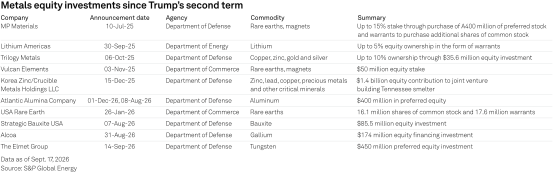
Huffman signed two letters addressed to Trump administration officials raising concerns about recently announced US critical minerals agreements with foreign governments and the administration's acquisition of equity stakes in mining and minerals companies.
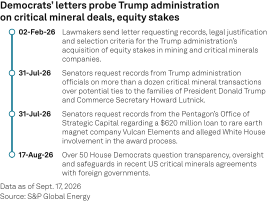
In a February letter to the secretaries of Defense, Energy, Commerce and Interior, Huffman and other lawmakers requested documents, a briefing and the legal justification for the government's acquisition of equity stakes in metals and mining companies.
By taking direct ownership stakes in selected companies, the government was "essentially picking winners and losers," the lawmakers wrote.
Huffman also joined an August letter with over 50 House Democrats expressing concerns about recently announced critical minerals agreementswith other countries, which the lawmakers said lacked transparency. The letter cited reporting that companies linked to the families of Trump and Commerce Secretary Howard Lutnick could benefit from a US-backed critical minerals agreement in Kazakhstan.
"The doors have just been thrown wide open for every shady business scheme to pretend to be critical to our national security," Huffman told Platts.
Huffman called for a review by the US Government Accountability Office review, a nonpartisan congressional watchdog agency, of whether the Trump administration adequately protected taxpayer funds and managed potential conflicts of interest related to government equity stakes.
Senator Elizabeth Warren of Massachusetts, the top Democrat on the Banking, Housing, and Urban Affairs committee and another prospective committee chair, has been among the lawmakers scrutinizing the Trump administration's critical minerals and mining investments.
Warren and Democratic colleagues questioned Defense Secretary Pete Hegseth in a January letter about potential conflicts of interest involving Pentagon contracts and loans awarded to companies backed by 1789 Capital, a venture capital firm that Donald Trump Jr., Trump's son, joined as a partner. This included a $620 million loan to rare earth magnet company Vulcan Elements.
"The people of the United States have a right to know that when public officials are making decisions, it's on behalf of the country, not the personal financial interests of that official," Warren told Platts on Sept. 15.
Warren and other senators also questioned Lutnick in February about a Commerce Department agreement to provide up to $1.6 billion in funding to USA Rare Earth, which would include an equity stake in the company. The lawmakers raised conflict-of-interest concerns because the rare earth miner raised $1.5 billion from private investors in a transaction brokered by Cantor Fitzgerald, Lutnick's former firm, which is now run by his sons.
Additionally, Warren joined Senators Richard Blumenthal of Connecticut and Adam Schiff of California in July, demanding records on more than a dozen critical minerals transactions over potential conflicts of interest with reported ties to the families of Trump or Lutnick.
"We need to hose the corruption out. Republicans clearly refuse to do it, but if Democrats can take the majority, we'll have a chance to do that," Warren told Platts.
Democrats will use all tools available to Congress, including future powers of a majority, to expose abuses of law, Schiff said in a Sept. 14 statement to Platts.
"Any company that got a sweetheart deal from the administration because the President's family or the family members of his Cabinet had an inside track should be on notice: the American people must understand the full scale and scope of the corruption emanating from the Oval Office, and the cost they are paying for it with their tax dollars," Schiff said.
Republicans see congressional role in critical minerals push
Republicans support the Trump administration's strategy of pursuing critical minerals agreements with partners and incentivizing domestic production to diversify the supply chain.
"These are significant steps," Representative Jason Smith of Missouri, a Republican who chairs the House Ways and Means Committee, said of the administration's actions during a Sept. 2 committee hearing on securing critical resources and supply chains. "But long-term success requires Congress to play an active role in shaping these agreements and evaluating the tools the administration is putting on the table."
Republicans also continue to prioritize streamlining permitting and encouraging domestic mining and processing.
"America has the resources. We have the workers. What we don't need is years of government delay and uncertainty," Representative Jefferson Shreve, a Republican from Indiana, said during House floor remarks on Sept. 2. Shreve introduced the Protecting Domestic Mining Act of 2025, which passed the House in September and codifies mining and processing projects as eligible for coverage under the federal FAST-41 permitting program.
The White House did not provide comment on metals and mining priorities in the next Congress.
