Metals & Mining, Non-Ferrous
October 20, 2026
US government equity stakes deliver short-lived boost to metals, mining shares
By Rachel Looker and Susan Dlin
Editor:
HIGHLIGHTS
Investor gains fade after equity announcements
Price floors outweigh ownership as value driver
Political uncertainty clouds deal longevity
Shares of publicly traded metals and mining companies that received US government equity investments have tanked since the deals were announced, as investors ignore the government's vote of confidence in favor of market fundamentals.
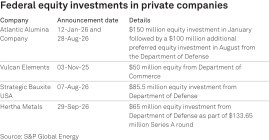
US President Donald Trump has shifted a typically hands-off US policy when it comes to loan guarantees and grants to requiring stock shares in companies seeking government help.Companies have been willing to make the deal, including at least seven metals producers: Trilogy Metals Inc., Lithium Americas Corp., MP Materials Corp., USA Rare Earth Inc., Alcoa Corp., Korea Zinc Company Ltd. and The Elmet Group Co.
But the stock prices of the seven metals companies decreased by an average of 26.5% since the government announced it would take a stake, according to a Platts analysis. And two of the companies — Lithium Americas and USA Rare Earth — lost over 60% of their value after their respective deal announcements. Platts is part of S&P Global.
The government deals vary in structure and have not yet closed for some of the metals companies, but the decline in share values raises questions about the administration's approach.
"At the end of the day, you might get a little bit of a pop from some of these government investments in the beginning, but in the longer term, I would argue it's the macroeconomic trends and earnings trends that end up mattering more for the stock," Michael Casper, senior market strategist and director of equity at wealth management firm HB Wealth, told Platts.
The US government traditionally does not take a role in company ownership, with the exception of the 2007-8 financial crisis, instead opting to boost companies with loans and grants and take the dividends in the form of jobs and taxes. But the Trump administration views that as a giveaway.
"President Trump's approach is different: no blank checks — build in America or face tariffs," the US Department of Commerce posted on X on Aug. 19, 2025. "Instead of giveaways, equity for the American people. A better deal for taxpayers, a stronger deal for US industry."
Markets navigate equity stakes
Government equity stakes are becoming a weaker market signal to investors, analysts said.
This is in part because of an increase in the use ofequity as a preferred funding instrument by the government, which means each deal carries less weight and leaves investors wondering whether projects will come to fruition, Tom Moerenhout, a research scholar at Columbia University's School of International and Public Affairs, told Platts.
"In the initial equity deal, the markets get enthusiastic... and then you confront it again with all of the things that make any metals project and mining project so difficult to implement," Moerenhout said.
Government backing has historically played a consequential role in stabilizing companies during times of crisis. In 2008, the US Treasury Department committed $62 billion in Troubled Asset Relief Program assistance to General Motors and Chrysler, ultimately taking equity stakes in both automakers as part of efforts to support their restructuring.
However, former US President Barack Obama had a similar experience to Trump as company valuations fell.The government exited both investments by 2013 at a $9.3 billion cost to taxpayers, according to the Treasury Department.
Equity investments are more about creating a structure through which the government, and ultimately taxpayers, can receive a return on their investment, said Brad Handler, researcher and director of the Payne Institute for Public Policy's Energy Finance Lab at the Colorado School of Mines.
"It doesn't necessarily feel incrementally helpful and I think that's part of what the market has wrestled with," Handler said.
Korea Zinc received funding for a critical minerals smelter in Tennessee with federal government backing and investment in late 2025. In a statement to Platts, the company said its share price is influenced not only by company-specific factors, but also by fluctuations in the Korean stock market, overall market conditions and investor sentiment.
"Investment by the U.S. government is only one of many variables, and a relatively limited one at that," the company told Platts.
Price floors, offtakes stand out
MP Materials received the most extensive market-support measures, pairing the government's $400 million equity investment with a 10-year price floor and magnet purchase commitment.
In the first three months after the deal was announced on July 10, 2025, the company's share price jumped 118.1%, according to the Platts analysis. As of Oct. 14, 2026, MP Materials' share price was down 11.7% compared with July 10, 2025.
"I'd say that it was less the US government taking an investment and more the announcement of a floor price," Max Yerrill, vice president at BMO Capital Markets, said of the initial pop in the company's stock.
Other transactions carry different forms of support. Lithium Americas' Thacker Pass lithium project has 20-year offtake agreements with General Motors rather than the federal government, which holds a 5% equity stake in the company and a 5% economic stake in a joint venture for the project.
As of Oct. 14, Lithium Americas' shares had dropped 62.6% from the announcement of the government deal on Sept. 30, 2025.
"The US can't afford to depend on China for the lithium powering its defense systems and electric grid. Thacker Pass changes that. With strong federal, state, and local partners behind us, our project is fully financed, on schedule for mechanical completion in late 2027, and already putting thousands of Americans to work," Tim Crowley, Lithium Americas' senior vice president of government and external affairs, said in a statement.
While a government investment can signal that the US is a partner, investors still have to weigh whether the projects can be permitted, financed and built, Handler said.
"I think that's what sort of gave way in terms of the stock reaction. There's some implicit support, but when you really started to squint at it, there's questions as to how much different this looked than a loan or some other way that the government would grant money," Handler said.
USA Rare Earth also recorded a significant decline in share price following the announcement of an equity deal. The company's share price fell following both the January 2026 announcement of the proposed US government investment and the June execution of the deal, declining 61.4% from the announcement date through Oct. 14, 2026. The Department of Commerce invested $1.6 billion and received shares and warrants as the company works to start producing critical minerals at its Round Top deposit in Texas.
"The strategic need for a secure rare earth value chain outside China is only growing. USA Rare Earth is focused on execution to meet that demand," a spokesperson said in a statement.
Congressional oversight brings uncertainty
Federal equity investments have also drawn congressional scrutiny over taxpayer protections, company selection and potential conflicts of interest.
Democrats in both chambers have sought information from Trump administration officials about the government's equity investments, including how companies were selected, how taxpayer funds are protected and whether conflicts of interest are being addressed.
Senator Jacky Rosen, a Democrat from Nevada, introduced a resolution Oct. 1 calling for the president, vice president, cabinet secretaries, members of Congress and their immediate families to be barred from profiting from federal acquisitions, sales or transfers of stakes in private companies. The resolution also calls for prohibiting the sale or transfer of government-owned stakes to those officials and their family members.
"The Trump administration has taken voluntary equity investments in willing companies as we are focused on reshoring critical supply chains and safeguarding our national and economic security – all while ensuring American taxpayers receive the largest benefit out of every deal," Taylor Rogers, a White House spokesperson, said in a statement to Platts.
Investors also face uncertainty about whether future administrations and Congresses would maintain the government support and policies underpinning the investments. That uncertainty could undermine private-sector confidence in the durability of the federal support, potentially dampening investment appetite, Moerenhout said.
"I think [the markets] are skeptical about whether the equity investments can be enough and whether the equity investments can survive," Moerenhout said.
