Metals & Mining, Ferrous
July 10, 2026
Global iron ore trade hits record high, driven by Chinese demand, Australian exports
Editor:
HIGHLIGHTS
China imports 1.33 bil mt in 2025
Brazil exports rise to 413.6 mil mt
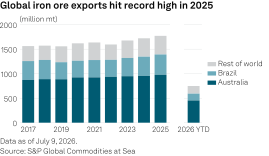
Global seaborne iron ore trade is expected to remain strong in 2026, following a record-breaking total in 2025 that featured all-time-high imports by China and exports from Australia and Brazil, according to S&P Global Commodities at Sea.
Seaborne trade in 2026 reached 748 million metric tons as of July 9, of which 453.3 million mt came from Australia and 138.6 million mt from Brazil, CAS data showed.
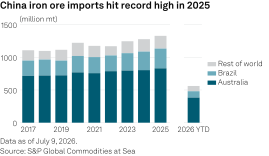
China, which has long been the demand driver for iron ore, imported 561.3 million mt so far this year, according to CAS.
The country imported 1.33 billion mt in 2025, comprising the bulk of the 1.77 billion mt in seaborne trade, CAS data showed. This was despite China's steel production peaking in 2020.
Australia, the world's biggest producer, exported 977.2 million mt of iron ore in 2025, of which 830.9 million mt went to China, also an all-time high, according to CAS.
The 2025 record-high figures occurred despite some challenges for BHP's iron ore fines in China. Those challenges persisted into 2026, while Chinese steel mills and traders reassessed purchases of certain Fortescue Ltd. products from Australia.
"We expect Chinese crude steel production to reach 978 million mt this year -- so another strong year," Paul Bartholomew, associate director of metals and mining research at S&P Global Energy CERA, told Platts in a July 9 interview.
"That said, iron ore imports are running ahead of production, as can be seen by iron ore port stocks surpassing 160 million mt," Bartholomew said. "Some of this is due to mills and traders taking advantage of lower iron ore prices, but there is a sense of oversupply in the market, which is putting pressure on prices."
Brazil's exports rise
Brazil's exports totaled 413.6 million mt in 2025, with 302.2 million mt destined for China. Both figures marked record highs, according to CAS.
Brazilian iron ore exports are on track to remain high in 2026, supported by stronger output from Vale SA and resilient Chinese demand, Luke Nickels, senior commodity intelligence analyst at Signal Ocean, a maritime platform for charterers, brokers and owners, told Platts on July 8.
While Chinese steel production is down about 4% year to date, mills have continued to import large volumes to rebuild inventories and secure higher-quality feedstock, Nickels said.
Port stocks rose from about 131 million mt in July 2025 to more than 175 million mt by early July 2026, while geopolitical uncertainty following the conflict involving Iran also spurred precautionary buying amid concerns over possible shipping disruptions, according to Nickels.
The longer-term case for Chinese imports remains underpinned by declining domestic iron ore production and the lower quality of local material, Nickels said. China's domestic ore typically contains 20%-30% iron, compared with 60%-65% for imported ore, making higher-grade seaborne supply more attractive to mills seeking efficiency gains and lower emissions.
That trend also helps explain China's strategic interest in Guinea's Simandou project, one of the world's largest untapped high-grade iron ore resources, Nickels said. China has imported just over 4 million mt from Guinea year to date as of July 9, according to CAS data.
India's shifting import mix
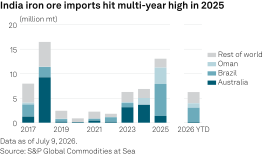
India has also shifted its import mix, significantly increasing purchases of Brazilian iron ore while reducing reliance on Australian supply, reflecting growing demand for higher-grade ore as it expands steelmaking capacity toward a 300-million-mt target by 2030, Nickels said.
Steelmakers are putting pressure on India's government to boost iron ore imports, citing challenges within the domestic mining sector, Sanjiv Bhargava, CEO of Bulk Marine Ltd., told Platts on June 26. "Good imports of iron ore will also improve the efficiency of their steel plants."
Australia's iron ore exports to India fell 61.8% to 1.4 million mt in 2025, while Brazil supplied 6.5 million mt out of India's total 13 million mt imports that year, according to CAS. Oman contributed 3.3 million mt of India's iron ore imports in 2025, marking the country's highest import volume since 2018, CAS data showed.
India is expected to help offset China's falling steel output, enabling world production to reach about 2 billion mt by 2031, according to a July 3 report from Australia's Office of the Chief Economist.
"India continues to be the primary driver of global steel production growth," the Australian report said.
Nickels said Brazilian ore is increasingly being blended with Omani pellets to improve the quality of lower-grade domestic ores, making it a more important part of India's steelmaking strategy.
However, not all cargoes arriving in India should be regarded as domestic consumption, according to Nickels. Following the disruption linked to the conflict involving Iran and the temporary closure of the Strait of Hormuz, ports such as Kandla have become strategic transshipment hubs, with some imported ore later reexported to the Middle East, Nickels said.
Canadian growth
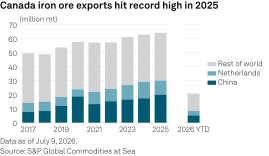
Canada's imports have also steadily increased since 2021 to a record 64.1 million mt in 2025, according to CAS.
Patrick Lahaie, co-global metals and mining lead and senior partner at McKinsey and Company, attributed this to "a few structural shifts that play into Canada's domestic advantages."
"Most notably, as the global steel industry transitions toward lower-emission production, like the shift from blast furnaces to electric arc furnaces, buyers are in search of high-purity iron ore concentrates and pellets that Canada produces," Lahaie told Platts on July 8.
"In recent years, to meet that demand, Canada has been able to expand its mining capacity and pair it with robust logistics infrastructure," Lahaie said.