Metals & Mining, Non-Ferrous
July 07, 2026
TRADE REVIEW: European aluminum market seeks floor as Middle East war premium fades

By Sophie Dyas
Editor:
HIGHLIGHTS
Aluminum prices surged 64% year to date
Peace talks trigger sharp market correction
Canadian flows satiate European demand
The In-warehouse Rotterdam P1020 aluminum market faces an uncertain second half of the year, as participants consider the long-term impact of the Middle East war.
The conflict sent shockwaves through the aluminum market, with the region historically accounting for 9% of global aluminum supply and around 20% of Europe's import mix.
The effective closure of the Strait of Hormuz cut this supply, which, alongside subsequent higher energy prices and complex logistical issues, sent immediate bullish signals to prices.
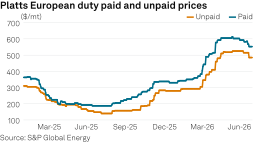
Platts, part of S&P Global Energy, assessed the Duty Paid IW Rotterdam P1020 price in a range of $525-$560/mt July 6, a 64.4% increase at the midpoint year to date.
Platts assessed the Duty Unpaid IW Rotterdam P1020 price in a range of $470-$500/mt July 6, rising at the midpoint by 73.2% from Jan 2.
A memorandum of understanding signed by US President Donald Trump and Iranian President Masoud Pezeshkian June 17 set the foundation for 60-day peace talks, and led to a large sell-off in the underlying London Metal Exchange aluminum price.
This has led to some downward movement in global regional premiums as the markets consolidate against the removal of a war premium.
"Where is the floor? This is the question dominating the aluminum market following the sharp correction triggered by the US-Iran memorandum," said Massimo Grifone, director of Cauvin Metals. "The removal of the geopolitical risk premium quickly pulled the LME down from its peaks above $3,700/mt to the $3,100-$3,200/mt range."
"However, pinpointing a clear equilibrium level remains challenging, as conflicting market forces pull in opposite directions," he said. "The aluminum market is currently going through a major transitional phase, characterized by a tug-of-war between bearish pressures and solid structural support."
The amount of metal stockpiled in the Persian Gulf remains opaque; however, some companies are reportedly offering aluminum billet for third-quarter delivery.
Most recently, the commodity trading company Vitol successfully shipped 35,000 metric tons of UAE-origin material through the Strait of Hormuz, bound for the US.
Emirates Global Aluminum has also resumed hot metal casting at its 1.3 million mt/year Al Taweelah smelter. The site sustained significant damage during the conflict and entered an emergency shutdown following Iranian attacks on March 28.
EGA said a return to prewar production levels could take up to a year due to the complex nature of aluminum smelters.
Karen Norton, associate director of Aluminum Research at S&P Global Energy CERA, said: "We expect the easing supply situation to weigh increasingly on prices in the second half of the year, but even so, it will not be one-way traffic."
"Prices may spike higher at times on supply-related news such as shipment delays or production hiccups, but upward momentum is unlikely to sustain," she said. "Problems could involve smelter ramp-up issues in the Middle East after the earlier curtailments, or delays to new capacity coming on stream in Indonesia."
"However, our base case view is that the highs have likely been seen and despite potential bumps along the way, supply is picking up and prices will moderate to reflect this," Norton said.
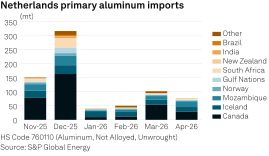
Primary aluminum imports into Rotterdam were subdued across the first quarter, largely due to pre-CBAM stockpiling activity in December.
Rotterdam saw an influx of imports in the back end of 2025 as importers looked to customs-clear metal ahead of the implementation of CBAM.
Throughout the first quarter, European demand was met by Canadian volumes, with Canada accounting for more than half of total imports in March.
However, the flow of Canadian metal to Europe is not guaranteed, with producers and traders closely tracking the arbitrage opportunity between Rotterdam duty-paid and the US Midwest premium.
The US has historically been the default destination for Canadian metal, given its geographic and logistical advantages. However, following the US administration's 50% tariffs on aluminum, those flows re-routed to Europe.
Market participants place the current US replacement value -- the price at which Canadian metal is attracted to the US market -- at around 110 cents/lb, which is above the current price.
Platts assessed the US Midwest transaction premium at 107.95 cents/lb July 6, down from 108.70 cents/lb previously.
"The replacement story for Europe is still the Canadian ton, and there is no shortage of tons arriving from there," a trader said.
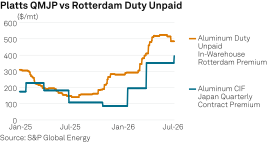
The latest Quarterly MJP price -- considered the benchmark for the Asian market -- settled at its highest level in over a decade.
Platts assessed the third-quarter premium for imported primary aluminum to Japan at $395/mt plus LME cash, CIF main Japanese ports, on July 6, up 11.9%-12.9% from $350-$353/mt in the second quarter.
Offer levels were elevated over the negotiation period due to the limited availability of Good Western-origin volumes following Middle East supply disruptions.
However, market sentiment shifted as concerns of Persian Gulf supply disruption eased and premiums in the European and US markets softened. This, alongside a drop in the LME cash price, led to an agreed premium of $395/mt CIF Japan, as a total recovery of Good Western-origin supply across the third quarter remains uncertain.
