Metals & Mining, Ferrous, Non-Ferrous
July 02, 2026
Metals industry groups back continued USMCA talks after US declines renewal
Editor:
HIGHLIGHTS
Steel, aluminum groups seek stronger USMCA
Annual reviews create investment uncertainty: trade expert
US aluminum and steel groups view the Donald Trump administration's decision not to renew the US-Mexico-Canada Agreement as an opportunity to strengthen the pact through more talks,though some trade experts warn the White House's move could deter long-term investments.
The US announced July 1 that it would not agree to renew the USMCA in its current form, triggering annual reviews over the next decade as the three countries continue to negotiate proposed changes. The trade pact will remain in effect until 2036 unless one of the countries gives a six-month exit notice or they reach a new agreement.
Some US metals industry groups told Platts, part of S&P Global Energy, that the non-renewal decision helps pave the way for new policies -- such as tougher rules of origin for steel -- that US trade associations are seeking. However, some experts warn that protracted talks could leave metals and mining investors in the lurch.
"I think metals and mining, in order to benefit properly from USMCA, require a longer-term horizon in order to properly invest," said Zack Hadzismajlovic, a partner at law firm McCarter & English and leader of the firm's global trade and export controls practice. "Annual reviews, that's not helpful."
Industry: 'Still in a good spot'
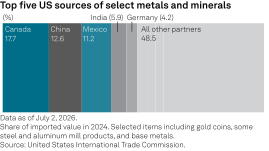
The US relies heavily on Canada and Mexico for metals imports. Canada supplied 70% of the US' primary aluminum imports in 2024, according to S&P Global Market Intelligence data, while Canada and Mexico combined accounted for 93% of US steel exports, according to the American Iron and Steel Institute.
The Steel Manufacturers Association supported the administration's decision not to renew the trade pact, Philip Bell, SMA president, told Platts in a July 1 interview. He called the 10-year review a "safeguard" that "doesn't introduce volatility."
"I don't think this does too much for the steel industry," Bell said. "I think we're still in a good spot."
SMA has advocated for better rules of origin and tougher rules governing North American melted and poured requirements. Bell also pushed to keep 50% steel tariffs under Section 232 of the Trade Expansion Act of 1962. There are also 50% Section 232 duties on aluminum.
"The 232s need to stay in place as long as they need to stay in place to accomplish two things: to prevent bad actors from transshipping, circumventing and breaking our trade laws, and then also to allow these enormous investments that American steel companies are making to modernize and make our steel industry more efficient," Bell said.
A senior administration official said on July 1 that any changes to these duties, which remain in effect despite the USMCA pact, would need to align with Trump's goals of reducing the trade deficit and reshoring manufacturing.
Still, Mexico and Canada, key US trade partners, would like to see the metals tariffs reduced or eliminated.
"There are issues that still need to be resolved: rules of origin, how the rules of origin will evolve, how we will verify the rules of origin, or the new provisions that the United States wants to propose," Marcelo Ebrard, Mexico's economy minister, said at a July 1 press conference.
Negotiations continue
The USTR's decision not to renew the USMCA marks another step in the negotiating process, AISI President and CEO Kevin Dempsey said in a July 1 statement to Platts.
"AISI appreciates the administration's continued engagement on these issues and we look forward to working closely with USTR and other stakeholders throughout the review process to ensure the USMCA is updated in a manner that reinforces resilient North American supply chains and supports a strong American steel industry and downstream steel-intensive manufacturing sectors," Dempsey said.
The Aluminum Association also said it will engage with policymakers as the review process moves forward.
"Our focus remains on strengthening North American trade enforcement, aligning regional tariff policies, improving rules of origin and preserving the free flow of aluminum scrap within North America," Katie Rosebrook, external affairs director at the Aluminum Association, told Platts.
Hadzismajlovic said he thinks USMCA negotiations will be a multi-year effort. While negotiations unfold, Hadzismajlovic said he worries about integrated supply chains for lithium, nickel, copper, rare earths and batteries.
"The USMCA, in my mind, has always been a defense against China because with these integrated supply chains, there was really no room for China to step in," he said. "What we're doing, here, is that uncertainty is probably giving them an opening."
