Metals & Mining
June 29, 2026
Myanmar's rare earths could serve as strategic hedge for India: experts

Editor:
HIGHLIGHTS
Myanmar among top dysprosium, terbium producers
Myanmar supplies 52.8% of China's imports
Infrastructure challenges delay supply plans
India could build flexibility in sourcing rare earths after recent talks with Myanmar, industry experts told Platts, though growing ties between the two countries are not likely to generate immediate new supplies.
India and Myanmar agreed to cooperate on trade and investment in mining following a meeting between Myanmar President Min Aung Hlaing and Indian Prime Minister Narendra Modi in New Delhi on June 1. The two nations did not sign a supply agreement, but they discussed collaboration on rare earths, Vikram Misri, India's foreign secretary, said in a same-day news briefing.
Like other nations, India is seeking to strengthen its own critical minerals supply chain and reduce dependence on China, which dominates the rare earths industry. Myanmar is a heavyweight producer, but any country looking to source Myanmar's critical metals must navigate infrastructure challenges, China's heavy influence and militant control in Myanmar's rare earths-rich regions, experts said.
Amid these complexities, engaging with Myanmar could allow India to bolster supply options — at least one day, experts said.
"Despite the challenges, dismissing Myanmar's rare earths would be shortsighted," Sreeparna Banerjee, associate fellow at the New Delhi-based Observer Research Foundation think tank, told Platts, part of S&P Global Energy.
"The mistake would be viewing Myanmar as a quick solution; it is better understood as a long-term investment in supply-chain diversification and strategic resilience," Banerjee added.
Rare earths giant
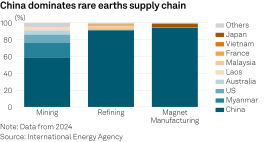
Myanmar is one of the world's largest mined producers of heavy rare earths, including dysprosium and terbium. These elements boost the performance of permanent magnets used in electric vehicle motors, wind turbines and advanced defense systems, according to the IEA. About 83% of global mined supply of heavy-magnet rare earths comes from Myanmar and China, IEA data showed.
Most of Myanmar's rare earths production is sourced from its northernmost Kachin state, which borders China. Kachin is partly controlled by the militant Kachin Independence Army (KIA), according to Volodymyr Berezhniy, founder and CEO of US-based critical-materials firm K66, and separate reports.
"Heavy rare earths are the hardest part of the chain to substitute, and Kachin is one of the few alternative geological sources at scale," Berezhniy told Platts.
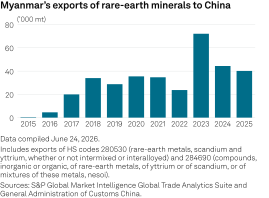
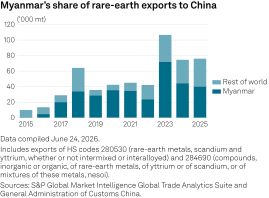
When the KIA seized control of Kachin's main mining towns in late 2024, China's heavy rare earths imports from Myanmar fell, according to Berezhniy. In 2025, Myanmar represented 52.8% of China's total rare earths imports, down from 59.5% in 2024, according to data from S&P Global Market Intelligence's Global Trade Analytics Suite. China had to negotiate with the KIA to regain access to rare earths from Kachin.
China has demonstrated its critical metals leverage by limiting exports. China accounted for 91% of the global rare earths refining capacity and 94% of magnet manufacturing in 2024, based on International Energy Agency data.
These Chinese restrictions have prompted India, the US and other nations to search for alternative sources and build a supply chain independent from Chinese influence.
Berezhniy said Myanmar's rare earths are worth pursuing as a hedge for India, but he noted that India does not currently have the capability to process them.
"For now, Myanmar is more useful as a strategic option in reserve than as a near-term supply solution," Berezhniy said.
India's processing ambitions
India shares a border with Kachin, though there are no existing transport links connecting them, and the area is mountainous terrain, Banerjee said.
Still, India is well-positioned to take advantage of rare earths opportunities in Myanmar, according to Cchavi Vasisht, associate fellow at the New Delhi-based Chintan Research Foundation think tank.
Bilateral cooperation also aligns with India's own goal to build out a rare earths industry. India aims to complete four mineral processing parks by 2030–2031 under its National Critical Mineral Mission launched in 2025.
Coordinating with both Myanmar's government and the KIA, in particular, makes sense if India wants to access more rare earths, Vasisht said. Even before the India-Myanmar agreement, India already engaged with the KIA over Kachin's rare earths, Banerjee and Vasisht said.
India's affiliation with the Quad Critical Minerals Initiative Framework along with Australia, Japan and the US could accelerate India's rare earths ambitions. Under the framework, the nations agreed to mobilize $20 billion in funding to advance eligible critical minerals projects.
While the US has imposed sanctions on Myanmar, the Trump administration previously evaluated proposals to access Myanmar's rare earths, according to a July 2025 Reuters report.
With support from the Quad, India could establish processing hubs in its northeast region near the border with Kachin, Vasisht said. The Quad could also help address environmental and social concerns linked to Myanmar's rare earths by launching responsible sourcing standards, Vasisht added.
India also maintains active diplomatic relations with Myanmar despite international concerns about Min Aung Hlaing.
Myanmar's president led the nation's military government following a 2021 coup and was inaugurated as president in April after an election that the UN criticized as undemocratic. He visited India in his first official foreign trip as president, signaling friendly ties between the two countries.
Infrastructure, compliance hurdles
Accessing Myanmar's rare earths is easier said than done. India needs to make massive investments in infrastructure that could take years to develop, according to experts.
"The scale of investment required will be both substantial and high-risk, particularly given Myanmar's own internal volatility and militia activity," Gracelin Baskaran, director of the Critical Minerals Security Program at the Center for Strategic and International Studies, told Platts.
Beyond logistics, prospective investors in Myanmar's rare earths sector could face compliance challenges.
"An original equipment manufacturer cannot qualify and audit a frontier militia as a tier-one supplier," Berezhniy said.
Despite these issues, India's outreach to Myanmar reflects a pragmatic approach to resolving vulnerabilities in the rare earths supply chain, experts said.
"This will not be a quick win, but [it is] worth pursuing given strategic interests," Vasisht told Platts.
Platts assessed dysprosium oxide at $2,100/kilogram CIF North America on May 29, up $100/kg from April 30. Terbium oxide was assessed at $4,700/kg on May 29, unchanged from April 30.
