Metals & Mining, Ferrous
June 25, 2026
US tariff proposal threatens Brazilian pig iron, risks hurting steelmakers

Editor:
HIGHLIGHTS
May raise US steelmaker input costs
Section 301 exemption decision is pending
Brazil supplied more than half of US pig iron imports in 2025
Higher US tariffs on Brazilian goods, including pig iron, would raise costs for US steelmakers and undermine the Trump administration's efforts to bolster the domestic steel industry, industry participants told Platts, part of S&P Global Energy.
On June 1, the Office of the US Trade Representative proposed a new 25% tariff on Brazil under Section 301 of the Trade Act of 1974,hitting all goods, after the US agency determined that some of Brazil's policies burden or restrict US commerce. Brazil could also be subject to a separate 12.5% duty under another Section 301 investigation tied toconcerns over alleged forced labor, which could stack on top of the 25%.
Pig iron was left off the exemption lists under both proposed duties, and some in the US steel industry worry this could undercut their operations. Brazil has been the leading exporter of the raw material to the US in recent years.
Now -- once again facing the prospect of higher pig iron costs -- the US steelmaking industry wants an exemption, as was the case under a previous tariff on Brazilian goods. And the exemption could still come, a steel industry leader and trade expert told Platts.
A 25% tariff on Brazilian pig iron "will cause anticompetitive harm to domestic steel producers that are currently making record investments to make the American steel industry more efficient and competitive," Philip Bell, president and CEO of the Steel Manufacturers Association, told Platts.
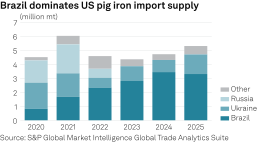
Although pig iron is an essential feedstock for US steelmakers, there is little to no domestic market. US companies that produce pig iron typically consume all their output, leaving other steelmakers to rely on imports, Bell said.
The US imported 3.3 million metric tons of pig iron from Brazil in 2025, accounting for more than half of the 5.3 million mt the US imported that year, according to S&P Global Market Intelligence's Global Trade Analytics Suite data.
SMA represents the US electric arc furnace steel industry. Over 70% of US steel production uses EAFs, which typically do not process raw iron ore, but can usea mixof pig iron and scrap.
The duty, if applied to pig iron, would also undermine the global steel tariff imposed by US President Donald Trump and his administration's overall efforts to revitalize the US steel industryby raising input costs for producers, Bell said.
In June 2025, Trump imposed a 50% steel tariff as part of his economic agenda to boost US manufacturing amid concerns by the US and the steel industry about the oversupply in the global market.
The protectionist move has dissuaded some US-based buyers from importing steel,raised US steel prices and allowed domestic steelmakers to increase their margins and win business.
Platts, part of S&P Global Energy, assessed the TSI US HRC EXW Indiana at $1,140/short ton on June 24, up 35.7% from $840/st on June. 3, 2025, before the US imposed its steel tariff.
New Brazil tariff not yet final
The USTR must still go through a public comment period before it can finalize its proposed action. The agency is currently accepting written comments on the proposed action, which will then be followed by a public hearing.
The US may not impose its newly proposed tariffs and could opt to suspend or adjust the action as has happened in past investigations, according to Greta Peisch, an international trade attorney at Wiley Law.
While 301 investigations typically take a year to complete, the final action isn't required to be implemented within that timeline, Peisch, a former general counsel at USTR, told Platts.
"It isn't the case that tariffs have to come into effect at a particular date as long as the report and the investigation is concluded and there is at least a sort of concluding action, even if that action is a suspension or further consideration of remedies," Peisch said.
US officials have met with Brazil's President Luiz Inácio Lula da Silva and his cabinet over the past year to address US concerns, but the governments have not yet been able to resolve the issues raised in the US investigation, US Trade Representative Jamieson Greer said June 1.
The USTR did not respond to a request for comment.
Meanwhile, the steel industry is confident that pig iron will be exempt from the new duty.
"We strongly believe that, consistent with its previous actions, the administration will refrain from increasing tariffs on pig iron above 10%," Bell said.
Impact on Brazil's pig iron sector
The proposed tariff would also deliver a major blow to the Brazilian pig iron sector.
Pig iron exports to the US accounted for about 83% of the 4.1 million mt of total pig iron Brazil exported in 2025, according to GTAS data.
Most pig iron exported to the US is produced in Sete Lagoas, Minas Gerais, Brazil, according to Alessandro Jacob, an international trade attorney at law firm Alves Jacob in Brazil.
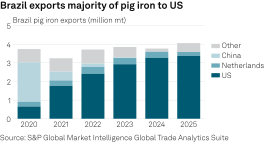
"A sector dependent on a single market cannot quickly replace that demand," Jacob told Platts. "The immediate effects would be margin compression, suspended or canceled US orders, and in some cases temporary production halts — exactly what happened in 2025 when the threat of a 50% tariff first appeared."
Trump levied a 50% tariff on Brazilian imports in 2025 as part of country-specific tariffs, but the US ultimately exempted pig iron from the duty. The US Supreme Court later struck down the tariffs in February 2026.
Now, Brazil's producers are hoping for another exemption, this time from the looming new tariff.
"Pig iron was carved out of the exemptions once before," Jacob added. "So, an exclusion is not out of the question."
Pig iron from Brazil currently faces a temporary 10% tariff, which is set to expire on July 24. Trump imposed a global 10% duty under Section 122 of the Trade Act of 1974 after the high court found Trump's country-specific tariffs unconstitutional.
Brazilian producers and industry groups are also seeking new markets, particularly in the EU and Italy, where carbon trade policies provide a competitive advantage for Brazil's lower-carbon products, according to Jacob.
