Metals & Mining Theme, Ferrous
January 12, 2026
Global steel industry battles surplus supply, protectionism
HIGHLIGHTS
India's steel output rises, China grapples with surplus
China's steel exports likely to hit new record in 2025
US tariffs reshuffle trade flows; Europe suffers
Metals Market Movers 2026: Metals markets are increasingly being shaped by policy as much as by fundamentals. This is the last of our 6-part series that explores how climate regulation, industrial policy, trade policy and strategic investments are influencing supply, demand and prices across steel, iron ore and critical minerals.
The global steel industry is facing multiple headwinds as protectionism becomes the norm amid excess capacity and trade policy uncertainty.
Steel production capacity expanded at its fastest rate since 2009 in 2025, exacerbating trade friction and depressing prices, as oversupply -- compounded by reshaped trade flows -- forces producers to seek new markets, prompting a proliferation of antidumping and safeguard measures globally.
Steelmaking capacity is expected to rise for a seventh consecutive year, reaching 2.55 billion metric tons by the end of 2025, according to the latest Organization for Economic Cooperation and Development steel report. Planned additions in Asia and the Middle East are expected to bring an additional 109 million mt of new capacity by 2028, reinforcing the world's structural overcapacity. The report pegged 2025 surplus capacity at 680 million mt.
India grows, China battles surplus
India is expected to produce an additional 11.4 million mt of crude steel in 2026, up from an estimated 154 million mt in 2025, according to the Steel Commodity Briefing Service data published by S&P Global Energy CERA in December.
"Excess supply has been weighing on prices, and the market needs new demand to absorb the surplus. Supply is expected to rise further as India works toward 300 million mt of capacity by 2030, and without adequate backing from domestic demand or exports, the market risks prolonged weakness," a Mumbai-based trader said.
From a 2025 high of Rupees 52,750/metric ton ($586/mt) assessed by Platts, part of S&P Global Energy, May 6, the spot cut-to-length price of IS2062, 2.5-10 mm thick HRC stood at Rupees 42,800/mt Dec. 26, down 18.9%.
The government aims to continue its steel capacity goals beyond 2030 and is eyeing 500 million mt/year by 2047, with the ambition aided by a proposed Rupees 50 billion ($570 million) initiative to promote the adoption of clean steelmaking technologies, which will leverage Europe's Carbon Border Adjustment Mechanism.
"The strength of domestic markets will all depend on the export volumes. With aggressive capacity expansion in India, mills will have to ship out the excessive quantities to hold the domestic market stable," another Mumbai-based trader said.
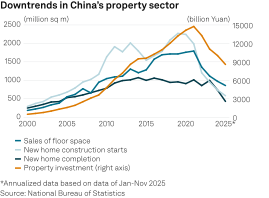
Meanwhile, China is contending with a steel surplus exacerbated by poor domestic demand and minimal efforts to reduce capacity.
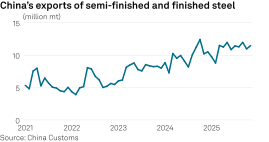
China's steel exports appear poised to set a record in 2025, continuing a trend of exporting in a bid to prevent inventory buildup. As a result, protectionism is likely to grow as countries with domestic steel industries implement antidumping duties and seldom-used safeguards.
Vietnam, which is leading the pack in Southeast Asia with steel capacity expansions, has launched an antidumping investigation into imports of wider-width hot-rolled coils from China as of late October. The probe followed Vietnam's imposition of antidumping duties in July on China-origin HRC with a width of less than 1,880 mm.
According to Yeoh Wee-Jin, secretary general of the South East Asia Iron and Steel Institute, steel overcapacity could lead to severe competition, adding that China's neighbors are the first to face the brunt of any export surge, and that US tariffs will result in trade diversions and circumvention of existing protectionist measures.
Tariffs reshuffle trade flows
The doubling of Section 232 tariffs to 50% in April is expected to further boost US domestic capacity utilization, reducing imports and increasing domestic output.
Benefitting from a buy US steel policy, strong trade protection and tariffs, the US steel industry has regained price competitiveness versus imports and has invested 8 million-9 million mt in new capacity. For instance, US Steel Corp. announced early November plans to invest $11 billion by the end of 2028 via a multiyear growth plan.
South Korea's Hyundai Steel and POSCO finalized plans in December to build a 2.7 million mt/year flat steel plant in Ascension Parish, Louisiana, over the first quarter of 2029. POSCO Holdings plans to expand into the US steel market, having signed a memorandum of understanding with Cleveland-Cliffs in October.
The US decision to raise steel tariffs to 50% has intensified Europe's challenges. EU producers are losing their remaining foothold in the American market while simultaneously absorbing deflected volumes that would have otherwise gone to the US.
Eurofer's latest Economic and Steel Market Outlook, published Dec. 2, maintains its downbeat assessment. Import penetration rose to 27% in the first eight months of 2025, up from 25% the previous quarter, reaching historic highs. The surge in imports -- driven by Turkey, South Korea, China, India, Ukraine, Taiwan and Indonesia -- underscores the pressure on European mills as global flows increasingly favor lower-cost producers.
"European steelmakers cannot yet see the end of the tunnel," said Axel Eggert, director general of Eurofer, commenting on the association's fourth-quarter outlook. He warned that the European Commission's new trade defence proposal, unveiled in October, must be adopted urgently and applied from early 2026, well before the existing safeguard regime expires in June. Otherwise, he said, "the ongoing stockpiling of cheap imports will continue and nullify the effectiveness of the measure for the entire year."
The EU plans to double the out-of-quota duty on imported steel to 50% from its current 25% rate, which is due to expire June 30. At the same time, import quotas on tariff-free steel will be reduced by 47% compared to 2024, to 18.3 million mt.
While capacity growth continues across Asia and Africa, Europe is moving in the opposite direction. Steel output in the EU-28 (including the UK) has plunged by 65 million mt since 2018 to just 126 million mt in 2024. Excluding the UK, EU-27 output has fallen to 129.7 million mt in 2024 from 185.2 million mt in 2008. Worldsteel data for January-October 2025 showed EU-28 production down a further 3.4% year over year to 105.7 million mt. The region shed 10 million mt of capacity in 2024 alone -- its steepest annual retreat on record.
It is still too early to conclude the winners and losers, but decarbonization has become collateral damage as overcapacity undermines investment. In Europe, for instance, steelmakers have put on hold the investment needed to decarbonize one of the continent's most carbon-intensive sectors.
Read the first story in the Metals Market Movers 2026 series here.
Read the second story in the Metals Market Movers 2026 series here.
Read the third story in the Metals Market Movers 2026 series here.
Read the fourth story in the Metals Market Movers 2026 series here.
Read the fifth story in the Metals Market Movers 2026 series here.
