Metals & Mining Theme, Ferrous
January 07, 2026
Europe's steel industry faces its 2026 reckoning with CBAM
HIGHLIGHTS
CBAM to impose carbon costs on imported steel
EU steelmakers face heavy decarbonization investment
Regulation overtakes demand as key driver of steel prices
Metals Market Movers 2026: Metals markets are increasingly being shaped by policy as much as by fundamentals. This is the third of our six-part series that explores how climate regulation, industrial policy, trade policy and strategic investments are influencing supply, demand and price across steel, iron ore and critical minerals.
For Europe's steelmakers, 2026 is the year when climate policy starts reshaping balance sheets. From January, the EU's Carbon Border Adjustment Mechanism transitions to enforcement, making carbon intensity a direct factor in trade competitiveness and steel pricing.
The mechanism is intended to prevent carbon leakage by imposing a carbon levy on the imported steel equivalent to the costs borne by EU producers under the EU Emissions Trading System. In theory, it levels the playing field with lower-cost suppliers in China, India and Turkey. In practice, it arrives at a time when Europe's steel industry is financially stretched and in the midst of transition, according to several European sources.
CBAM offers long-term protection from high-emission imports, but it coincides with the most capital-intensive overhaul the sector has faced in decades. Steelmakers are being asked to replace blast furnaces with electric arc furnaces and hydrogen-based direct reduction plants, which are central to Europe's decarbonization strategy. But cost and commerciality factors have led to most low-carbon projects being put on hold.
CBAM also coincides with the gradual withdrawal of free ETS allowances. From 2026, free allocations will be reduced by 2.5%, with the reduction rising to 5% in 2027 and accelerating thereafter, reaching nearly 50% by 2030 before the allowances disappear entirely in 2034, according to the EU CBAM legislation.
Executives warn that while the early cuts are modest, the combined impact of rising ETS costs and heavy capital spending risks constraining cash flow just as global competitors scale up their own low-carbon capacity.
CBAM is also being reinforced by a tightening of EU import safeguards as earlier WTO-compliant measures expire. Proposed replacements would significantly reduce tariff-free quotas and double out-of-quota penalties to 50%.
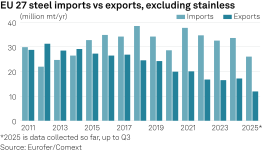
European market participants say the combination of CBAM costs and stricter safeguards removes the safety valve of cheap third-country supply that previously capped European prices.
Regulation may set the price floor
Heading into 2026, regulation is overtaking demand as the main driver of European steel prices. European flat steel mills are pushing offers higher despite subdued end-use consumption and thin spot liquidity. Automotive output has stabilized but has shown little growth, while construction remains weighed down by high borrowing costs and weak permitting.
Under normal market conditions, such demand would limit price increases. CBAM changes the equation. From January, benchmark emissions values and default carbon factors become a tangible cost, often eroding the apparent competitiveness of imported material, several buyers said.
Buyers added that attractive CIF offers frequently lose their appeal once carbon costs, administrative risk and financing are included.
Some importers said they are shifting toward delivered-duty-paid terms, transferring the CBAM risk to sellers. But the added cost is typically reflected in higher prices, narrowing or eliminating any discount to domestic steel. The result is a higher, regulation-driven price floor for flat products such as hot-rolled coil and plate, even in the absence of a demand-led recovery.
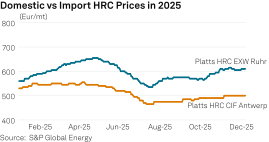
"Many foreign offers are now DDP with CBAM included, typically around Eur600-620/mt for HRC, which is broadly on par with domestic EU prices; this has largely eliminated the traditional import price advantage," a North Europe-based distributor source said. "Some traders have stopped quoting CIF/CFR altogether due to potentially very high default CBAM values," he added.
Downstream expansion
The regulatory impact on steel will not stop at semi, long and flat steel products. From January 2028, the EU plans to extend CBAM to around 180 downstream steel and aluminum products, including finished goods such as washing machines, car doors and kitchen equipment.
According to the European Commission, the expansion would increase CBAM revenues by 23% and generate around Eur500 million by 2030, reflecting the significant carbon content embedded in downstream manufacturing.
EU climate commissioner Wopke Hoekstra said Dec. 17 that the primary objective was to prevent carbon leakage further along the value chain, deterring companies from relocating manufacturing outside the bloc to avoid carbon costs.
"The aim is to avoid that, for example, washing machine production in Poland moves to just outside of the EU because of CBAM," he said.
The extension would also be accompanied by stronger anti-circumvention measures to combat trade fraud, including closer monitoring of trade flows and the use of country-specific carbon values where systemic avoidance is detected.
For the steel industry, the downstream expansion cuts both ways. On the one hand, it strengthens CBAM's protective logic by reducing the risk of demand shifting from EU-made steel to imported finished goods. On the other hand, it reinforces the concerns among manufacturers that carbon pricing is steadily permeating the entire industrial ecosystem, raising costs not just for steelmakers but for their customers as well.
A critical year
CBAM makes 2026 a potentially defining year for Europe's steel industry. The mechanism promises protection against high-emission imports and a clearer framework for decarbonization.
In the short term, however, it raises costs, tightens supply and risks pushing prices higher before sufficient volumes of affordable low-carbon steel are available.
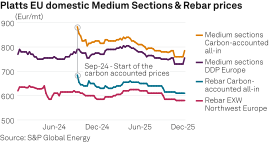
For downstream sectors — from automotive to construction — this means higher input costs and more complex sourcing decisions. Internationally, CBAM also carries political risk, with trading partners increasingly accusing the EU of climate-based protectionism.
Whether 2026 marks the start of a greener, more competitive steel industry or a prolonged period of strain may depend on execution. If CBAM is implemented smoothly and paired with adequate support for investment, it could buy Europe's steelmakers the time they need to adapt. If not, it may simply expose how hard the transition has become and how little room for error remains.
