Metals & Mining Theme, Ferrous
January 05, 2026
Iron ore industry challenges Simandou’s 'Pilbara killer' status
HIGHLIGHTS
High-grade ore expected to add flexibility
Supply uncertainty works in Pilbara’s favor
Impact on iron ore prices not seen until 2027
Metals Market Movers 2026: Metals markets are increasingly being shaped by policy as much as by fundamentals. This is the first of our 6-part series that explores how climate regulation, industrial policy, trade policy, and strategic investments are influencing supply, demand and price across steel, iron ore, and critical minerals.
Australian Pilbara iron ore is expected to maintain its competitive position in China's steel supply chain despite the imminent arrival of iron ore from Guinea's Simandou project, as logistical constraints and a gradual production ramp-up would limit the high-grade African ore's immediate market impact.
Simandou's high-grade iron ore (65% Fe content) is expected to arrive in China not long after Platts, part of S&P Global Energy, updated the baseline quality specifications of its IODEX iron ore benchmark to reflect 61% Fe iron ore fines from 62% effective Jan. 2, 2026, in view of confirmed degradation to the quality of Australian iron ore fines informing the assessment.
Simandou has been described by some as a "Pilbara killer" due to fears of the impact of its size and high grade on prices and demand for the lower-grade ore mined in Western Australia.
"Simandou's high grade will mostly be commercialized as a mid-grade blend, forming a direct substitute for Pilbara Blend and Vale 62%–63% fines," Kaan Peker, director of Australian metals and mining equity analyst at RBC Capital Markets, told Platts in a Dec. 3 email.
Hence, iron ore miners, particularly those in the Pilbara, which predominantly mine lower grades, "need to continue to push the quality narrative, where high-grade ores have quantifiable efficiency advantages," Peker said.
This strategy "encourages mills to prioritize quality, quantified by productivity and environmental benefit over headline discounting. The value-in-use (quality) battle will be fought on blend consistency," not just the percentage of iron ore, Peker said.
While Simandou is high grade, it "can vary in gangue," as opposed to the Pilbara ores, which "can deliver repeatability that mills use to stabilize the sinter bed," he added.
Rio Tinto operates both the Simandou project in Guinea and mines in Australia's Pilbara region. The company maintains that Simandou is a strategic diversification rather than a direct competitor to its established Pilbara operations.
Simandou complements Rio Tinto's Pilbara and Canadian portfolios, with portside blending options and strong connectivity to the current customer base, Matthew Klar, head of media relations at Rio Tinto, told Platts.
"Simandou adds another pillar that will provide the opportunity to expand our high-grade offering through BF (Blast Furnace) and DRI (Direct Reduced Iron) products at a time when the world needs to meet its decarbonisation goals," Klar said.
Vural Burç Çakır, founder and director of Africa Mining Community, echoed the same view, describing Simandou as "more of a diversification play than a disruptor."
"Given the current push toward lower-carbon steelmaking, I'd expect it to appeal both to blast furnace operators trying to reduce emissions and to the growing DRI/DR-pellet value chain,"
"I don't see it replacing or undermining the Pilbara blend but rather adding flexibility for customers who want to blend up quality or meet emissions targets," Çakır said.
Supply outlook uncertain
The Simandou iron ore property comprises four blocks of mining concessions split into two: Simandou Blocks 1 & 2 and Simandou Blocks 3 & 4. The Guinean government holds interests in both properties, along with Rio Tinto and a Chinese-led consortium.
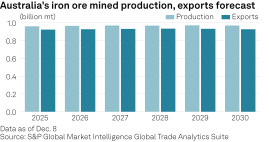
According to several Chinese mining and trading sources and estimates by S&P Global Energy CERA, iron ore shipped from Simandou was expected to reach 15 million-20 million metric tons in 2026 and 40 million-50 million mt in 2027. China's equity iron ore is likely to account for 17 million mt in 2026 and 35 million mt in 2027, a very small percentage of its total iron ore import volumes.
However, due to the current limited railway capacity from the mines to the port and low efficiency of barge transportation at the port, iron ore shipments from Simandou may struggle to reach 20 million mt in 2026, these sources added. The first shipment of Simandou ore was delayed before leaving Guinea's port of Morebaya Dec. 2 for Majishan in China's eastern province of Zhejiang.
The many and long delays also work in the Australian miners' favour.
"The insufficient railway capacity is the key reason for the slow iron ore shipments from Simandou. Due to a shortage of locomotives, the first shipment of 200,000 mt iron ore from Simandou took 22 days to complete loading," said a Chinese mill source. He added that a 200,000 mt bulk carrier typically requires only two to three days to load.
Besides logistics issues, there have been other delays over the past decade: investigations into alleged illegal payments, and Guinea's governing military junta halting activities to clarify how the country's interests will be preserved.
RBC now sees Rio Tinto's 30-month Simandou ramp-up plan to reach its 60 million mt per year capacity from the SimFer mine as "technically ambitious," according to a Nov. 28 note.
Rio Tinto flagged 5 million-10 million mt/year production for 2026 in a Dec. 4 strategy update.
RBC said that achieving a stable nameplate capacity in 48-60 months for Simandou is "more realistic," which means "meaningful tons" would only arrive in 2029, and will support "Pilbara margins relative to consensus."
The upshot of all this is that the Pilbara will be "killed later, if at all. A slower Simandou ramp delays displacement of existing high-grade supply and supports medium-term grade and lump premiums," RBC said.
Surplus in 2026 not enough to impact prices
China, the world's leading importer of iron ore, is expected to have a significant influence on future demand for the project. However, the primary concern in China now is the unusually sluggish domestic demand for steel. China's iron ore market has been in surplus since 2024.
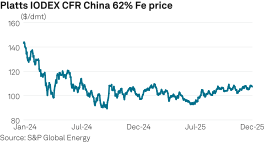
Iron ore prices have remained relatively solid in 2025, as China's strong exports of steel and steel-intensive manufactured goods have helped maintain resilience in its pig iron production.
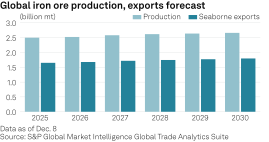
However, the iron ore oversupply is expected to rise from 2026, with particularly sharp growth from 2027 onward, as Simandou ramps up supply, according to China-based market participants. At the same time, China's steel demand and production are expected to remain in a downward trend in the years to come.
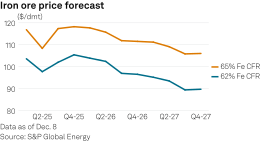
But given the uncertainty regarding Simandou volumes in 2026, sources expect limited impact on prices in the year.
"Even if Simandou's shipments can reach 20 million mt in 2026, our calculations suggest that the global iron ore supply surplus could be just around 10 million mt maximum next year, which is not considered as severe, and thus unlikely to have a significant impact on the iron ore market," a China steel mill source said.
"We think Simandou is likely to export around 15 million mt of iron ore in 2026. At these volumes, we don't expect any meaningful impact on iron ore prices next year as we think Chinese pig iron production may only decrease by around 1.5%-2% year over year. We see the IODEX averaging around $100/dmt in 2026," Paul Bartholomew, lead ferrous metals analyst of S&P Global Energy, said.
Platts assessed the 62% Fe Iron Ore Index at $108.5/dry mt CFR North China on Dec. 31, unchanged from the previous day.
Although market participants that Platts spoke to believe the commissioning of Simandou will not significantly increase oversupply in the iron ore market in 2026, and iron ore prices will only decline moderately next year, they stressed that iron ore oversupply could intensify noticeably in 2027 and onwards.
Based on a $106/dry mt forecast for December 2025, CERA analysts expected iron ore prices to fall by 16% to reach $89/dmt by December 2027. With an all-in sustaining cost in the range of $55-$60/dry mt, it could push some high-cost seaborne and domestic iron ore out of the market, they added.
