Metals & Mining Theme
January 09, 2026
US, EU to further intensify critical mineral investments as China tightens hold
By Rachel Looker and Euan Sadden
HIGHLIGHTS
Governments back private firms with equity stakes, financing
International partnerships formed to diversify supply chains
Metals Market Movers 2026: Metals markets are increasingly being shaped by policy as much as by fundamentals. This is the fifth of our 6-part series that explores how climate regulation, industrial policy, trade policy, and strategic investments are influencing supply, demand and price across steel, iron ore, and critical minerals.
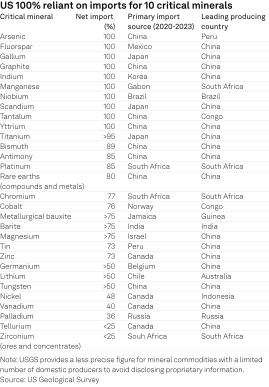
The US and EU are intensifying efforts to safeguard their critical minerals supply chains, with momentum poised to accelerate in 2026 as China's hold over most of the global processing capacity poses risks to national security and economic resilience.
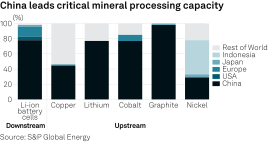
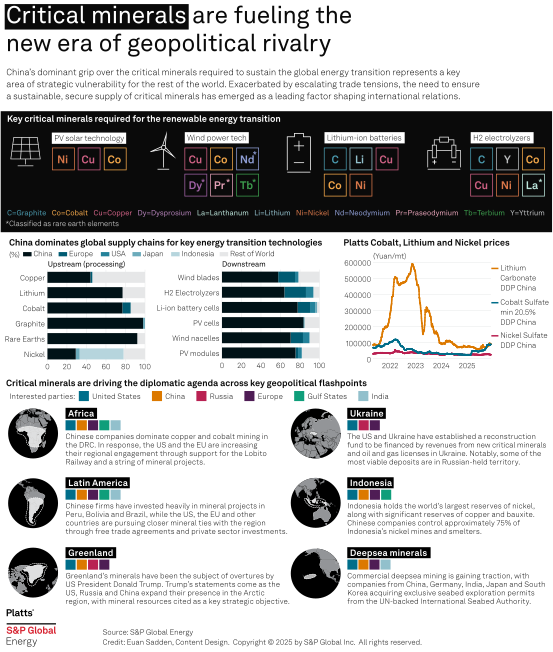
Chinese state-owned companies dominate the extraction and processing of critical minerals, giving Beijing control over the downstream manufacturing of high-end renewable technologies, including electric vehicles, photovoltaic solar panels, wind turbines and hydrogen electrolyzers.
US and EU policymakers have launched government initiatives in response, including diversifying their supply chains, establishing stockpiles, investing in private companies and expanding domestic processing and recycling capacities. These efforts seek to mitigate the risk of supply chain disruptions and price fluctuations as Beijing restricts critical minerals supplies for geopolitical leverage.
Government involvement is expected to accelerate in 2026 as recent restrictions on Chinese rare earths exports highlight vulnerabilities and drive the US and EU to reshape the global supply landscape, experts told Platts, a part of S&P Global Energy.
"What we're seeing globally is that the composition of mining companies is getting much more complex where you have a combination of government stakeholders, private equity, private investors and even capital from export and import banks," said Julie Klinger, a University of Delaware professor in the geography and spatial sciences program.
Government involvement and international partnerships
The US and EU have accelerated efforts to strengthen access to critical minerals through a series of strategic interventions over the last year.
In the US, federal agencies launched $134 million in investment opportunities for rare earths and obtained several equity stakes in private companies, including the formation of a public-private partnership between the US defense department and rare earths company MP Materials, which aims to build a secure, end-to-end domestic rare earths supply chain. The deal involved a $400 million equity investment, a $150 million loan and a 10-year offtake agreement.
"The administration is committed to safeguarding our national and economic security, and leaving no tool off the table to deliver on this priority of utmost importance," a White House official told Platts on Dec. 16.
The US energy department also invested in Lithium Americas, taking a 5% equity stake in the company to help finance the construction of a lithium carbonate manufacturing facility in Nevada.
"This feels very different because rather than saying, 'We're going to save a failing industry,' what seems to be the rationale for these is, 'Let's actually launch this industry,'" Beia Spiller, a critical minerals expert and director of transportation program at research nonprofit Resources for the Future, said of the government investments in private companies.
Government backing of critical minerals projects provides more credibility to projects and sustains long lead times, Jarrod Agen, the executive director of the White House's National Energy Dominance Council, said Dec. 15 at a Center for Strategic and International Studies' critical minerals event.
"I do think that from the federal government side, the funding mechanisms are working. You've seen announcements happening, I'm sure more announcements will come," Agen said.
In Europe, the EU ratified the Critical Raw Materials Act in 2024, which aims to enhance the EU's domestic capacities. The law stipulates that no more than 65% of the EU's annual consumption of any strategic raw material should come from a single third country.
The bloc in March 2025 also published a list of 47 strategic and critical minerals projects, accounting for an expected overall capital investment of Eur22.5 billion ($24.35 billion). Other actions include plans to mobilize up to Eur3 billion in funding over the next 12 months to fast-track strategic extraction and processing projects that could reduce EU import dependencies by up to 50% by 2029.
To date, the EU has established 15 critical minerals partnerships with resource-rich countries, such as South Africa, Namibia, Argentina, Chile and Canada, to bolster resilient supply chains. The bloc has also launched negotiations with Brazil, while deepening cooperation with Ukraine and the Western Balkans through the Global Gateway investment initiative.
Designed to facilitate closer trade links with respect to critical minerals, these agreements are also intended to lower the barriers to European investment in foreign critical minerals projects.
Countries seek international partnerships
Deals between countries may be more cohesive for building supply chains and creating structures that can protect markets, Spiller said.
In one example, the US and Australia signed a critical minerals framework that includes a $1 billion investment from both countries in financing critical minerals projects over the next six months.
Henry Sanderson, an associate fellow at the Royal United Services Institute, said that Australia is likely to play a key role in diversification strategies for both the US and EU, with agreements already signed for joint funding of rare earth and lithium projects.
"Australia is a big part of this diversification strategy for the US and the EU, with the US having already secured an agreement and the EU currently pursuing a deal," he said.
Spiller also pointed to the Critical Minerals Production Alliance, a G7 initiative involving member nations and several partner countries that aims to diversify and secure global critical minerals production and supply.
As part of the alliance, Canada announced $6.4 billion in new investments for critical minerals projects and partnerships, including offtake agreements with Rio Tinto PLC and Nouveau Monde Graphite Inc. for scandium and graphite. Canada's Office of the Prime Minister did not respond to a request for comment on future investments.
"I think these international deals are probably more interesting from securing a very reliable supply chain because they are broad and it's not choosing winners," Spiller said.
Governments are expected to further increase their involvement in the critical minerals space in 2026, experts told Platts.
"I think it's going to be on a much greater scale than we've ever seen. I think it's going to be much more invasive," said Karl Friedhoff, a senior fellow for Asia studies at the Chicago Council on Global Affairs.
Capital investments pose challenges
While funding helps kickstart projects, it doesn't address the long timelines required to construct mining facilities, Friedhoff said.
There is also uncertainty on whether investments will actually pay off over the longer term. Friedhoff pointed to Australian mining company Lynas Rare Earths, which is constructing a rare earths processing refinery in Texas. The defense department signed a contract with the company in 2023 to contribute $258 million for the project.
However, company executives indicated on a Nov. 25 earnings call that it is "unlikely that the proposed facility will proceed."
"It'll take quite a while, even with this unprecedented government investment, for US manufacturing to step in to have the capacity to fully meet the demand of firms within the US and North America more broadly," Klinger said.
Funding and speed are the biggest constraints to bringing new critical minerals capacity online, Chris Beatty, TechMet Limited's head of government relations and public affairs, said on Dec. 11 at the Atlantic Council's 2025 Critical Minerals Supply Chains Summit.
"I think it's really important work that's being done, however, we need to speed up and we need to scale up as fast as possible," the executive said.
The private sector applauded the Trump administration's efforts to roll out new and innovative tools to fund critical minerals projects, Beatty said. The US International Development Finance Corp. made an equity investment in the critical minerals company in 2020, which he said helped attract private sector investment.
"We're not intending to rely on public support for everything, but we need to get over the gap that has been existing in private capital markets," Beatty said.
