Natural Gas, LNG
July 30, 2026
Five months on: The Middle East War’s continued impact on Atlantic Basin LNG

Editor:
HIGHLIGHTS
Prices expected to remain elevated on tight global supply
No LNG vessels have transited the Strait of Hormuz since July 12
US exports increased by nearly 25% in H1 2026
The Middle East conflict continues to weigh on the Atlantic Basin LNG market as tight supply and elevated prices persist five months after the US and Israel launched military strikes on Iran on Feb. 28.
After the initial strikes, Platts DES NWE LNG prices surged 63% to $15.479/MMBtu on March 2, according to S&P Global Energy data, and have continued to increase, hitting a three and a half year high on July 22 at $20.746/MMBtu, a 24 cent/MMBtu discount to the Title Transfer Facility, the Dutch trading hub for natural gas.
The last time NWE prices reached these heights was on Jan. 9, 2023, when Platts assessed DES NWE prices at $21.675/MMBtu in the wake of the Russia-Ukraine war.
Since the beginning of the war with Iran, prices in the Atlantic Basin have been predominantly driven by three factors: the closure of the Strait of Hormuz, QatarEnergy declaring force majeure at its Ras Laffan LNG facility, and the increased inter-basin competition between the Atlantic and Pacific Basins.
The Strait of Hormuz
In retaliation to the initial strikes, Iran implemented an effective halt to tanker traffic through the Strait of Hormuz.
"Prior to the Middle East conflict, we could see an average of three laden LNG tankers per day (or about 90 laden tankers per month) exiting the Persian Gulf to markets predominantly in Asia," said Sara Pourghorbani, Associate Director of Global LNG analytics at S&P Global Energy CERA.
CERA calculated these crossings based on a monthly average prior to the outbreak of the conflict.
Traders said there have been no vessels traversing the Strait of Hormuz since the beginning of March, and voyages have been inconsistent since then.
"We have not observed any LNG vessel transiting since July 12, although it is possible that some vessels (laden or ballast) would attempt to cross in dark mode," Pourghorbani added.
"[Some companies] have put in halts from any attempt to cross because there have been confirmed fatalities and injuries to crew," an Atlantic Basin source said.
On July 6, a QatarEnergy-chartered LNG vessel, the Al Rekayyat was hit by strikes as it traveled through the Strait of Hormuz, according to S&P Global Commodities at Sea.
"After a brief recovery in LNG transit post Iran-US MoU, LNG shipping via the Strait came to a sudden halt when Iran attacked several tankers, including one LNG tanker (Al Rekayyat)," said Pourghorbani.
Aside from the physical danger, the threat of attack also pushed up insurance costs.
"I think lately what I heard was insurance cost[s] were stagnant and remained at very high level[s]. Especially with the escalation [seen last week]," said another Atlantic-based market participant.
"At one point it was 3%-10% of cargo value," the source said, which would be an additional 63 cents to $2.1/MMBtu, considering the Platts Japan Korea Marker assessment of $21.565 on July 30.
A third LNG trader said, "I've heard war-risk premiums have eased from the peak but are still elevated and very voyage-specific."
Ras Laffan
The Atlantic Basin market faced additional pressure after a drone attack on QatarEnergy's Ras Laffan LNG facility on March 4 and ensuing force majeure declaration.
More recently, on June 29, QatarEnergy extended its force majeure declaration for the fourth time on LNG deliveries to Italian counterparty Edison, the Italy-based group said.
At its peak, Qatar accounted for 32% of global LNG supply, according to CERA data.
Prior to the war in February 2026, Qatar exported 6.28 million metric tons of LNG, equivalent to 28% of global LNG exports.
There has been no update from QatarEnergy on when it would be able to resume exporting to its previous levels.
Asia's reaction
The loss of supply from Qatar has been felt most acutely in Asia, as it lost nearly a quarter of its LNG supply.
CERA data shows Qatar accounted for 24.7% of all LNG imports to Asia in 2025—equivalent to 67.5 million metric tons, or 909 cargoes.
Subsequently, Asia turned to the Atlantic Basin, primarily the US, to make up for the loss of supply.
Through July 30, Asia has imported 1.7 million mt of LNG from the US, accounting for about 17.3% of all US exports in the month, Platts data show.
In the first half of 2026, the US exported record volumes of LNG to counteract the loss of Middle Eastern supply. The US exported 65.9 million mt in H1, up nearly 25% year on year.
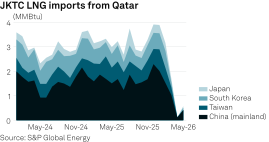
The loss of LNG volumes from Qatar has also impacted Europe, forcing it to compete with Asia and other importers for US volumes.
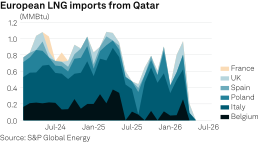
Europe has only imported 2.39 million mt from Qatar in H1 2026, compared to 5.4 million mt over the same period in 2025, according to CERA data.
The loss of supply from Qatar has kept NWE prices buoyant.
Platts assessed the DES NWE for September at $19.557/MMBtu on July 30, a discount of 23 cents/MMBtu to the September TTF hub futures price, down slightly from its recent high.
In Europe, Italy typically imports the largest volumes of LNG from Qatar. In July last year, Italy imported 280,000 mt or 21.9% of its total LNG imports from Qatar. However, not only Italy but no European countries have imported Qatari LNG in July 2026.
Another Atlantic Basin market participant said Qatari supply would be impacted for years.
"I expect Qatar will [only] be running at 75% capacity in 2027," the LNG trader said.
According to CERA forecasts, Qatar will export 6.3 million mt of LNG by January 2027.
The tight fundamentals are expected to continue and market participants do not expect prices to materially decrease as there is limited new LNG export capacity due to come online before 2027.
"It's the same story, whether there's peace talks or not, fundamentally the market is still tight, and we've lost so much supply," an LNG trader said.
"We are likely entering winter with such lower storage, LNG supply still lost and likely US-Iran will take much longer to solve than expected, it will take a while for flows to normalize," the source said.
