LNG
March 13, 2026
Force Majeure forces market shifts in European LNG market
By Megan Gildea and Aly Blakeway
HIGHLIGHTS
European LNG tightens as a result of Qatar force majeure
US running near capacity at 137% for Jan, 121% utilization for Feb
With force majeure declarations shaking up LNG supply, the fallout from the escalating Middle East war adds further uncertainty, pushing European traders to re-evaluate sourcing and pricing strategies.
QatarEnergy said March 4 it had declared force majeure on its LNG supplies to affected buyers, after having halted LNG production on March 2 amid military attacks.
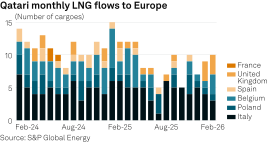
Qatar exported around 9.12 million mt , or 111 cargoes, to Europe in 2025, according to S&P Global CERA data. While this was down just over 18% on the year, it accounted for around 7% of European LNG imports in 2025.
Several companies with contracts with QatarEnergy subsequently received force majeure declaration notices, including Edison – for its LNG cargoes set to arrive from next month.
"You've got a few companies like RWE, Enel, Total, Naturgy, OMV, EDF, ENI who have contracts with Qatar... Some players in Europe will have to bid to replace these lost volumes. You already had Qatar give the FM to Orlen and Edison, so that's some extra cargoes of demand per month needed into Europe," an LNG trader said.
The force majeure events are putting upward pressure on European spot prices. Importers, faced with uncertain supply volumes, are willing to pay higher premiums to secure cargoes.
LNG-TTF spread changing flows
Given DES NWE prices have been trading either at a premium to or close to parity with TTF, many regasification slots in Europe have remained out of the money on a marginal basis, a much narrower discount to TTF erodes the incentive to buy LNG and sell as gas to Europe.
Prior to the war, DES NWE was at a $1.115/MMBtu discount to TTF on Feb. 27, according to Platts data. It flipped to a 50-cent/MMBtu premium on March 2, and was stands at a discount of 20 cent/MMBtu for April deliveries, as of March 11.
"The [LNG-TTF] spreads are tight though, so depending on your terminal with the regas costs it could be out of the money. It'd make more sense to backfill with pipeline than a cargo right now," a second LNG trader said.
As a result, traders said portfolio players have increasingly explored cargo swaps or diversions toward higher-priced markets where margins remain more attractive, since in many cases it may not be economical to take the cargo into your own slots and pay regasification costs with current narrower NWE-TTF discounts.
Another trader added: "if you can buy pipeline and not use your slot to backfill the volumes, it'd make more sense, a lot of us are in a wait and see mode, the gas-LNG spreads are super narrow, some of our slots aren't in the money but then you have some companies in the Atlantic buying up cheaper US FOB on spot to try help replenish the lost cargoes."
Should the LNG-TTF spreads narrow further, players with the capacity will look to divert cargoes to Asia and potentially backfill their positions in Europe with pipeline gas as current LNG-TTF spreads may see pipeline procurement as more economical in some hubs across Europe, traders said.
At least seven LNG cargoes have been directed away from Europe to Asia since the war in the Middle East began on Feb. 28, S&P Global Commodities at Sea data showed. Several of the diversions in the Atlantic are likely cargo swaps by US long-term contract holders rather than spot cargo sales, an Atlantic-based market analyst said.
Pressure on US supply
While the US LNG market is poised to help provide a buffer to the cut in supply from Middle East, producers in the US are running near capacity, traders said.
According to S&P Global CERA data, US liquefaction rates were running at 137% and 121% in January and February, respectively.
For January, this compares to 123% liquefaction utilization in 2025 and 119% in 2024, while for February, this compares to 120% utilization in 2025 and 108% in 2024.
Supply has continued to see ramp-ups, with the US exporting around 373 cargoes so far in 2026 versus the 308 cargoes in 2025 over the same period, CERA data showed as of March 13.
CERA data forecasts that the US will see exports increase by 18.43 million mt in 2026 versus 2025, a 16.51% year-on-year increase.
However, with plants running at near top rates, traders see few candidates in the US selling pool as able to ramp up exports.
"Venture Global has the most extra capacity to sell on spot, if they get rates where they requested to, they can have another 7 million tons added to their capacity of 27 million mt/year from Plaquemines," a European-based trader said. "You look this year so far, around 30% of exports were from VG and they've still got a lot of volumes to sell on spot, there have been buyers in the Atlantic bidding strongly to secure those extra cargoes to backfill any positions."
While players have been bidding to procure flexible FOB volumes from the US and West Africa, traders also said that companies in Europe have been taking a "wait and see" approach. As Europe enters the end of the winter withdrawal cycle and prepares for the summer injection season, companies are waiting to see how prices will react and how long global LNG supply outages will last.
"The market is factoring in when do we need to inject in Europe and how will we inject? You can see price reactions are shifting, more rises on winter than summer, so we're likely to delay injections but if spreads stay tight and the arb is open over summer then Europe will be trying to pull in all the extra gas and LNG it can," a Med-based trader said. "Players are just doing swaps or diverting cargoes right now to manage, some slots are not in the money so Europe is just waiting to see how long this all lasts and how much Asia will compete with us. If this lasts till April that's when we may see a bigger reaction and we'll have to fight for tons."

Editor: