Natural Gas, LNG
June 26, 2026
Golden Pass LNG exports third cargo as commissioning advances

By Corey Paul
Editor:
HIGHLIGHTS
Third LNG cargo signals Italy as destination
Feedgas flows rebound after maintenance work
Developer gets US FERC nod for Train 2 commissioning
Golden Pass LNG has exported its third cargo as commissioning progresses on the first of three liquefaction trains at Texas facility.
The QatarEnergy-chartered vessel Al Na'amah departed laden in the evening local time June 25, S&P Global Commodities at Sea data showed. The vessel was underway in the US Gulf on June 26, signaling Italy as its destination.
The Golden Pass developer, owned 70% by QatarEnergy and 30% by ExxonMobil, declined to comment June 26.
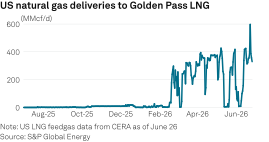
The resumption of exports from Golden Pass followed a sustained rebound in feedgas deliveries to the plant after weeks of planned maintenance.
Golden Pass was scheduled to receive about 330 million cubic feet/day of feedgas on June 26, according to S&P Global Energy CERA data, based on nominations for the morning cycle that could later be revised. Flows to the terminal have topped 300 MMcf/d since June 13 and hit the highest level to date of nearly 600 MMcf/d on June 23, after dropping to near zero during the maintenance work.
Overall, US feedgas demand was about 19.7 billion cubic feet/day on June 26, having recovered from mid-June following seasonal maintenance at multiple facilities, CERA data showed.
Feedgas deliveries to Golden Pass remain below full utilization levels for Train 1, which exported its first LNG cargo on April 22, about three weeks after it began producing LNG.
The operator confirmed taking Train 1 offline in mid-May to address startup-related maintenance, about a week after shipping the second LNG cargo from the plant.
Another ballast tanker arrived at Golden Pass on June 8 before departing with a draft suggesting it had not loaded cargo. Instead, the newbuild vessel may have lifted small volumes to cool down the ship on its maiden voyage, according to CERA analysts.
Golden Pass will be able to produce about 18.1 million metric tons/year when all three trains are fully online, and the facility's feedgas demand is expected to reach up to about 2.5 Bcf/d.
Train 2 timeline
The developer received permission from the US Federal Energy Regulatory Commission to begin commissioning work on Train 2 systems on June 24 (CP14-517).
Golden Pass is expected to begin producing LNG from Train 2 in the first half of 2027, according to ExxonMobil and construction contractor McDermott. Train 3 is expected to follow, with the possibility that the project could be ramping up production into 2028.
QatarEnergy and ExxonMobil are independently marketing their shares of supply from the project.
Commissioning activities at Golden Pass are progressing as global LNG prices remain elevated, although they have softened amid talks between the US and Iran aimed at easing Middle East tensions and restoring traffic through the Strait of Hormuz.
Platts, part of S&P Global Energy, assessed the August JKM benchmark price reflecting LNG delivered to Northeast Asia at $15.167/million British thermal units on June 26, down 10.10 cents/MMBtu day over day but still about 42% higher than prewar levels.
In the Atlantic, Platts assessed the DES Northwest Europe marker for August at $13.373/MMBtu on June 26, an increase of 1 cent/MMBtu day over day and about 35% higher than before the conflict.
