Natural Gas, LNG
May 26, 2026
Hormuz reopening unlikely to quickly unwind LNG supply backlog: lawyers

Editor:
HIGHLIGHTS
Backlog claims may extend into 2027 programming cycles
Supply reduced by 20 mil mt since conflict began: CERA
Chokepoint becomes foreseeable risk: lawyers
Middle East LNG exporters could spend years resolving contractual disputes and restoring missed deliveries after LNG tanker traffic through the Strait of Hormuz resumes, with a backlog of claims potentially affecting cargo programming well into 2027, contract lawyers have told Platts.
"A key question remains whether base volumes are restored first, or whether deferred and make-up volumes take priority," said Max Rockall, partner at Squire Patton Boggs, in an interview with Platts, part of S&P Global Energy. "There will be a backlog to deal with, including possible contested force majeure claims, rescheduling, restoration, and future cargo programming."
How deliveries are prioritized will depend on the wording of individual contracts, he added, noting that priority would likely be given to annual volume commitments under long-term contracts.
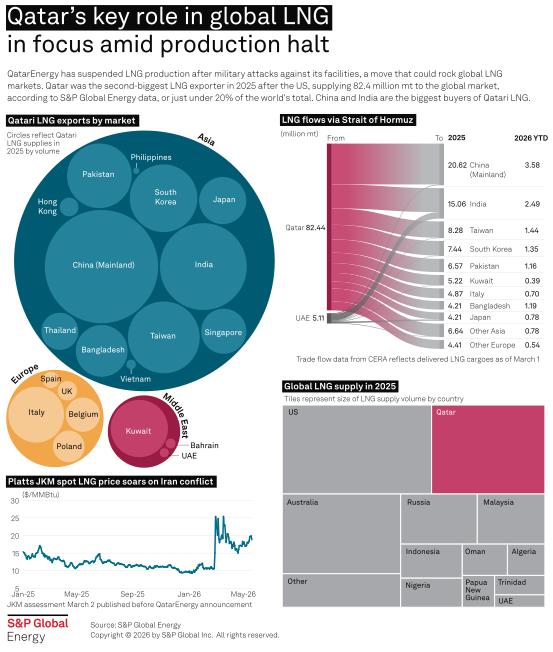
The comments come as the closure of the Strait of Hormuz approaches three months, constraining roughly 20% of global LNG supply.
"Most LNG SPAs contain an 'attribution' clause prioritizing base contractual volumes (the annual contract quantity), followed by make-up volumes, force majeure restoration volumes, and upward flexibility volumes, usually in that order," Patricia Tiller, partner at Bracewell LLP in Dubai, told Platts via email.
Since the Middle East conflict began, LNG supply losses from the UAE and Qatar have averaged about 90 cargoes a month, or about 6.4 million-8.2 million metric tons/month, bringing total lost volumes to date to roughly 20 million mt, S&P Global CERA data showed as of May 21. This compares with about 89 million mt of exports through the strait in 2025.
QatarEnergy declared force majeure on LNG supplies to affected buyers on March 4, after halting production at its Qatar export facility on March 2. Two liquefaction trains at the export facility were damaged and have previously been reported as requiring years to rebuild.
QatarEnergy did not respond to a request for comment on the matter.
Even with a full opening of the Strait of Hormuz from the start of June, CERA forecasts total losses from the overall Persian Gulf of 31 million mt in 2026, and a base case of a disruption through July estimates losses of 42 million mt, versus its pre-war outlook, according to Mehrun Etebari, senior principal analyst at CERA.
"Missed deliveries will affect base volumes and programming next year and potentially beyond, underscoring the scale of the challenge once operations resume," Sagar Gupta, associate at Squire Patton Boggs, said.
Restoring cargoes
In a contract-driven industry, lawyers said force majeure provisions remain central to how supply restoration unfolds.
Annual programming provisions in long‑term LNG contracts allow parties to reflect missed volumes when setting forward schedules, incorporating them into contract quantities or additional volumes subject to availability, lawyers told Platts.
Restoration quantities may also be addressed through an extension of the LNG sales and purchase agreement, Tiller said, noting that a long-stop date of up to five years is consistent with industry practice for such extensions.
In these discussions, "sellers are typically required to use reasonable endeavors to bring the force majeure to an end and to resume performance as soon as reasonably practicable," Rockall said.
Platts assessed the July JKM, the benchmark price for LNG cargoes delivered to Northeast Asia, at $18.121/MMBtu, up 13.2 cents/MMBtu day over day but still about 70% higher than before the conflict.
Contract language
"There are useful parallels here with the contractual evolution that followed the 2020 pandemic," said Humzah Yazdani, counsel at Gibson Dunn and senior research fellow for LNG at Tulane Energy Law and Policy Center.
"Before 2020, many force majeure clauses contained generic references to epidemics or pandemics. After COVID-19, however, the drafting became far more granular, often referring expressly to COVID-19, variants, government lockdowns, quarantine measures, supply-chain disruption and related public health interventions," Yazdani added.
"The current disruption has turned chokepoint risk into a concrete issue," Yazdani said. "Buyers and sellers are now likely to seek much greater precision around what happens when a critical maritime chokepoint is closed, restricted or becomes unsafe for LNG transit."
"New LNG SPAs involving deliveries exposed to potential closure of the Strait of Hormuz would potentially exclude that event from the definition of force majeure on the basis that it now constitutes a known and foreseeable risk," Tiller said.
