LNG
May 13, 2026
Limited uptick in Hormuz LNG traffic offers scant relief to global markets
By Matt Hoisch and Geraint Moody
Editor:
HIGHLIGHTS
Several LNG tankers have recently exited the Persian Gulf
Market watchers stress added supply is minor
Some see traffic as positive step but full reopening is key
The recent uptick in LNG tanker crossings out of the Persian Gulf is offering only limited immediate relief to international buyers grappling with the sustained loss of about 20% of global supply, market watchers told Platts, part of S&P Global Energy.
While a steady trickle of vessels has voyaged via the Strait of Hormuz since the start of the Iran war, LNG tankers have largely eschewed the transitway. No LNG vessels crossed Hormuz in March, compared, for instance, with 26 Very Large Crude Carriers across the month, according to data compiled by analysts with S&P Global's Commodities at Sea.
The count has since grown slightly, including the first transit of a Qatari LNG shipment on May 9. That tanker, the Al Kharaitiyat, was heading to Port Qasim in Pakistan, CAS data showed. It was shortly followed by a second Pakistan-bound LNG tanker transiting the strait around May 12, according to CAS.
Many ships around the strait have obscured their locations throughout the war, making a precise count of tanker voyages across the strait difficult.
All the same, market participants see limited impact from the recent crossings.
"Yes, Pakistan gets some supply, but the whole market is still short," one analyst with a major LNG buyer told Platts.
A second, Europe-based analyst similarly stressed that the added cargoes pale in comparison to the scale of the ongoing supply shock.
"The volumes at play are quite limited, so I don't think that could bring a substantial loosening of the physical market," the Europe-based analyst said.
Rather than piecemeal voyages, market watchers are monitoring for a more robust resumption of trade.
"Until we see [Qatari exports with] regular transit, I think the market will not show any [reaction]," a trader said.
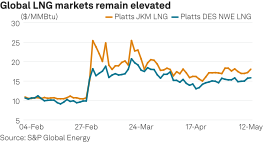
Global LNG indices have so far shrugged off the added volumes. Platts assessed the JKM benchmark for LNG cargoes delivered to Northeast Asia at $18.051/million British thermal unit on May 12, up 5% day-over-day. The index is roughly 69% higher than just before the war began in late February.
'A positive sign'
Still, some see the handful of recent LNG tankers transiting the strait as a promising step, even if it has yet to mark the sort of structural shift that would make a material difference to wider fundamentals.
"It's a positive sign," the Europe-based analyst said.
Anna Mikulska, Senior Vice President and Head of Analytics at US-based CGCN Group, also told Platts there may be broader geopolitical motivations for Iran to favor further LNG exports to some Asian buyers facing acute shortages of the super-chilled fuel.
"Tehran may have an incentive to allow LNG shipments to continue flowing in order to preserve goodwill with key Asian partners and, in doing so, strengthen its broader geopolitical position relative to the United States and the wider Western world," she said.
Ultimately, though, market participants continue to stress the key requirement to temper elevated prices remains the full resumption of maritime traffic to and from the Persian Gulf.
"The solution to the crisis is really just to reopen the strait without any restrictions," the Europe-based analyst said.
