Refined Products, Crude Oil, Electric Power, Energy Transition, Agriculture, Jet Fuel, Hydrogen, Carbon, Biofuels
October 20, 2026
INTERVIEW: SAF scale-up needs investor push, Dubai Airports CEO warns
By James Burgess and Thomas Washington
Editor:
HIGHLIGHTS
Aviation's green fuel push stalls on cost and scale
eSAF could be game-changer for sun-rich Middle East
Hormuz disruption causes minimal Dubai fuel issues
The head of Dubai Airports has warned that sustainable aviation fuel will remain a marginal energy source for the global aviation industry unless a major injection of capital into production infrastructure breaks a self-reinforcing cycle of high costs and weak demand.
Dubai Airports CEO Paul Griffiths told Platts in an interview that SAF currently accounts for barely 1% of global jet fuel consumption — which runs at around 7 million to 8 million b/d — and that the economics of scaling up production remain deeply challenging for an airline industry operating on thin margins and already facing soaring oil prices amid the US-Israeli war with Iran.
"The only way forward is to stimulate [SAF] supply," Griffiths said. "Don't start at the demand end, start at the supply end. The biggest single problem you've got to solve is the fact that there is inadequate supply of SAF to make even the smallest dent in global jet fuel demand."
His comments reflect growing frustration among airport operators and aviation sustainability advocates that policy fragmentation, feedstock constraints and the steep cost premium of SAF are preventing the fuel from gaining meaningful traction in global aviation trade flows, despite regulatory mandates in Europe and elsewhere.
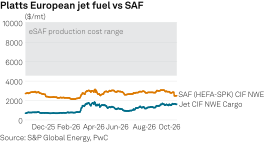
Platts, part of S&P Global Energy, assessed SAF, produced via the hydroprocessed esters and fatty acids pathway CIF Northwest Europe at $2,498.75/metric ton on Oct. 19, a 52% premium to jet fuel on an equivalent basis. The premium has shrunk from 176% on Feb. 27, before the US and Israel war with Iran boosted jet fuel prices.
Analysts at S&P Global Energy Horizons expect 60,000 barrels/day of SAF production globally in 2026, rising to 72,000 b/d in 2027 and 97,000 b/d in 2028.
Supply chain fix
Griffiths said only economies of scale can bring SAF costs down to parity with conventional jet fuel, and proposed assembling a financial consortium of capital partners to invest directly in SAF production infrastructure.
"We're not going to do this unless we produce SAF at scale, and you're not going to get investment in SAF at scale until you've got demand at scale," Griffiths said. "If demand is dependent on equalized pricing with jet A1, then you've got to invest in supply to [bring] the production cost down to the production cost of jet A1."
Griffiths leads the aviation workstream at the Sustainable Markets Initiative, a global private-sector organization for sustainable transition.
He outlined one potential mechanism to bridge the cost gap: blending SAF into conventional jet fuel at the airport level and spreading the cost premium across the entire fuel supply via a small surcharge on jet fuel.
Under a 10% blend scenario in which SAF costs twice as much as conventional fuel, the SAF premium would be distributed across the remaining 90% of the fuel supply, resulting in a modest per-unit surcharge for airlines, he said.
As blend ratios rise and production volumes increase, unit costs should fall, he added.
Griffiths acknowledged, however, that implementing such a scheme would require unanimity among fuel suppliers operating at any given airport, since SAF must be introduced into the shared fueling system rather than delivered separately to individual aircraft.
Securing that agreement in a cost-sensitive market would be difficult, he said.
Griffiths pointed to Singapore, Heathrow and Amsterdam Schiphol as airports that have moved furthest toward embedding SAF into their fuel supply chains — through passenger ticket surcharges, government-mandated blend targets and sustainability compliance requirements. But he expressed skepticism that consumer preference for greener airlines would be sufficient on its own to drive wider adoption, particularly given current market conditions.
On the policy side, Griffiths said the absence of a universal government mandate remained the central obstacle to investment in SAF production. He noted that EU policy and US policy were "diametrically opposed" — with the US incentivizing supply-side production without mandating consumption, while Europe had introduced consumption mandates without yet enforcing them.
"Unless more governments mandate this, the incentive to invest in the production of SAF isn't really there," he said.
He also noted that several airlines that had previously committed to SAF purchase policies and carbon offset programs had quietly abandoned those pledges "because they don't think that particular initiative is something that's economically sustainable."
At a 30% SAF blend ratio — a level that would make a material difference to aviation's carbon footprint — the cost premium would be so large that any airline absorbing it would become uncompetitive, Griffiths said.
Dubai and eSAF
At Dubai Airport itself, Griffiths said there were pilot SAF projects under way but no permanent SAF blend in the airport's aviation fuel supply, and no clear near-term pathway toward one. Conventional SAF production pathways, particularly the HEFA process, are constrained by limited feedstock availability in the region, he said.
However, Griffiths identified synthetic SAF — known as eSAF — as a potential game-changer for the Middle East, given the region's abundant solar energy resources. But eSAF, which is produced from renewable-powered hydrogen production and CO2, currently costs around 10-12 times the price of conventional jet fuel, and relies on immature, energy-intensive production technology, he said.
"The Middle East, with its abundance of sunshine, is probably very well placed for the development and production of eSAF plants to be undertaken in sufficient quality to make a difference to the fuel supply chain," Griffiths said. "But the technology is nascent technology. It's not very mature. It's incredibly inefficient in terms of the amount of power use."
He described eSAF as "the future, but probably not the immediate future," and said investment in photovoltaic energy generation was a prerequisite for making eSAF a viable commercial proposition in the UAE.
A challenge for eSAF is price; analysts at Energy Horizons forecast the levelized cost of eSAF at $7,720/mt in 2026, falling to $6,213/mt in 2030 and $5,152/mt in 2040.
On the impact of the Strait of Hormuz crisis on Dubai Airport's operations, Griffiths said the closure had not caused significant disruption to fuel supply, given the UAE's status as an oil-producing nation.
He warned, however, that a sustained period of high oil prices could weigh on aviation demand by making air travel more expensive. He said traffic at Dubai Airport had recovered strongly over the past six months following a period in which regional conflict had suppressed demand, and expressed optimism about a further rebound in October.