Refined Products, Agriculture, Energy Transition, Jet Fuel, Biofuels, Renewables
October 02, 2026
INTERVIEW: Geopolitics reframes SAF as strategic asset, not just green fuel: Vopak

Editor:
HIGHLIGHTS
EU traceability rules seen restricting Rotterdam-Schiphol flows
Dutch HBE scheme drives localized voluntary SAF blending
ReFuelEU review should tackle logistics bottlenecks
Geopolitical instability has recast sustainable aviation fuel as a strategic energy security asset, beyond being a clean fuel transition, but fragmented EU pipeline regulations are hampering supply chains, an official at storage firm Royal Vopak said.
Higher conventional jet fuel prices driven by global instability have shifted the industry's perception of SAF, elevating it from a green-transition instrument to a tool for national and regional fuel autonomy, Nikki Schutte, senior vice president for business development in the Netherlands at Vopak, told Platts, part of S&P Global Energy, in an interview Oct. 2.
"Geopolitical instability has driven conventional jet fuel prices higher and transformed the role of SAF," Schutte said. "It elevated energy security, shifting the view of SAF from purely a green fuel to a strategic asset for fuel security."
Platts assessed jet fuel cargoes on a CIF basis in Northwest Europe at $1,603.5/metric ton Oct. 1, up 93% from Feb. 27, before the war in the Middle East upended jet fuel trade flows. Platts assessed SAF on an equivalent basis at $2,903.25/mt, up 27% over the same timeframe. The spread between jet and CIF has narrowed from 176% before the war to 81% Oct. 1, Platts data showed.
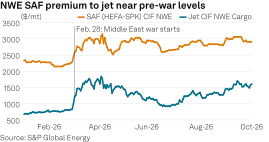
While the end goal remains the broad adoption of clean fuels, the geopolitical landscape has accelerated the transition by framing SAF as a security tool rather than just a sustainability one, Schutte said.
Global SAF demand is forecast to reach 80,000 barrels/day in 2027, up from 62,000 b/d in 2026, driven by higher demand in the UK and Asia, analysts at S&P Global Energy Horizon said Sept. 7.
Policy remains the main driver of SAF adoption, with uneven ambitions at the regional level, Ina Chirita, associate director, biofuels analytics at S&P Global Energy, said on a webinar Sept. 30. "Although the Strait of Hormuz has created the incentives for more biofuels blending in general, we have not really seen this facilitating a higher adoption of SAF," Chirita said.
Logistics bottleneck
Despite strategic momentum, critical regulatory friction within European pipeline infrastructure risks undermining the scale-up, Schutte said.
One issue is the Central Europe Pipeline System, or CEPS, the NATO-operated multi-connected pipeline network linking major fuel import hubs, including Rotterdam, to key aviation centres such as Amsterdam's Schiphol Airport. Differing interpretations across EU member states of how SAF deliveries into CEPS should be treated are creating a critical choke point.
"Current European rules on traceability in multi-connected pipeline systems, such as NATO's Central Europe Pipeline System, restrict efficient transport from primary import hubs like Rotterdam to major aviation hubs like Schiphol," Schutte said. "Different member states interpret delivery into CEPS differently."
Vopak advocates a book-and-claim approach within logistics networks as the most operationally and commercially effective solution. Under such a system, the sustainable attributes of a fuel — such as its carbon-reduction credentials — would be decoupled from the physical movement of molecules, allowing supply and demand to be matched administratively rather than requiring SAF to physically travel to each specific point of use.
This approach would deliver three concrete benefits, she said. These are eliminating inefficient physical routing to hubs where SAF is available; enabling economies of scale by allowing blending in larger volumes at major hubs, thereby lowering overall transport costs; and streamlining accounting processes while preventing double-counting of sustainability credits.
"To keep clean fuels affordable and flowing, regulatory rules need full harmonization within the EU and therewith acceptance of at least mass balancing across pipeline networks," Schutte said, adding that for CEPS entry specifically, this means "decoupling administrative traceability from physical molecule tracking."
The ReFuelEU Aviation regulation requires SAF to account for 2% of aviation fuel supplied at EU airports from 2025, rising to 70% by 2050.
Mandate momentum
Despite the regulatory complexity, Vopak's own experience in the Netherlands points to strong underlying demand when the right incentives are in place. In 2025, driven by national incentive schemes known as HBEs — Hernieuwbare Brandstofeenheden, or Renewable Fuel Units — the Netherlands recorded voluntary SAF blending volumes that significantly exceeded the volumes required under the ReFuelEU mandate, Schutte said.
The broader market will ultimately be mandate-driven, with voluntary uptake remaining a localized and secondary force, Schutte said. "Long-term regulatory stability is a non-negotiable prerequisite for developing physical supply chain infrastructure, and even more important to ensure producers and end-consumers will invest in the new SAF production technology. Shifting target lines creates market uncertainty that halts investment decisions right when infrastructure needs to scale," she said.
The European Commission had made its decarbonization trajectory clear, and proposals such as the 2027 revision of the EU Emissions Trading System reaffirm that aviation decarbonization remains a top policy priority, she said.
"While we recognize the gap between ambition and current production levels, the upcoming review of ReFuelEU Aviation should also focus on resolving logistical bottlenecks and setting realistic operational rules," Schutte said.
