Agriculture, Refined Products, Energy Transition, Biofuels, Jet Fuel, Renewables
September 24, 2026
INTERVIEW: DHL sees sharp SAF price gap between voluntary and compliance markets

Editor:
HIGHLIGHTS
Compliance SAF costs 2-3x voluntary market prices: DHL
California leads on incentives, Asia lacks policy support
Book-and-claim credibility key to scaling SAF demand
Europe's sustainable aviation fuel mandate has resulted in a two-tier market, with compliance markets commanding a significant premium, an official at DHL told Platts Sept. 24.
The compliance cost passed through by fuel suppliers under the EU's SAF mandate is running at two to three times the price achievable in the voluntary market — sometimes at the same airport and from the same supplier, Tim Lederer, vice president of global aviation regulatory affairs and fuel at DHL, said in an interview.
"It's not a market, you're just being hit with the price," Lederer said. "And you don't even have an option not to pay."
Europe's RefuelEU Aviation regulation requires a 2% SAF blend from 2025, rising to 6% by 2030, with the compliance obligation on fuel producers rather than end users. The voluntary markets cover optional mechanisms driven by corporate sustainability commitments.
Platts, part of S&P Global Energy, assessed SAF, produced via the hydroprocessed esters and fatty acids pathway, on a CIF basis in Northwest Europe, at $2,922.75/metric ton Sept. 23, 85% costlier than $1,576/mt for jet fuel cargoes on an equivalent basis.
Regional divergence
Pricing also varies across regions. The US — and California in particular — is the most competitively priced SAF market globally, driven by state and federal incentive frameworks, Lederer said. Europe sits in the middle of the global price range, partly cushioned by emissions trading system allowances that reduce net SAF costs. Asia is currently the most expensive region, despite rising production, due to an almost complete absence of policy incentives, Lederer said.
Platts assessed HEFA SAF on a FOB basis at Singapore at $2,465/mt Sept. 23, compared to $2,908/mt for SAF on an equivalent basis at Flushing-Amsterdam-Rotterdam-Antwerp-Ghent and 1,066.137 cents/gal in California, equivalent to $3,706/mt.
"European SAF and Asian SAF and US SAF, whilst it's all the same product, at the moment it comes at a very different price point in the market," Lederer said. "And that tells you something about regional scalability."
China is rapidly expanding SAF production capacity, but cautioned that volume and competitive pricing are not the same thing without demand-side policy support, Lederer said.
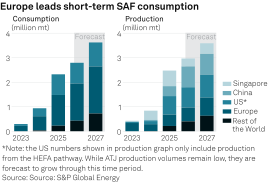
Global SAF demand is forecast to reach 66,000 b/d or 2.79 million mt in 2026 and 3.62 million 2027, driven by higher demand in the UK and Asia, analysts at S&P Global Energy Horizons said Sept. 7. Amid this, Europe leads consumption at a forecast 1.518 million mt in 2026, with the US at 844,000 mt and the rest of the world at 427,500 mt, according to data from Energy Horizons.
On the production side, European output in 2026 will be 564,000 mt in 2026, US output will be 828,000 mt, with China and Singapore combined at 1.173 million mt, Energy Horizons said.
Beyond mandates
DHL's own procurement figures illustrate how far the company has moved beyond mandate-driven purchasing. DHL procured 185,000 mt of SAF for its Scope 1 emissions in full-year 2025, with 97% sourced through voluntary agreements, Lederer said. The company achieved a 10% SAF sub-blend rate — a figure Lederer described as industry-leading. Industrywide, SAF production is expected to reach around 2.4 million tonnes in 2026, representing just 0.8% of aviation fuel use, the International Air Transport Association said June 6.
DHL holds active SAF supply agreements at 19 airports globally. Fixed-price contract structures have largely insulated the company from the jet fuel price volatility seen elsewhere, while HEFA-pathway SAF prices have trended downward over the past three years as supply availability has grown, Lederer said. On power-to-liquid fuels, which face a dedicated EU sub-mandate from 2030, there is scope for caution, Lederer said. Insufficient projects had reached financial close to give confidence that the target could be met, he said.
DHL's customer-facing GoGreen Plus product, which allows shippers to co-fund SAF procurement on a book-and-claim basis, now has approximately 570,000 active subscribers, Lederer said. Every euro generated is reinvested into additional SAF purchases, providing certified Scope 3 emissions reductions to corporate customers, he said.
Full recognition of book-and-claim under the Greenhouse Gas Protocol remains outstanding, but registry-based systems — including ISCC, Avelia and RSB — provide sufficient credibility to scale now, Lederer said.
