Fertilizers, Chemicals, Energy Transition, Renewables, Hydrogen
May 29, 2026
FACTBOX: Asia-Pacific bets big on renewable hydrogen as deals, infrastructure, prices align
By Ruchira Singh, Vipul Garg, and Mark Astley
Editor:
HIGHLIGHTS
Energy supply shocks push clean fuel shift
Deals signal early hydrogen trade flows
Costs start to drive market optimism
Asia-Pacific could become a key driver in commercializing low-carbon hydrogen and its derivatives, as firm supply agreements, emerging infrastructure buildouts, and low production costs signal the region's ambition to anchor the future global clean fuel trade.
The region hosts about 795 projects with a combined projected capacity of about 35.20 million metric tons/year, including renewable-derived and fossil fuel-based hydrogen with carbon capture, according to S&P Global Energy's Hydrogen Production Assets database.
The Middle East conflict could accelerate a structural shift, with the transport, power, and industrial sectors increasingly pivoting toward renewables and low-carbon hydrogen -- a transition already beginning to take shape across the region, Nobuo Tanaka, chair of the steering committee of the Innovation for Cool Earth Forum and former executive director of the International Energy Agency, has said.
"The oil shock will certainly push Asian countries into the more energy-efficient model of economic growth," Tanaka said.
Below are select facts on Asia-Pacific's emerging renewable hydrogen and ammonia infrastructure, trade flows, and prices.
Infrastructure
- Chifeng, Inner Mongolia, an emerging hub of renewable hydrogen/ammonia projects, is expected to connect to northeast China, from which seaborne exports can be made to Asia and Europe, according to Frank Yu, Envision Energy's senior vice president, hydrogen marketing and sales product line president.
- India's Pudimadaka, a 60-acre renewable hydrogen hub in Andhra Pradesh led by NTPC Green Energy, expects to start the first plant by 2029, with 2.5 million mt/y of low-carbon fuels such as renewable ammonia, methanol, and e-SAF on the cards, targeting Europe and Asia.
- A 3,500 mt capacity gas carrier, An Shun Yuan, which called at Lianyungang Feb. 16-18 and Dalian Feb. 19-21, arrived at Ulsan in South Korea Feb. 26 to deliver renewable ammonia from Envision Energy to Lotte Fine Chemical, according to the companies and data from the S&P Global Maritime platform.
- Japan's Kawasaki Heavy Industries and Japan Suiso Energy have signed a contract to build a 40,000 cubic meter liquid hydrogen carrier, marking a move toward establishing a commercial-scale hydrogen supply chain.
- Western Australia hosts InterContinental Energy's 1.6 million mt/y renewable hydrogen hub -- the Australian Renewable Energy Hub in the Pilbara -- and the 5 million mt/y Western Green Energy Hub in the Goldfields region.
Trade flows
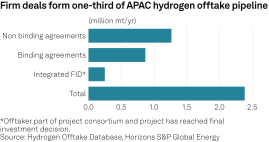
- L&T Energy GreenTech has signed a long-term agreement with Japan's Itochu Corp. to supply 300,000 mt/y of renewable ammonia from Kandla, Gujarat, on a captive, take-or-pay basis, with the first output expected in 2029.
- India's Reliance Industries said in April that it is likely to have more renewable ammonia export deals following the 15-year supply agreement with South Korea's Samsung C&T starting 2028-29.
- AM Green Ammonia has signed a binding deal with Germany's Uniper for up to 500,000 mt/y of renewable fuel of non-biological origin-certified renewable ammonia supply starting 2028 from a 1 million mt/y plant in Kakinada, Andhra Pradesh.
- Japan's Ministry of Economy, Trade and Industry said in December 2025 that it certified two ammonia projects developed by JERA and Mitsui as part of the country's ongoing Yen 3 trillion ($19.6 billion) hydrogen price-gap subsidy plan.
- China's Envision Energy signed a binding sales agreement to supply Japan's Marubeni with renewable ammonia from its Chifeng project, according to a May 2025 report by the renewable hydrogen developer.
- In 2024, Korea Power Exchange opened a 6,500-GWh, 15-year tender under its Clean Hydrogen Portfolio Standard for power production using low-carbon hydrogen, picking Korea Southern Power Co. as the preferred bidder, with a capacity of 750 GWh/y.
- A demonstration voyage by the world's first liquid hydrogen carrier, Suiso Frontier, in February 2022, from Hastings, Victoria, Australia, to Kobe, Japan, proved that an international liquid hydrogen supply chain could enable large-scale trade in the environmentally friendly fuel.
Prices
- Platts, part of S&P Global Energy, assessed the India renewable hydrogen term contract at $3.19/kg as of May 18, mostly unchanged from a month earlier.
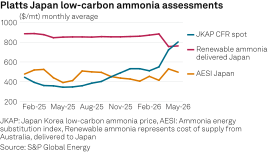
- Platts assessed Australia renewable-derived ammonia delivered to Far East Asia, with high-capacity factors, at $761.71/mt on May 25, down 0.5% from a month earlier.
- India's government-conducted domestic renewable ammonia auctions, which concluded in August 2025 at a weighted-average price of around $604/mt, have set a new price point for global trade.
- India's renewable hydrogen prices reached a new low in February, as NeuEn Green Energy won Numaligarh Refinery Ltd.'s tender at Rupees 279/kg ($3.08/kg), excluding taxes.
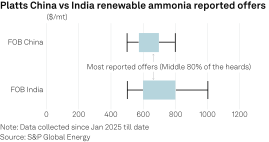
- The FOB India renewable ammonia price has been mostly reported between $600/mt and $650/mt for Asian markets, while for the European market, the RFNBO-compliant price has been reported close to $700/mt, according to Platts heards data.
- The FOB China renewable ammonia price has been reported around $600/mt, Platts heards data showed.
- The gap between Platts' Japan AESI and the JKAP assessments illustrates the price support required to encourage uptake of low-carbon ammonia by power generation companies.
- The gap between Platts' renewable ammonia delivered to Japan and JKAP closed as a result of the gas price escalation due to the conflict in the Middle East.