Energy Transition, Emissions, Carbon, Renewables
September 22, 2026
PATH TO NET ZERO: Sustainability now support actor in EU energy security play
By Camilla Naschert and Alex Blackburne
Editor:
HIGHLIGHTS
Utilities seek government investment support
Power demand to surge 65% by 2050
This is the second in a multi-part series on net-zero efforts across industries. The first part can be found here.
European utilities are now navigating a policy paradigm shift as energy security takes center stage, with market observers pointing to stronger government support to unlock further investment in renewables.
Most European utilities in Platts' annual survey of net-zero targets held on to their commitments this year.
But with the European Union facing financial constraints and security imperatives, security of supply and affordability are taking priority over strict 2040 climate targets, analysts at S&P Global Energy said.
"My view is that Europe's trajectory is unaltered, but the packaging has moved away from sustainability to resilience and security of supply," said Coralie Laurencin, director of European gas, power and carbon policy at S&P Global Energy CERA. "Since Europe has very limited oil and gas resources, the plan is to boost renewables and electrification, which will conveniently achieve sustainability as well as resilience."
That said, analysts at S&P Global Energy expect that Europe will not meet its emissions targets for 2030, 2040 or 2050. Still, emissions will continue to fall quickly given a profound transformation of the energy system, and by 2050 will have fallen 70% compared with 1990, Laurencin said. "It's likely the EU will be the leader or one of the leaders in emissions reduction."
In July, the European Commission proposed a substantial redesign of the EU Emissions Trading System (ETS), slowing the pace of emissions reductions beyond 2030, delivering €6 billion in additional free permits to manufacturers, and introducing controlled access to carbon removals and international credits while deploying more than €100 billion toward industrial decarbonization through a new financing instrument.
Electrification helps net-zero
Utility executives have reflected on the political messaging in recent conversations with investors and journalists.
"The energy security and affordability backdrop in Europe is stronger than I have seen at any point in time," Rasmus Errboe, CEO of Danish wind developer Ørsted A/S, said Aug. 14.
Ørsted is set to bid in offshore wind auctions across various markets, including Germany, the Netherlands and the UK, in the coming year, the executive said.
"Renewables will always be the foundation," Markus Krebber, CEO of Germany's RWE AG, told reporters at a press conference Aug. 13, when asked whether the EU policy emphasis on security of supply could delay net-zero progress.
"The trend of the general electrification will actually help us" with net zero, the executive said.
While electrification has been a political buzzword, tangible support from governments across Europe has been limited due to stretched fiscal resources, said Sylvain Cognet-Dauphin, executive director in the European power market analysis team at S&P Global Energy.
"Utilities are caught in the middle" when it comes to investments in new generation, Cognet-Dauphin said, noting that investments require higher power prices or government support.
"Utilities have to navigate a very complicated policy environment — what they can do is build up their lobbying teams and tell governments, 'This is what you should be doing,'" the analyst said. "Right now, 99% of investments rely on government support."
The recent hike in gas prices due to tensions in the Middle East has benefited utilities and raised most European utilities' second-quarter results, beating analyst expectations.
"More money is coming in, but that doesn't mean people will invest without government support," Cognet-Dauphin added.
It is also against that backdrop that many utilities are seeking further exposure to regulated markets via grid investments, a trend that is intensifying M&A appetite for network assets.
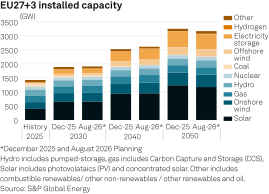
Still, by 2050, European renewables capacity will double from 2025 levels, analysts wrote in their European Long-Term Power Outlook report Aug. 14.
Storage will play a greater role in providing grid flexibility, and wind will become the largest power source by midcentury, reflecting higher capacity factors than solar PV.
Power demand outlook
Analysts at S&P Global Energy estimate European power demand to grow 65% by 2050. This is a correction from the researchers' December 2025 forecast, reflecting reduced expectations for industrial power demand and slower deployment of green hydrogen.
Increased electrification will support growth, and data center power demand will also grow in Europe, they noted. Further upside could come from higher cooling demand in summers, should extreme heat become the norm.
Power demand from data centers will grow fivefold in Europe to 2050, the analysts expect, accounting for 11% of total demand growth. The largest markets are Germany, the UK and France.
Utilities like Germany's RWE are positioning themselves to capitalize on the rapid growth of AI data centers.
While data center power demand, especially in the US, is outpacing renewables deployment, tech companies are holding on to their net-zero targets, RWE's Krebber said.
"I need power quickly now, and then I will decarbonize later," he characterized their thinking.
For tech companies looking to build data centers in Europe, there will likely be more pressure to use decarbonized electricity, Cognet-Dauphin said, adding that electricity is already about 70% decarbonized.
Susan Dlin contributed to this article.
