Energy Transition, Electric Power, Agriculture, Coal, Natural Gas, Carbon, Emissions, Food, Renewables
September 21, 2026
PATH TO NET-ZERO: Two-thirds of top US utilities cancel or fall behind targets

By Karin Rives
Editor:
HIGHLIGHTS
Rising electricity demand complicates goals
Emissions increase after years of decline
This is the first in a multi-part series on net-zero efforts across industries.
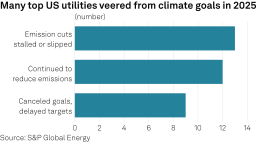
As atmospheric carbon dioxide levels reached another high in 2025, a majority of the 30 largest US electric utilities relaxed or withdrew their net-zero goals.
One power company canceled all its emission reduction targets, while others lost ground on reductions already achieved, according to an annual survey by Platts, part of S&P Global Energy.
The shift in the US power sector marks a major departure from the climate ambitions most companies expressed a few years earlier and comes amid major policy and market changes.
"We are shifting our 2030 goal not because we believe we can't achieve it, but because doing so would put an unacceptable cost burden on our customers," Xcel Energy Inc. explained in its 2025 sustainability report after canceling its goal to reduce companywide emissions by 80% by 2030. "The responsible pathway requires more time to get there. Our destination hasn't changed, but the pathway must evolve."
American Electric Power Co. Inc. (AEP), the fifth-largest publicly traded US electric utility by market cap, adopted a new strategy in 2025 to serve differing energy policies and customer priorities within its 11-state service territory as demand for electricity soared.
The company canceled all its climate goals to instead pursue an "all-of-the-above approach" to balance economic growth, reliability and affordability with state-specific objectives, according to company spokesperson Matthew Thompson.
"AEP remains on track to meet clean energy mandates in states [such as] Virginia and Michigan," Thompson said in an email, referencing states with renewables goals mandated by law.
A year earlier, AEP said it would reach net-zero for operational Scope 1 and Scope 2 greenhouse gas emissions by 2045 and cut Scope 1 emissions by 80% by 2030.
Even so, all but two of the 30 US largest power companies still say they will zero out emissions by 2050 or sooner.
Simply switching out paid-for fossil-fueled plants with clean energy is not as easy as it was when electricity demand growth was flat, said Steve Piper, energy research director with S&P Global Energy CERA.
"When demand growth starts going to 1.5% and 2%, the math gets much harder," Piper said in an interview. "You have to substitute for your fossil fuel generation while also providing for that incremental load growth. The targets get more difficult to reach in that situation."
Add to that equation disappearing tax subsidies for solar and wind investments, tariffs and trade restrictions limiting imports of key technology components, overall inflationary pressures and regulatory delays, and the industry has started reevaluating the timing of new clean energy investments, Piper said.
Climate fades from discourse
Pressures to keep power costs down permeated this year's survey and newly published sustainability reports.
"Many New Jerseyans are trying to make ends meet as costs including food, housing, energy and health care increase," Public Service Enterprise Group Inc. (PSEG) wrote in a 2026 progress update announcing it had delayed until 2050 its previous goal to hit net-zero emissions for all utility operations by 2030. "PSEG stands ready to work with policymakers to take steps to tackle the root cause of New Jersey's supply-and-demand imbalances that have led [to] the recent increases in electric rates."
PSEG, which also operates in a state with renewables and net-zero mandates, has delivered 100% clean power since 2023 and has already reduced Scope 1 and 2 carbon emissions by 95% from 2005 levels — results exceeding what most US power companies have achieved. Still, preparing for complete decarbonization by 2030 is proving tough.
Ben King, director of the think tank Rhodium Group's energy and climate practice, also pointed to what he said could be "the highest demand growth that we've ever seen." Interim 2030 goals crept up on companies as power needs and the political environment shifted, prompting companies to delay and cancel promises made a few years ago, King said in an interview.
"I also think, candidly, that the political environment makes it easier to do that right now," King said. "You've got a White House and Congress saying we need power and we need to get it from our preferred resources. And you've got folks on the other side of the aisle not talking as much about climate right now."
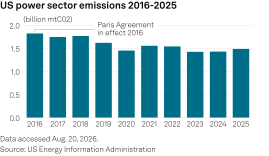
The power sector's carbon footprint has been expanding as a result, reversing several years of declining emissions.
Evergy Inc., also with an all-of-the-above approach to power production, reported a 24% increase in Scope 1 operational carbon emissions in 2025. Even so, Evergy had cut emissions to 47% below 2005 levels.
The total greenhouse gas emissions of AEP, another coal and natural gas-heavy utility, rose 10% in 2025. Emissions from AEP's total owned generation had dropped to 68% below 2005 levels, the company reported.
Experts said that without accelerated emission reductions, US electric utilities will fall significantly behind their 2050 climate ambitions.
With emissions on the rise and reductions slowing down after years of progress, net-zero by 2050 has become "very much a questionable goal," said Lily Bermel, a visiting fellow at Columbia University's Center on Global Energy Policy. But the trajectory could change, Bermel said.
If permitting and transmission barriers are removed, the pace at which clean energy sources are added to the grid will likely rapidly accelerate and get the US energy transition back on its previous track, Bermel said in an interview.
"Last year, 93% of what got added to the grid was renewables and storage," Bermel said. "There's no amount of policy that can change that."
Bermel recently published a paper arguing that even though Congress rescinded most clean energy incentives and programs under the Inflation Reduction Act and passed the Republican One Big Beautiful Bill Act that favors fossil fuels, 67% of emission reductions the 2022 law would have delivered over 2025-2035 will be preserved. At the same time, fossil fuel generation could be 19% higher, Bermel wrote.
Susan Dlin contributed to this article.
