Electric Power, Energy Transition, Crude Oil, Emissions, Hydrogen, Renewables
September 24, 2025
PATH TO NET ZERO: European utilities cut investments as pace of transition slows
By Alex Blackburne and Camilla Naschert
HIGHLIGHTS
Market uncertainty drives capex cuts by European utilities
Climate goals holding strong amid volatility
EU decarbonizing at 'rapid pace' despite slowdown
This is the latest in a series of articles tracking the net-zero greenhouse gas emission goals of companies across various sectors, including energy, shipping and chemicals. The previous story in the series is here.
Market volatility is driving some of Europe's largest utilities and power producers to rein in their investments. Although that may be a sign that the energy transition is slowing, many companies are choosing to uphold their existing emissions-reduction targets, signaling a commitment to sustainability amid the uncertainty.
"What we see is that directionally, this is going ahead as we expected before," Markus Rauramo, CEO of Finnish state-controlled utility Fortum, said in an interview with Platts, part of S&P Global Energy.
Indeed, Fortum's list of potential electrification projects — with customers from metals, hydrogen, data centers and battery manufacturing industries — is unchanged or may even have grown, the executive said.
"What has changed is that, given the interest rate volatility, geopolitical turbulence and the general increase of uncertainty, investment decisions may be postponed and take longer," Rauramo added. "But the queue of customers hasn't gotten any shorter."
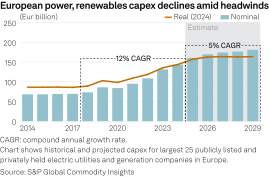
Germany's RWE, Denmark's Orsted and Britain's SSE are among those to announce scaled-back capital expenditure plans in 2025 due to a mix of financial challenges, regulatory delays and macroeconomic upheaval.
As RWE slashed spending by 25% for the next five years in March, CEO Markus Krebber said the company sees significant investment requirements in renewables, batteries and gas generation across all its markets.
"However, for massive investments, a stable and reliable investment framework is key. And unfortunately, here, we experienced much higher uncertainties," Krebber told analysts.
Despite the spending cuts, the likes of RWE, Orsted and SSE kept their long-term net-zero goals and interim emissions-reduction targets intact over the last year.
Some analysts attribute this ongoing commitment partly to decreasing power demand forecasts in Europe. This trend could lead to lower thermal generation, particularly from coal, according to Sylvain Cognet-Dauphin, executive director in the European power market analysis team at S&P Global Energy.
As the share of renewables in the mix increases from projects already under development, utilities' overall carbon intensity declines, Cognet-Dauphin said in an email. Gas prices are also projected to fall, which will further push coal out of the market and thereby reduce emissions.
"As witnessed in the past, an economic crisis is usually good for CO2 emissions — and doesn't require capex," Cognet-Dauphin said.
Spending cuts
The offshore wind sector has been among the hardest hit by European utilities' scaled-back investment plans.
In May, Orsted halted development of its 2.4-GW Hornsea 4 project in the UK, citing rising costs and heightened risk. The Danish wind giant is also facing significant challenges with its US portfolio, which prompted it to launch a capital raise.
More recently, its nearly completed 704-MW Revolution Wind project in the US was hit with a stop-work order. On Sept. 22, a federal district court judge in the District of Columbia issued a preliminary injunction allowing work to continue.
RWE also stopped developing US offshore wind amid US President Donald Trump's hostile stance toward the industry.
Elsewhere, in Europe's green hydrogen industry, project pipelines have shrunk in recent months as developers reassess investments due to challenging market conditions.
Spanish utility Iberdrola's UK subsidiary, Scottish Power, recently halted its renewable hydrogen project developments despite having secured funding for two projects in government support auctions.
While the company continues to support hydrogen as a decarbonization tool, Scottish Power said Sept. 3 that it sees "a limited route to market."
Norwegian state-owned Statkraft is also halting most of its hydrogen project development due to increased uncertainty in the market.
As investments in low-carbon generation decline, spending by utilities on regulated grid networks is ramping up, driven by the segment's lower risk profile and more certain outlook, according to Chris DeLucia, senior director in global power and renewables at Energy.
Iberdrola and SSE, as well as Italy's Enel, have all shifted the weight of their capex plans more toward networks recently.
"Overall, spending by the sector on the transition continues, but not quite at the pace from recent years, and with a shift in terms of where much of this capital is being allocated," DeLucia said in an email.
Europe leads green transition
Europe's energy transition can now be seen in a new geopolitical light, amid reduced focus on climate in the US and the development of clean technology as a strategic sector in China, according to analysts at Energy.
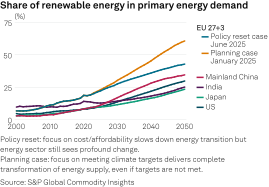
In what the analysts described as a "policy reset" scenario, European policymaking will increasingly pivot toward ensuring competitive energy prices for industry and consumers, and focus more on energy security while holding on to climate commitments.
"A slower pace of energy transition and of the transformation of Europe's energy sector could be on the cards," the analysts said in a July report.
Meanwhile, gas demand will fall less than previously expected amid a slower electrification of the heating segment and a slower deployment of hydrogen, while the previously anticipated rise in power demand will be dampened.
"Even under a softer transition, Europe continues to decarbonize at a rapid pace compared with other leading economies," the analysts said.
Climate goal revisions
Many of Europe's major publicly listed or state-owned utilities have kept their emissions-reduction targets intact in the last year, according to an analysis by Platts.
In some cases, companies have even moved to strengthen their goals. That includes Britain's Centrica, which in January released a new climate transition plan that brought forward its scope 1 and 2 net-zero target by five years to 2040.
Centrica's scope 3 net-zero target remained at 2050. Scope 3 accounts for the vast majority of the company's emissions, or about 93%, mostly as electricity and gas sales to customers.
Germany's Uniper and Austria's Verbund also published their first climate transition plans in the last year, with differing outcomes.
Uniper, which in August reduced its 2030 capex plan by Eur3 billion due to the slower development of renewables and hydrogen, is now targeting carbon neutrality on scope 1 and 2 emissions by 2040, instead of 2035 previously.
Meanwhile, Verbund, the only European utility analyzed by Platts a year ago that did not have a formal net-zero target, established a goal to reach net-zero across all three emissions scopes by 2050.
Norway's Statkraft advanced its scope 3 net-zero target by a decade, bringing it in line with its scope 1 and 2 target in aiming for 2040, and France's Engie strengthened its 2030 interim target, while adding new goals for 2035 and 2040.
Conversely, German grid utility E.ON eased its interim scope 1 and 2 target for 2030, aiming to reduce emissions by 50% instead of 75%.
Being clean 'pays off'
For Fortum, the utility's transformation following its divestiture of Uniper saw it establish new climate goals in January, validated by the Science-Based Targets initiative (SBTi), resulting in a delay of the company's 2030 carbon neutrality goal to 2040.
However, Rauramo explained that change relates to the methodology used in making Fortum's ambitions SBTi-compatible, as well as the SBTi's definition of net-zero.
"From our point of view, the targets got tighter," the executive said.
Needless to say, Fortum's divestment of Uniper had a significant positive impact on the Finnish utility's carbon footprint. In 2024, 99% of its electricity generation was CO2-free.
"It will just be very difficult in the long term to run a high fossil content business," Rauramo said, pointing to obstacles around supply chain, procurement, financing and stock market regulations. "From my point of view, being a clean company pays off really well."

Editor: