Refined Products, Crude Oil, Gasoline, Jet Fuel, Diesel-Gasoil
October 13, 2026
Landlocked Midwest refiners expand pipelines to reach coastal markets

Editor:
HIGHLIGHTS
Laurel Pipeline expansion moves Midwest fuel east
Western Gateway targets California supply gap
Midwest refining capacity grows to 24% of US total
US Midwest refiners have long faced a structural problem: large, sophisticated refineries producing more gasoline, diesel and jet fuel than the regional market can absorb, with limited pipeline and waterborne access to move surplus barrels to higher-priced coastal markets.
Two infrastructure developments — the expansion of Buckeye Partners' Laurel Pipeline system into the US Atlantic Coast and the proposed Western Gateway pipeline connecting Illinois to Los Angeles — are now beginning to change that calculus.
The comparison with the US Gulf Coast is instructive. Few regions combine such diverse crude access, dense pipeline connectivity, enormous storage capacity and world-scale export infrastructure in one integrated system.
The USGC became the world's most important refining center not simply because it built large refineries, but because an unusually deep midstream network — anchored by the Colonial Pipeline's roughly 5,500-mile system from Houston to New York Harbor, alongside Explorer, Plantation, Buckeye and Magellan — allowed those plants to source almost any crude and sell products into almost any major market.
That combination gave Gulf Coast refiners exceptional scale, flexibility and multiple outlets for every barrel. It is precisely that model that Midwest refiners are now attempting to replicate.
Shrinking USAC, growing Midwest
The structural case for Midwest-to-East flows has been building for decades. Between 1990 and 2016, US Atlantic Coast refining capacity fell by 570,450 b/d, according to Energy Information Administration data, leaving the region with 1.353 million b/d — just over 7% of total US refining capacity of 18.317 million b/d.
By 2026, USAC capacity had fallen further to 896,300 b/d, representing roughly 5% of total US refining capacity of 18.16 million b/d. Over the same period, Midwest refining capacity rose to 4.282 million b/d, representing about 24% of total US capacity.
The competitive landscape shifted further in 2019 when the permanent shutdown of the Philadelphia Energy Solutions refinery — the largest on the USAC at 330,000 b/d, following explosions and fire at its alkylation unit — reduced locally refined product flows moving west on the Laurel Pipeline, weakening the case made by Philadelphia-area refiners that protecting intrastate east-to-west capacity was essential to regional supply security.
A 2019 FERC settlement had already authorized bi-directional service on the Coraopolis-to-Eldorado segment of the Laurel Pipeline, creating 40,000-60,000 b/d of west-to-east interstate capacity while guaranteeing 120,000 b/d of east-to-west intrastate capacity — roughly 22% of the pipeline's 180,000 b/d total — to protect Philadelphia-area refiners.
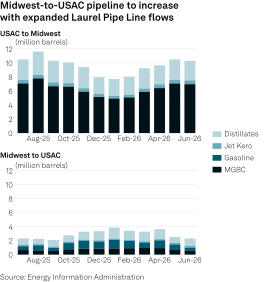
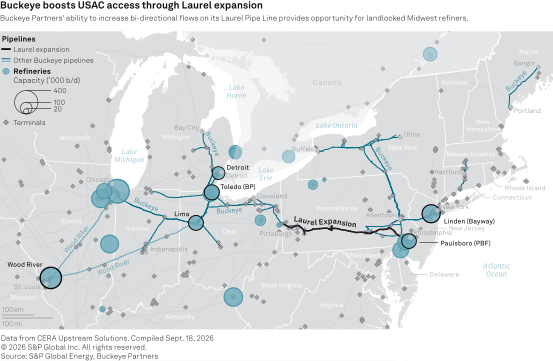
Phase 3 of Buckeye's Boardwalk project extended that logic further east, converting approximately 200 miles of additional Laurel infrastructure — Line 720, a 20-inch line from Mechanicsburg to Eldorado/Altoona, and Line 724, a 24-inch line from Sinking Spring to Mechanicsburg — to bi-directional service, adding 80,000 b/d of incremental Midwest-to-eastern Pennsylvania capacity.
The route connects onward via Buckeye's Eastern Products System to eastern Pennsylvania terminals and, via pipeline swaps, to New York Harbor.
FERC approved the tariffs on Sept. 10, 2026, for a service that had already begun Sept. 1. The Pennsylvania Public Utilities Commission's denial of a stay order requested by refiners and petroleum marketers allows Buckeye to operate the expanded service while state courts consider a pending appeal.
The spread dynamics driving shipper interest were acute before the Sept. 1 launch, with Chicago CBOB trading at approximately 11 cents/gal under NYMEX RBOB and hitting intraday extremes of 27 cents/gal under NYMEX on Aug. 24, 2026.
Shippers moved quickly once flows began.
Citgo was the first refiner to publicly confirm on Oct. 1 it had begun shipping gasoline east from its Lemont, Illinois, refinery via the expanded Buckeye system, capturing the premium held by USAC refined product markets by moving surplus barrels produced at a Midwest discount past saturated regional racks.
For the week ended Oct. 9, 2026, Laurel Pipeline CBOB averaged $3.3680/gal, nearly 10 cents/gal above NYMEX RBOB futures, according to Platts assessments. Platts is part of S&P Global Energy.
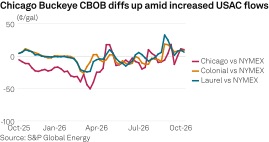
Buckeye Chicago CBOB for the same week averaged $3.3527 per gallon at an 11.375 cents per gallon premium to futures — more than 60 times the 18 cents per gallon premium recorded for the week ended Oct. 2, when flows first began.
Even so, the tariff economics require scrutiny.
| Route | Tariff | Rate (¢/b) | Notes |
| Eagle Point NJ → Brewerton NY (via Macungie) | Sunoco 186.18.0 | 297.13 | USAC route; no TSA required; indexed rate |
| Midland PA → Brewerton NY (Base) | Buckeye 463.0.0 | 497.63 | Midwest route; no TSA |
| Midland PA → Brewerton NY (Tier 3) | Buckeye 463.0.0 | 419.05 | ≥10,000 b/d TSA required; 7-year ship-or-pay |
| Toledo OH → Brewerton NY (Base) | Buckeye 463.0.0 | 594.01 | Midwest route; no TSA |
| Toledo OH → Brewerton NY (Tier 3) | Buckeye 463.0.0 | 499.72 | ≥10,000 b/d TSA required; 7-year ship-or-pay |
At Tier 3, Buckeye's Brewerton, New York, tariff exceeds Sunoco's competing rate by approximately $1.22/b from Midland, Pennsylvania, and $2.03/b from Toledo, according to FERC tariff filings, requiring equivalent Midwest origin discounts to reach parity.
Up to 80,000 b/d of new Midwest supply should pressure the Laurel-Chicago premium as barrels compete for eastern Pennsylvania terminal capacity, though the impact will depend on TSA participation rates and committed volume tiers. Buckeye said it had seen continued strong interest in movements but declined to comment on specific commitments.
California: a market in need
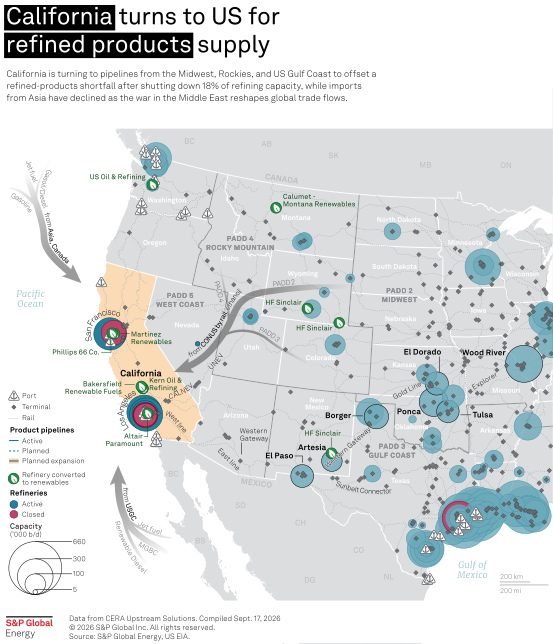
California's refined product market has been bleeding supply for years - and the Western Gateway pipeline final investment decision is the most significant structural response yet.
The Aug. 11, 2026, Final Investment Decision (FID) by Phillips 66, Kinder Morgan Inc., and HF Sinclair sets in motion a 1,300-mile, $5 billion pipeline system with a design capacity of 230,000 b/d, targeting completion in 2029 - subject to permits and regulatory approvals.
California has lost more than 30% of its refining capacity in five years, with the closure of the Phillips 66 Wilmington refinery in October 2025 and Valero's Benicia plant in April 2026, leaving California structurally short of in-state supply, with refiners pointing to unhospitable policy by the state as a reason for shutting down plants.
The state has grown increasingly dependent on waterborne imports - primarily from South Korea - to fill the gap, but that strategy has shown its limits: Asian supply has been squeezed by Middle Eastern crude disruptions, and West Coast gasoline inventories have remained persistently below year-ago levels through the summer of 2026.
The commercial underpinning for Western Gateway is the durable premium California-spec CARBOB commands over US Gulf Coast RBOB.
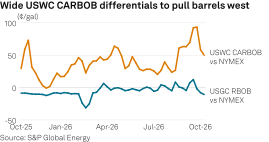
The pipeline creates a new fuel supply corridor originating from St. Louis, Missouri, and expanded Gulf Coast receipt points.
Phillips 66 will construct and operate an approximately 900-mile new-build pipeline from its Borger, Texas, refinery to Phoenix, Arizona, while its Gold Pipeline - reversed - will connect to the Explorer Pipeline and allow Midwest-origin refined products to flow toward Borger.
Kinder Morgan's existing SFPP West Line, running from Colton, California, to Phoenix, will also be reversed to move product east-to-west into California. The system is underpinned primarily by 10-year, take-or-pay contracts and is designed to allow future expansion with limited capital and no new pipe required.
ONEOK's Magellan Pipeline subsidiary has proposed the Sun Belt Connector, a roughly 440-mile refined-products pipeline from El Paso, Texas, to the Phoenix area that would transport gasoline, diesel and jet fuel at an initial capacity of about 200,000 b/d. In addition to the El Paso-to-Phoenix segment, the project's open season contemplated transportation options from Houston and southern Oklahoma into El Paso and Phoenix through the broader Magellan system. ONEOK has indicated the line could enter service in mid- to late 2029, but as of October 2026, no final investment decision or construction start has been announced.
Proposed pipelines could reduce USWC reliance on imported refined products, but may pressure regional refinery margins given cost advantages held by Midwest and USGC refiners — mirroring USAC's experience. The pipelines would also offer Midwest refiners a new outlet as local gasoline demand declines, according to analysts from S&P Global.