Crude Oil, Refined Products, Diesel-Gasoil, Gasoline
May 20, 2026
INTERACTIVE: California's refinery closures create volatile fuel prices, supply gaps

Editor:
HIGHLIGHTS
State loses 30% refining capacity in five years
New pipelines proposed to ease supply gaps
California's lower refining capacity over the last few years has led to a volatile price environment for the US West Coast, as it turns to a refined product import model to meet demand amid a challenging supply landscape due to the Middle East war.
California has been waging war on the fossil fuel industry at least since the 1969 Santa Barbara oil spill, putting in place the country's strictest environmental protections imposed on the industry while promoting policies supporting cleaner transportation fuels like renewable diesel and sustainable aviation fuel.
Their unfriendly policy has made it difficult for refiners to operate in the state, with some converting plants to renewable fuel facilities and others just shutting down, as state policies supported a refined product import model with Asian countries filling the supply gap.
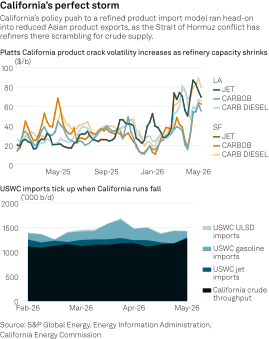
Since the closure of Phillips 66's Wilmington refinery and Valero's Benicia plant in October 2025 and April 2026, respectively, Los Angeles jet differentials to NYMEX ULSD futures have gone from an 80-cent/gal discount in the second quarter of 2025 to a 52-cent/gal premium over the screen as of May 20, 2026, according to assessments from Platts, part of S&P Global Energy.
Movement for California CARBOB and CARB diesel prices was less dramatic but still substantial.
Platts assessed CARB diesel prices, which were holding a 6.8-cent/gal premium over NYMEX ULSD prices in the second quarter of 2025, to a 35-cent/gal premium over the screen for the second quarter of 2026 as of May 20.
Los Angeles CARBOB, which averaged a 27-cent/gal premium to the NYMEX RBOB futures screen in Q2 2025, is, as of May 20, 2026, holding a 47.7-cent/gal premium to the screen, according to Platts assessments.
Perfect storm
California's shift to an import supply model for refined products comes at a time when other regions are struggling to find supply. Export-model countries like South Korea, which can create on-spec refined products, are dependent on Middle Eastern crude and are now scrambling to find crude to meet domestic demand and resume their previous level of exports.
Less California refining capacity also magnifies outages and hiccups at the remaining refineries, creating a volatile price and crack environment for gasoline, diesel, and jet fuel in the state, where fuel is more expensive due to the special formulated CARBOB gasoline and CARB diesel.
Marathon Petroleum, the largest US refiner and operator of California's largest refinery, estimated that approximately 6% of global refined products capacity has come offline during the conflict in the Middle East, with the timeline for return uncertain while crude flows out of the region remain constrained.
"We are largely insulated from global crude supply disruptions given our crude sourcing comes mainly from the United States and Canada," said CEO Maryann Mannen said on the first-quarter results call.
She noted that after an upgrade at its Los Angeles refinery, Marathon is well-positioned to take advantage of the state's refinery closure as well as increased California crude available from less refinery demand and greater production as a result of a recent loosening of permit restrictions.
Mid-Continent refinery supply tapped
While refiners outside the state have begun producing cleaner California-spec fuels, not every refinery can meet the specification, though the number that can has been increasing. HF Sinclair began making and shipping CARBOB or motor gasoline blending components, depending on the economics, from its Puget Sound refinery in Washington state down to California.
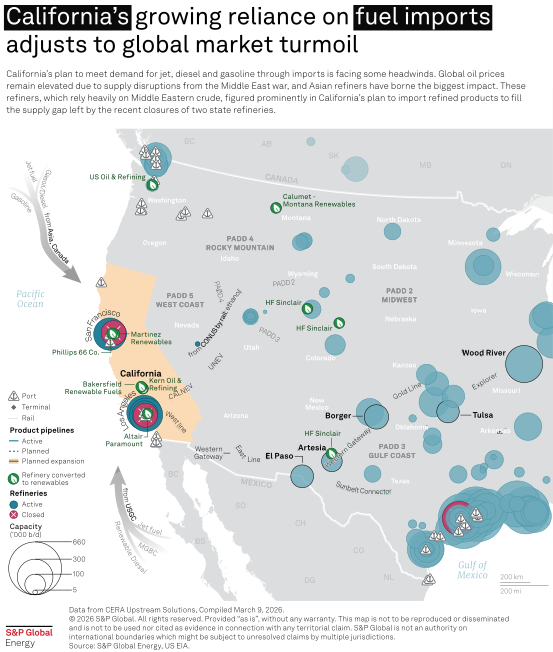
Also, several pipeline projects have been proposed to open up California, long seen as a refined product island due to its lack of inbound pipeline capacity.
These projects seek to mostly tap existing US pipelines from the Midwest, Rockies and US Gulf Coast, bringing refined products from the Mid-Continent west into California and the markets it serves in Arizona and Nevada.
These include the Western Gateway project proposed by Kinder Morgan and Phillips 66, which has had a very warm reception from shippers. This pipeline is expected to begin at Phillips 66's Wood River, Illinois, refinery and allow egress from USGC pipeline products on the Explorer as it moves west.
HF Sinclair, which operates 717,000 b/d of Mid-Continent and Rockies refinery capacity, has also proposed a pipeline, looking to leverage its Rockies footprint and existing pipeline capacity.
Midstream operator Magellan has also proposed the Sun Belt Connector to supply the Phoenix market, filling the gaps left by Kinder Morgan's SFPP pipeline reversal that moves refined products to California rather than from California. Initial capacity will be 200,000 b/d, with an expected start-up date by mid-2029.