Refined Products, Maritime & Shipping, Diesel-Gasoil, Gasoline, Jet Fuel, Wet Freight
August 27, 2025
USAC refiners and fuel suppliers again challenge Buckeye's Laurel pipeline expansion

HIGHLIGHTS
Further eastward access sought by Buckeye
Hearings set to begin in September
A coalition of US Atlantic Coast refiners and petroleum suppliers wants to keep traditional market share intact as pipeline operator Buckeye Partners once again looks to expand its refined product pipeline system to bring in more Midwestern barrels.
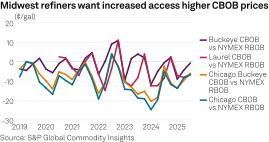
Buckeye wants to increase bi-directional flows on its Laurel Pipe Line system – which bisects the state of Pennsylvania from Ohio to New Jersey – in order to give the much larger Midwest refining hub access for their landlocked barrels into PADD 1's more lucrative gasoline, diesel and jet markets as it increases flows – and revenues – on its 5,000 mile US pipeline system.
With its Broadway Phase 3 project, Buckeye wants to exercise rights to expand Laurel's bi-directional capacity further east into Pennsylvania, a move which will also open for the first time pipeline Midwest refiner access to key New York Harbor market as well as upstate New York markets.
As part of the negotiated settlement, the 2019 PAPUC decision granted Buckeye the right to propose further extensions of bi-directional service or a full reversal of service.
So, on Dec. 20, 2024, as soon as it was eligible to do so, Buckeye filed with the Federal Energy Regulatory Commission (FERC) to extend Laurel's bi-directional segment about 200 miles east to Sinking Spring, outside Reading, on Line 720 and Line 724. FERC held the filing in abeyance for the PAPUC, as it did in 2019.
More bi-directional flows
Buckeye in its Feb. 11, 2025 PAPUC filing said increasing Laurel's bidirectional flows will "continue to bring new, diversely-sourced, and competitively-priced supplies of refined petroleum products from Midwestern refineries to consumers in western and central Pennsylvania, while continuing to transport the existing volumes of products supplied to these markets from Philadelphia-area refineries."
However, a coalition of suppliers, comprised of refiners Monroe Energy and PBF Energy, petroleum marketer Sheetz and terminal owner LHT Terminals – have fired back against Buckeye's optimistic spin on what increased eastward expansion could mean to residents of Pennsylvania, citing experiences with the current bi-directional segment.
In a letter to Pennsylvania legislators, they warned that supply disruptions could occur as Buckeye tariffs incentivize moving product through Pennsylvania and into other markets in New York and New Jersey ahead of hearings scheduled over the next several months.
"As these hearings take place, we wanted to ensure that you were aware of this issue and the risk it creates for your constituents," the four companies wrote in a letter to Pennsylvania legislators dated July 31.
In a PAPUC filing, the four companies noted if "shipments of gasoline or diesel are missed, delayed, or permanently removed as a result of this complicated system, there will be shortages of fuel for Pennsylvania residents and, as a result, Pennsylvanians will pay more for their fuel. The suppliers know from actual experience with limited bi-directional service on the Laurel Pipeline that these operational challenges are very real."
Buckeye has stated in filings that there have been no "actionable" complaints from shippers about current bi-directional operations.
However, while it is true the supply coalition has lodged no formal complaints with regulatory agencies about problems they have experienced with Laurel's current bi-directional service, sources familiar with the situation noted that is not because there have been none.
Complaints, several sources said, have been made directly with Buckeye operations about line disruptions resulting from bi-directional service, which they say have cost them time and money to navigate to ensure that their gasoline and diesel get to their western Pennsylvania clients.
Buckeye, once a local entity based in Macungie, Pennsylvania, is now part of IFM Investors, an Australian-based investment company owned by 16 of the country's pension funds. The transaction was valued at $10.3 billion when the deal was closed in 2019.
IFM, which got 5,000 miles of pipeline with the Buckeye deal, in July sold, along with its co-owners, its 15.795% stake in the 5,500-mile Colonial Pipeline to Toronto-based Brookfield Infrastructure, which is now the sole owner of the largest US refined products pipeline.
Incentives for Midwest flows
Buckeye is offering incentives for its Midwest clients which are not available for in-state refiners, and are further incentivizing these Midwest refiners with additional discounts to move product through Pennsylvania and into New York.
"The granting of the Buckeye/Laurel proposal would create an anti-competitive environment by disadvantaging shippers from the East, who have kept the market well-supplied for decades, and favoring shippers from the West, whose primary markets have historically been the large Midwest cities," said the USAC petroleum supply coalition in a filing.
Also, the supply coalition noted Buckeye has scheduled planned Laurel pipeline work in both August and September.
While planned pipeline maintenance is necessary for safe operations, it is disruptive in its own right, and in this case, the supply coalition say current planned work includes setting up the second segment to be bi-directional -- before they receive actual approval from regulators to do so.
Initially, Buckeye had hoped to have the second bi-directional segment in operation by July 31, 2025, according to early filings, a timeline which has since been pushed out to October, as several companies including Cenovus have signed on already.
A spokesperson for IFM said in an e-mailed response to queries that the company was not able to comment on Laurel at this time.
Buckeye says it is seeking to increase bi-directional volumes because east-to-west service flows on the Laurel have fallen off since the closure of the largest USAC refinery. Philadelphia Energy Solutions (PES) shut down permanently in 2019 after a fire and explosion swept through the inner city 330,000 b/d plant.
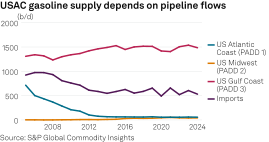
With the refinery closures, USAC imports about 80% of refined products needed, including imports from Canada and Europe, and deliveries from the US Gulf Coast refineries coming up the Colonial Pipeline, and to a lesser extent, Kinder Morgan's Products (SE) Pipe Line, to fill in the supply gap from fewer local refineries.
Currently, the evidentiary hearing is scheduled to begin in the second week of September, although the fuel coalition suppliers are requesting more time to read and digest fifteen separate sets of interrogatories and more than 500 total discovery requests.
The current case is under the aegis of Administrative Law Judge Eranda Vero, who in 2018 initially recommended that the five-member PAPUC Commission reject Buckeye's application to reverse the flow, only to change its ruling in August 2019, allowing limited bi-directional flows on the Laurel Pipeline.
