Refined Products, Crude Oil, Agriculture, Diesel-Gasoil, Gasoline, Jet Fuel
September 29, 2026
FACTBOX: Asia weighs price and supply fallout from potential US diesel export curbs
HIGHLIGHTS
European buyers to compete harder for Asian cargoes
China faces lower inventories, limited export surplus
Arbitrage cargoes from Asia to see longer voyage times
Asian countries are monitoring the possibility of US diesel export restrictions, a move that could reshape global refined product flows despite the region's limited reliance on US middle distillate supplies.
While a US ban would intensify competition for Asian and Middle Eastern barrels among European and Latin American buyers, driving up prices, the impact across Asia could be uneven. Import-dependent economies would face higher costs for replacement cargoes rather than outright shortages because of their reliance on regional suppliers such as South Korea, Singapore and China.
Export-oriented refiners in South Korea would need to balance domestic obligations against potentially more lucrative export opportunities, while China's ability to fill any supply gap could be constrained by tighter inventories, lower refinery run rates and Beijing's preference for serving the domestic market rather than maximizing export margins.
India, meanwhile, has pledged to honor its export commitments even as its diesel surplus narrows, underscoring how divergent policies across Asia could shape the region's response to a tighter global diesel market.
"If US barrels disappear, everyone starts chasing the same cargoes. That pushes diesel cracks higher and affects economic activities such as trucking, manufacturing, construction and agriculture," Premasish Das, executive director for oil analytics at S&P Global Energy CERA, told Platts on Sept. 28.
"Crude prices may not move much, but diesel prices could rise faster than crude, causing real pain in Asian economies, particularly in emerging ones," Das said.
The following are key facts about the potential impact of tighter global diesel supplies on Asia:
Trade flows
- Heightened competition from European and Latin American buyers for Asian cargoes could divert barrels away from traditional Asia-Pacific customers, trade sources said.
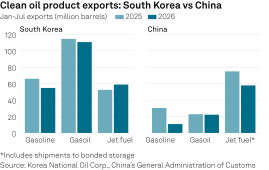
- South Korea -- Asia's top clean oil products supplier and net exporter -- sold record-high 5.73 million barrels of clean oil products, including gasoline, gasoil and jet fuel, to Europe in August, according to data from state-run Korea National Oil Corp.
- South Korea typically serves as a key source of replacement clean oil product cargoes for structurally import-dependent markets in Asia and Oceania. The country's total clean oil product exports rose 1% year over year to 38.47 million barrels in August, while shipments in the first eight months of 2026 fell 5% to 264.5 million barrels, KNOC data showed.
- South Korean refiners' ability to sustain these flows would provide an important buffer for Asian markets if US diesel exports are curtailed, although that cushion is constrained by refiners' domestic supply obligations and term contract commitments, trade sources said.
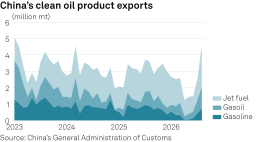
- China's ability to boost gasoil exports may be limited, with trade sources expecting October shipments to fall 31.4% month over month to 8.89 million barrels due to lower inventories and anticipated production cuts amid tighter feedstock supplies. The country's August gasoil exports hit a 29-month high of 9.9 million barrels, according to customs data.
- India's oil minister Hardeep Singh Puri said Sept. 24 that the country would honor its overseas commitments for petroleum products, including diesel.
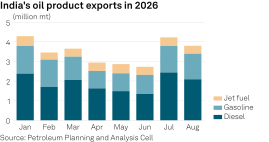
- India's petroleum product exports fell 40% year over year to 2.7 million mt in August, according to the oil ministry. Exports declined 46.7% year over year to 11.2 million mt during April-August, while fiscal year 2025-26 (April-March) exports fell 9.2% to 46.2 million mt.
Prices
- Trade sources said stronger European demand for Asian diesel would improve westbound economics and could lift Singapore gasoil prices and cracks, even if Northeast Asia remains adequately supplied.
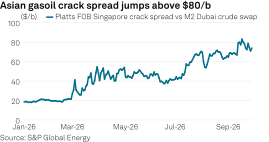
- Asian middle-distillate markets are already operating with a smaller export cushion. Platts assessed the second-month Singapore gasoil swap crack against Dubai crude swaps at a record high of $83.02/b on Sept. 16. The crack spread has averaged $73.14/b so far in September, up from $64.71/b in August, $56.14/b in July and the 2025 average of $18.16/b.
- As concerns over potential US diesel export restrictions push European prices higher, Europe has already started drawing diesel cargoes from Asia, supported by strong East-West arbitrage incentives, Singapore-based traders said.
- Arbitrage cargoes may face challenging economics due to steep backwardation, higher freight costs and longer voyage times, particularly if some vessel operators avoid transiting the Suez Canal, potentially delaying arrivals.
- Platts assessed the gasoil exchange of futures for swaps -- the spread between Singapore 10 ppm sulfur gasoil swaps and the corresponding ICE low-sulfur gasoil futures contract -- at a record low of minus $199.82/mt on Sept. 23, compared with an August average of minus $106.27/mt.
- A less negative gasoil EFS would improve the economics of moving Asian barrels to Europe, while a sharply negative EFS would discourage westbound flows or indicate weak European demand, rather than reflecting an improvement in Asia's physical balance.
Infrastructure
- With about 3.4 million b/d of refining capacity and domestic oil demand of around 2.3 million b/d, South Korea has roughly 1 million b/d of surplus refining capacity available for exports, according to data from KNOC and Korea Petroleum Association.
- At a typical speed of 12.5 knots, a voyage from South Korea to the UK-Continent takes 47 days via the Cape of Good Hope, compared with 36 days via the Suez Canal, according to a shipbroker. A Singapore-to-UKC voyage takes 39 days versus 27 days, while a Fujairah-to-UKC voyage takes 35 days versus 20 days, the shipbroker said.
- Westbound LR2 tanker freight rates have risen since early September, with Platts data showing the key LR2 Persian Gulf-UKC route at $13.85 million via the Suez Canal on Sept. 23, compared with $14.355 million via the Cape of Good Hope.
- China's gasoil inventory fell 8% month over month to 83.24 million barrels as of Sept. 24, according to JLC. This represents the lowest level since JLC began supplying inventory data to Platts on Jan. 6, 2023.
- Small independent refineries in China have been cutting throughput since September as Iranian feedstock supplies declined.
- Chinese state-run refineries, which rely on seaborne crude imports, are also expected to face tighter feedstock supplies in October, particularly in the first half of the month, due to slower deliveries from the Middle East and limited spot purchases from alternative sources, according to industry sources. A state-run plant with 200,000 barrels/day capacity has cut its utilization rate to about 70%, a level expected to persist until late October, a refining source said.
- China's state-run refiners must prioritize domestic supply over export margins, leaving little surplus for export, according to refinery sources.
- S&P Global estimates US Gulf Coast refiners would need to cut crude runs by nearly 1.9 million b/d, or about 12%, to eliminate the surplus in the domestic market, lowering utilization to 80%-82%. Because refineries cannot stop producing diesel while maintaining gasoline output, lower throughput would also reduce supplies of gasoline, jet fuel and petrochemical feedstocks, potentially turning the US into a slight net gasoline importer.