Refined Products, Energy Transition, Agriculture, Crude Oil, LNG, Diesel-Gasoil, Gasoline, Jet Fuel, Renewables, Biofuels
September 23, 2026
Diesel export ban would send shockwaves through US refining system

Editor:
HIGHLIGHTS
US refiners face 1.9M b/d crude run cuts
Export ban strands 1.5M b/d diesel domestically
Global prices surge as supply tightens abroad
A potential US ban on diesel exports might initially appear to be a straightforward way to increase domestic supply and lower prices, but the reality is far more complicated, analysts and industry watchers agree.
While the concept of a US diesel export ban has been floated over the past few weeks amid record high prices, President Trump's Sept. 22 statement that "let's not send out the diesel" brought it closer to reality.
The proposal comes as diesel markets are under extraordinary stress, but it would not necessarily be a quick fix for domestic diesel prices ahead of November's upcoming midterm elections.
"The US is not short of diesel. The world is. The US is a structural diesel surplus producer. Refineries in the US produce roughly 5.3 million barrels of distillates per day against demand of around 3.6 million barrels per day domestically," said Patrick De Haan, head petroleum economist at GasBuddy, on Sept. 22.
Because US refineries operate as part of a globally integrated fuels system, removing diesel exports would trigger a chain reaction across refinery operations, product markets, renewable fuels and international trade flows, S&P Global analysts noted.
A proposed ban on US diesel exports could strand up to 1.5 million barrels per day of fuel in the domestic market, triggering refinery run cuts on a scale not seen since the early months of the COVID-19 pandemic and sending global diesel prices sharply higher, they said.
The warning comes as diesel crack spreads hover at record or near-record levels, driven by refinery outages in the Middle East and Russia, lower Chinese exports and seasonally tight inventories — conditions that have already boosted profits for Gulf Coast refiners while raising fuel costs for truckers, farmers and industrial users.
The unplanned outage at ExxonMobil's Joliet refinery has amplified those pressures in Midwest markets just as the harvest season gets underway, illustrating how little buffer remains in a system running at near-100% utilization.
Impact on US Gulf Coast refiners
Gulf Coast refiners — including Valero, Marathon Petroleum, Phillips 66, ExxonMobil, Chevron and Motiva — depend on foreign markets to absorb excess diesel output.
S&P Global analysts Will O'Neil, Debnil Chowdhury and Brian Stetter estimated in a Sept. 22 note that removing export outlets would strand roughly 1.5 million b/d of diesel domestically, rapidly collapsing margins and crack spreads.
Chowdhury compared the potential shock to the demand collapse refiners experienced at the start of the coronavirus pandemic.
"You have to think of exports as demand," Chowdhury said, warning that Brazil, Mexico and Europe would all face reduced access to US diesel supplies.
S&P Global estimates refiners would ultimately need to cut crude runs by nearly 1.9 million b/d, or roughly 12%, to eliminate the surplus, pushing utilization toward 80%-82%.
Because a refinery cannot stop making diesel while maintaining gasoline output, lower crude throughput would also reduce gasoline, jet fuel and petrochemical feedstock production. S&P Global estimates the United States could shift from being a net gasoline exporter to a slight net importer.
The Platts USGC ULSD prompt pipeline crack averaged $104.66/b on Sept. 22, just below the record $105.42/b on Sept. 15. While far overshadowed by diesel's strength, USGC CBOB gasoline cracks are also rising, reaching $34.53/b on Sept. 22, and are likely to go higher if USGC run cuts go into effect. Platts is a unit of S&P Global.
With crack spreads potentially elevated into 2027, Jefferies analyst Lloyd Byrne on Sept. 22 downgraded Valero and Marathon Petroleum to Hold, citing a potential export ban as one of the two biggest threats to the current refining cycle, alongside demand destruction.
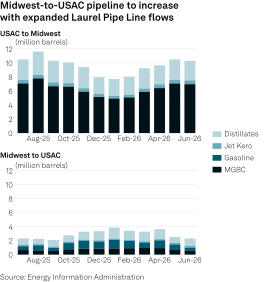
Pipeline infrastructure offers only partial relief to at-risk regions like the US Atlantic Coast although the expansion of the Laurel Pipe Line could help increase supplies.
"Between Colonial, Plantation and Laurel, you could probably backfill East Coast diesel imports, especially with a Jones Act waiver. The problem is that 100,000 to 200,000 b/d is a drop in the bucket compared with a 1.5 million b/d diesel surplus," O'Neil said Sept. 22.
Risky business for renewables
The renewable fuels sector also sees risks.
Renewable Fuels Association CEO Geoff Cooper said waiving the Renewable Volume Obligation would reduce supply in an already tight market.
"Waiving the RVO would most definitely not result in lower fuel prices," Cooper said on Sept. 22, noting that biomass-based diesel contributes roughly 400,000 b/d and ethanol more than 1 million b/d to overall supply.
S&P Global's O'Neil said a ban would create sharply divergent outcomes within renewables.
"If you're a Gulf Coast renewable diesel producer with access to export markets, your margins are going to be great because the rest of the world loses 1.5 million barrels a day of diesel and prices skyrocket," O'Neil said.
Biodiesel producers without export access would face deteriorating margins competing against discounted stranded petroleum diesel.
O'Neil also warned the disruption could trigger "massive noncompliance" with the Renewable Fuel Standard, sending RIN prices and gasoline costs higher.
Politics ahead of midterms
Not all analysts foresee deep run cuts.
Economist Philip Verleger argues refiners could adapt by switching from heavier Canadian and Venezuelan crudes toward lighter grades such as WTI, reducing diesel yields without large throughput reductions.
Verleger nonetheless opposes a ban, warning it would damage US credibility as a reliable supplier of crude, refined products and LNG as well as do little to lower the price of gasoline – a key and more direct metric felt among voting consumers.
"While diesel is the headliner today, it has been my experience that when it comes to elections, the price of gasoline impacts the consumer much more directly than the price of diesel," Verleger said in a Sept. 22 email to Platts.
He noted that although diesel costs are embedded throughout the economy, their impact on consumers is largely indirect, a sentiment echoed by GasBuddy's De Haan.
"Diesel may be driving today's energy debate, but gasoline remains the fuel that most directly influences voter sentiment. Consumers don't closely track diesel futures or wholesale markets, but they notice every penny change at the gas pump, which is why gasoline prices often become a bigger political issue than diesel prices during election years," said De Haan.
