Refined Products, Crude Oil, Diesel-Gasoil, LPG
September 25, 2026
India to honor oil product export commitments despite global supply concerns: Puri
HIGHLIGHTS
Middle East conflict could last longer than anticipated
Crude diversification helping to keep domestic market well-supplied
Acquiring equity oil from overseas a strategic priority
India will honor its overseas commitments for petroleum products, including diesel, Oil Minister Hardeep Singh Puri said Sept. 24, assuring global markets that the country would maintain supplies despite geopolitical tensions in the Middle East and the Russia-Ukraine conflict.
"We will continue with product exports and honor our export commitments," Puri said at an industry event in New Delhi.
India, the world's fourth-largest refining nation, is a major supplier of refined petroleum products to European and African markets, according to the oil ministry.
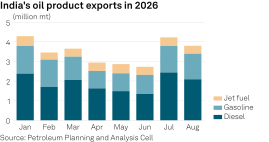
India's petroleum product exports fell 40% year over year to 2.7 million metric tons in August, according to the ministry. Exports declined 46.7% year over year to 11.2 million mt during April-August, while exports for fiscal 2025-26 (April-March) fell 9.2% to 46.2 million mt.
Concerns about tight diesel supplies come after US President Donald Trump and US Secretary of the Treasury Scott Bessent said their administration was considering fully or partially restricting diesel exports amid surging pump prices, following days of increasing political pressure from fellow Republicans to implement an export ban, Platts reported Sept. 22.
On Sept. 23, US Energy Secretary Chris Wright told a Dow Jones Energy event in New York that the US was unlikely to impose a full ban on diesel exports, though the government is considering a range of options to keep more US-produced diesel in the country in the coming weeks.
Fears over a potential US diesel export ban, which could further tighten global supplies and exacerbate the European diesel shortage, pushed the Platts-assessed front-month gasoil exchange of futures for swaps to an all-time low at the Sept. 23 Asian close.
Platts, part of S&P Global Energy, assessed the gasoil EFS -- the spread between Singapore 10 parts per million sulfur gasoil swaps and the corresponding ICE low-sulfur gasoil futures contract -- at minus $199.82/mt Sept. 23, widening from minus $162.69/mt Sept. 22, and from an average of minus $106.27/mt in August. On Sept. 24, it recovered slightly and was assessed at minus $185.91/mt.
Premasish Das, executive director for oil analytics at S&P Global Energy CERA, said that US diesel exports had helped to offset supply losses from both the Middle East and Russia. If those exports were suddenly removed, the immediate impact would be felt most in Europe and Latin America, which have become increasingly dependent on US diesel barrels.
"Asia is unlikely to face an immediate physical shortage, but it would feel the impact through higher prices. China has limited export flexibility, India's surplus has narrowed, and regional diesel balances are already much tighter than normal," Das added.
Long-drawn conflict
Puri said the conflict in the Middle East was not over and could last longer than anticipated.
India, the world's third-largest crude oil consumer and importer, has so far managed to navigate the disruption, Puri said. He noted that global crude supplies had remained available despite concerns that the Strait of Hormuz could be fully closed.
"There was apprehension about how we would survive if both chokepoints -- the Strait of Hormuz and the Bab al-Mandab Strait in the Red Sea -- were closed," Puri said. "India has survived despite those concerns."
He attributed India's resilience to measures taken by the government, including diversifying crude supplies across 41 countries and reducing taxes on oil and petroleum products.
According to S&P Global Commodities at Sea, Middle East-origin crude exports to India, both in transit and completed, improved to around 2.16 million b/d in September, despite ongoing concerns over Strait of Hormuz and Red Sea supply risks. Volumes are up from 1.50 million b/d in July and 1.66 million b/d in August.
India also faced concerns over LPG supplies because several supplier countries are in active conflict zones. Domestic refineries helped offset the risks by increasing LPG production, Puri said.
"The Hormuz crisis has presented an opportunity to ramp up LPG production and ensure supplies to domestic users," he said.
Overseas upstream strategy
Puri added that India's strategy of acquiring overseas equity oil remains a priority, including through stakes held by state-run exploration companies such as ONGC and Oil India in projects in Brazil and Mozambique.
"Equity oil in foreign lands will always be a priority despite the long gestation period associated with exploration activities and investment," Puri said.
According to Mansi Anand, principal analyst for research on national oil companies at CERA, India's national oil companies were increasingly favoring producing and near-development assets that can add reserves and production quickly, while avoiding the risks associated with frontier exploration.
"They are also increasingly leveraging government-to-government partnerships to access strategic opportunities overseas. At the same time, they are mandated to expand domestic exploration and production activities, meaning every overseas upstream investment is now being weighed against India's broader energy-security objectives," she said.
