Refined Products, Gasoline
June 23, 2026
California gasoline lawsuit shifts focus to retailers after refinery crackdown

Editor:
HIGHLIGHTS
Focus shifts from refineries to retail margins
Lawsuit targets retailers for pricing algorithms
State says retailers inflate prices 20-30 cents/gal
After years of tightening regulations on California refineries, the state government is challenging gasoline retailers for allegedly coordinating prices through algorithmic software, increasing scrutiny of the entire fuel supply chain to address persistent fuel price premiums rather than relying on refinery oversight alone.
In a lawsuit filed June 22, the state alleges major fuel retailers used pricing algorithms to maintain artificially high pump prices beyond what can be justified by crude oil costs, refining margins, taxes and regulatory compliance expenses.
California motorists filed a proposed class action lawsuit in federal court in Sacramento, accusing major fuel retailers — along with pricing software provider Kalibrate — of using artificial intelligence to coordinate gasoline prices across more than 1,700 stations statewide, allegedly inflating pump prices by 20-30 cents/gallon in violation of California antitrust law and a new state prohibition on shared pricing algorithms.
Major fuel retailers included in the suit are BP, Marathon Petroleum's ARCO network, 7-Eleven, Circle K, Walmart and Albertsons. Neither Kalibrate nor Marathon Petroleum responded immediately to emailed requests for comment on the lawsuit.
A BP spokesperson said the company "typically does not comment on active litigation."
Lifting the veil
The legal action represents the downstream phase of California's broader investigation into gasoline pricing, following earlier legislation that forced refiners to disclose detailed margin data.
California's Energy Commission has spent years analyzing what officials call the "gasoline surcharge," a persistent gap between California pump prices and the sum of identifiable cost components. That unexplained premium typically ranges from 40-50 cents/gallon, according to state analysis, or about half of what the lawsuit cites as inflated retail prices.
Refinery closures over the past five years have cut refining capacity by 30%, now at 2.1 million b/d of refining capacity, down from roughly 3 million b/d, according to both California Energy Commission and US Energy Information Administration data, forcing the CEC to stop treating the surcharge as pure "excess profit" and instead treat it as a market outcome shaped by tightening supply.
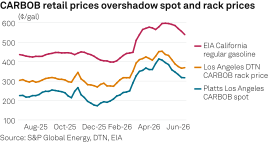
Over the last year, the price differential between the spot price and the rack price averaged 67.46 cents/gal over the past year, according to data from Platts and DTN while the price differential between the rack and the retail price is almost double, averaging $1.38/gal, according to data from DTN and the EIA.
Less in-state supply to meet demand, combined with California's stringent and unique fuels policy — which mandates ultra-clean and more expensive CARBOB and CARB diesel be used — contributes to the higher prices Californians pay for gasoline.
Legislation enacted in recent years required refiners to report granular cost and profit data, enabling regulators to quantify refinery margins with greater precision. While that transparency revealed some margin expansion during supply disruptions, it did not fully account for the price differential California motorists pay compared with other states.
The new lawsuit effectively reallocates the unexplained portion of the surcharge from refineries to retail operations. By establishing a data-backed baseline for wholesale and refining economics through mandatory disclosures, plaintiffs can now argue that retail margins are independently inflated rather than a simple pass-through of upstream costs.
Plaintiffs allege retailers used third-party pricing software to monitor competitors' prices in real time and adjust their own accordingly, creating what amounts to tacit coordination without explicit collusion. This algorithmic pricing, the complaint argues, allowed retailers to maintain elevated margins while avoiding traditional antitrust red flags like direct communication between competitors, the complaint notes.
The complaint also strengthens antitrust claims by addressing a key legal requirement: demonstrating super-competitive pricing not justified by costs. With refinery margins now partially transparent through state reporting requirements, the lawsuit can isolate retail pricing behavior as the source of excess premiums.
