Crude Oil
June 18, 2026
India reassesses its appetite for Iranian oil, once a favorite among refiners

Editor:
HIGHLIGHTS
Refiners in India took 518,000 b/d from Iran in 2018
Iran sanctions prompted refiners to diversify suppliers
Indian upstream firms operated in Iran before sanctions
Indian refiners are reassessing their strategy to Iranian crude purchases ahead of potential sanctions relief, but the barrels will face intense competition in a market that has successfully diversified away from Iran over the past few years, industry sources and analysts said June 18.
While Iranian oil's return to India — expected once a US-Iran peace deal is finalized and sanctions are waived — will provide strategic optionality and supply security, the crude will need to compete on price, logistics and payment terms rather than automatically reclaiming its pre-2018 market position, they said.
"India will buy Iranian crude again if sanctions are removed, but Iran is returning to a very different market from the one it left in 2018," B. Anand, industry expert and former CEO of Nayara Energy, told Platts, part of S&P Global Energy. "A return to pre-sanctions import levels should not be viewed as automatic. Iran will have to compete for market share rather than simply reclaim it."
Before the sanctions, Iranian crudes were a strategic component of India's crude basket due to quality, proximity, flexible loadings and favorable terms, but since then, Russian, US, Middle Eastern and Latin American barrels have become entrenched in Indian refiners' crude slates and procurement strategies, he said.
"The question is no longer whether India will buy Iranian crude again; it is what Iran will have to offer to displace barrels that have successfully filled the void over the last seven years," said Anand, who has experience in buying Iranian oil in his earlier role, when those volumes were not under sanctions.
Market shift
The US reimposed sanctions targeting Iran's oil exports in November 2018, though it initially granted 180-day waivers to China and several other buyers.
India bought 518,000 b/d of Iranian oil in 2018, which slowed to 268,000 b/d between January-May 2019 during the sanctions waiver period, according to S&P Global Commodities at Sea data. The key grades that Indian refiners used to purchase are Iran light and Iran heavy crudes.
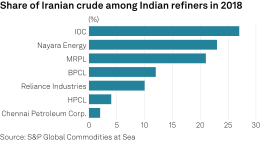
"If sanctions are lifted, Indian refiners are likely to ramp up purchases of Iranian barrels, as we have seen during temporary waivers, as an opportunistic swing supply source to optimize crude costs and diversify," said Premasish Das, executive director for oil analytics at S&P Global Energy CERA.
"However, the appetite will depend on the length and stability of sanctions relief and competition from other Asian buyers, especially China," he added.
Chinese independent refineries, the main buyers of sanctioned Iranian crude, imported about 1.58 million b/d in January-May, according to Platts data. Refining and trading sources, who spoke on condition of anonymity to discuss commercial matters, said June 17 that these buyers were in no hurry to secure more cargoes, even though a possible US waiver would eliminate the deep discounts they have enjoyed.
"Everything boils down to refinery economics in selection of crude oil imports," said DLN Sastri, former director of refining at the Federation of Indian Petroleum Industry.
Upstream opportunities
Sources said that oil and gas companies would also keep a close eye on upstream developments in Iran as any sanctions removal would open up investment potential in that sector, a segment familiar to state-run Indian companies.
In 2008, an ONGC Videsh-led consortium discovered Farzad B gas field within the Farsi offshore gas block, along with Oil India and Indian Oil Corp.
In 2021, India lost the OVL-developed Farzad-B gas field after Iran awarded a $1.78 billion contract to develop the giant gas field to a local company. Iranian oil ministry officials said that time any foreign participation was unlikely because of US sanctions, but India may join the project in later stages of growth.
"The upstream sector in Iran will also offer an opportunity. But a lot will depend on how soon things are put in order in terms of policy, logistics, and other things," said a senior Indian upstream source.
